Independent comparisons. We may earn from shop links. More info

Kiln dried sand vs jointing compound

Updated: October 2026

Kiln dried sand vs jointing compound is the fork when the joints are half empty and you have topped them up. A setting bag on amazon.co.uk promises to stop that chore. Loose sand and a curing compound are not two brands of the same joint. Loose sand is what a flexible block pavement is built around. A compound that cures is a different joint, with a width limit and a stain risk if you treat every tub as block sand. This page is that one fork. Prices and stars are on the [paving joint compound comparison](/hub/flooring-tools-and-accessories/paving-joint-compound). Peter F. did not lab-test either joint. If you buy through our links, we may earn a commission at no extra cost to you.

Kiln dried sand vs jointing compound is the fork when the joints are half empty and you have topped them up. A setting bag on amazon.co.uk promises to stop that chore.

Our top picks

On this page

What loose sand is doing

On a flexible block pavement the joint stays unbound. Pavingexpert’s guidance is kiln-dried sand, no cement, brushed in so the blocks keep their interlock. Tobermore keeps cement and lime out of that joint and describes a gap of about 2–5 mm excluding the chamfer. Brush at about 45 degrees, and wear a dust mask. Dry sand is a silica dust job. A plate compactor belongs with new laying, with a rubber mat so you do not chip the arris. Topping up an existing drive is a broom. Loose sand washes out, which is the maintenance that joint expects. Choosing among compounds is the paving jointing compound buying guide.

When setting sand is the block option

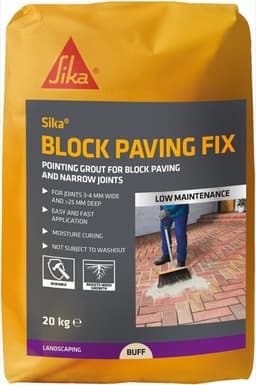
Sika setting sand, buff, 20 kg (B01JYXFRFG) is the block product here: £21.99, 4.2 from 2,591 reviews, joints of 2–5 mm, light vehicles only. The January 2026 sheet wants at least 25 mm of depth, a dry sweep, then a mist. Weeds still return on the surface. Wider than 5 mm once you ignore the chamfer, the bag is outside its window. Bostik’s UK sheet excludes block paving and driveways, even where the amazon bullets mention them. A 5–30 mm paste in a 3 mm joint bridges the mouth. Use setting sand only inside 2–5 mm, cleaned to depth. The steps are how to apply paving jointing compound.

Polymeric sand is not a guaranteed lock

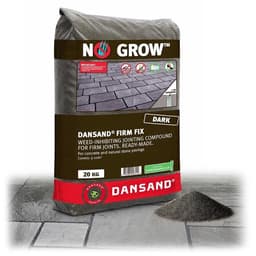
Dansand No Grow, dark, 20 kg (B09SH3FTC6) is £32.72, with 4.0 from 96 reviews, and no joint width in millimetres. Some reviewers say it set hard overnight after a gentle spray. Others say it never set and came out of the joints. Several say weeds came back, against a high-pH claim on the bag. You should not promise yourself that this bag will set. Tobermore notes that polymeric sand may leave a haze when you water residue left on the face. Dansand reviewers who left dust on jet-washed blocks report staining. If you cannot keep the face clean, loose kiln-dried sand is the messier annual job and the safer surface. A catalogue field that says Silicone on a sand listing is not the chemistry of the bag.

Which one, with a condition

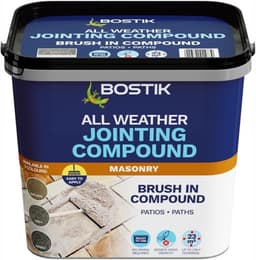
Keep loose kiln-dried sand when the pavement should stay flexible and you will top the joints up after washout. Use Sika setting sand when the joints are a true 2–5 mm, at least 25 mm deep, and you can dry-brush then mist without rain incoming. Do not put the Bostik tub on block paving. Do not treat Dansand’s firm-setting line as proved. If the blocks already rock, neither bag is first. Filling over movement hides a failed bed until the joint cracks. A drive that takes more than light vehicles is outside the Sika bullets. Weeds on a cured joint still have to be pulled. The bag was never a herbicide.

Common questions

Is kiln-dried sand still the right joint for concrete block paving?
Yes, when the pavement is a flexible block surface and the joint is meant to stay unbound. Pavingexpert and Tobermore both keep cement and lime out of that joint. Brush dry sand into a dry, full-depth gap of about 2–5 mm excluding the chamfer, and expect to top it up. Switch to a curing sand only if you accept that you are changing the joint, and only inside the width on the setting-sand sheet.
Will setting sand stop the annual top-up?
It can reduce washout compared with loose sand, which is what many of the 2,591 Sika reviews are describing, and it does not end maintenance. Weeds still appear on the surface. The joint has to be inside 2–5 mm and at least 25 mm deep, and you have to mist it rather than jet it. If the sand washes out on a slope, the usual cause in the reviews is too much water too soon, not a missing second bag.
Can I use a patio brush-in tub on block paving?
Not the Bostik tub. The UK sheet says it is not suitable for block paving or driveways, even if the amazon listing mentions them. A 5–30 mm paste in a 2–5 mm block joint sits on the chamfer and puts a binder where Tobermore wants none. The block option in this comparison is Sika setting sand, and only in that narrow window.
Does a hard joint stop the blocks locking together?
A flexible block pavement locks because the joint stays full of unbound sand and the blocks can move slightly as a mat. A cement-style binder fights that. Setting sand is still a curing product, so you are choosing a harder joint than kiln-dried sand, inside 2–5 mm, not a way to glue loose blocks back down. If the units rock, fix the bed before you argue about sand.
Will polymeric sand stain the blocks?
It can, if residue stays on the face and you wet it. Tobermore warns about polymeric haze, and Dansand reviews in this file include staining where dust was left on jet-washed blocks. Brush the face clean before any water, and do not pressure-wash the dust into the texture. If you cannot do that cleanly, loose kiln-dried sand marks the blocks less and simply asks for a top-up later.

Related pages

Sources

Public UK sheets and guidance, plus the amazon.co.uk listing lines kept for these ten products. This is not a laboratory test.

  1. Sika Setting Sand product data sheet, January 2026 (retrieved October 2026)
  2. Bostik UK TDS02249, 25 April 2025 (retrieved October 2026)
  3. Sika UK surface guide: match the jointing compound (retrieved October 2026)
  4. HSE: dry sweeping and construction dust (retrieved October 2026)
  5. BS 7533-103:2026, permeable pavement design (retrieved October 2026)
  6. Marshalls: how to lay a porcelain patio (retrieved October 2026)
  7. Pavingexpert: pointing (retrieved October 2026)
  8. Joint-it Simple, maker page (retrieved October 2026)