Independent comparisons. We may earn from shop links. More info

How to fit a fireplace guard

Updated: 22 October 2026

The guard is in the hallway, the hearth is empty, and the box is lighter on fixings than the photo suggested. How to fit a fireplace guard depends on which object you bought. A wall-fixed barrier needs plugs in sound structure. A folding screen needs a flat hearth and a sensible gap from the fuel. A mesh sheet needs tape, and it still will not behave like either of the others. This page is those steps, including the mistakes UK reviews describe. The [fireplace guard comparison](/hub/fireplaces-and-stoves/fireplace-guard) is the twelve listings. There is no ranking here. A qualifying purchase can earn us a commission at no extra cost to you.

The guard is in the hallway, the hearth is empty, and the box is lighter on fixings than the photo suggested. How to fit a fireplace guard depends on which object you bought.

Our top picks

On this page

Measure width, depth and height

Measure before you open the fixings. You want the clear width of the opening, the depth of the hearth in front of the fire, and the height from the hearth to anything that overhangs, such as a beam or a mantel. Safetots adjusts from 84.5 cm to 155 cm and projects 44 cm. Babylo is listed up to 133 cm. A 140 cm opening is inside Safetots and outside Babylo, and forcing the panels past their range is how clips tear out of plaster. The Milton is about 96 cm by 60 cm, the Buckton about 66 cm by 60 cm, and the Stanton about 100 cm by 64 cm. The Kingson arch is 102 cm wide and only 54 cm high. One Kingson page prints 96.5 cm in the title and 95.5 cm on the dimensions line. If the screen is shorter than the stove door, sparks clear the top even when the width looks right.

Wall-fixed assembly and clips

The Safetots Original uses screw-fit wall clips and a quick release. The brand’s instruction sheet describes an overlap on the width, screw eyes and wall plugs. Fit the clips to masonry or to a stud you have found, not to plaster that will crumble when a child pulls the top rail. UK reviews say the fixing-plate screws are fiddly and the clips are stiff to release. The Babylo Premier screws to the wall and does not describe a quick release. Several UK reviews say the pictured front door is not in the carton, so you move the guard or take curved sections off to tend the fire. If screw eyes or wall plugs are missing, stop and contact the seller. Another manufacturer’s sheet, not these ASINs, says about 300 mm from the fuel. That is not printed on the Safetots or Babylo listing, and it is not UK law. If the wall is dot-and-dab plasterboard with no stud, a competent person should say whether the fixings will hold.

Freestanding screens

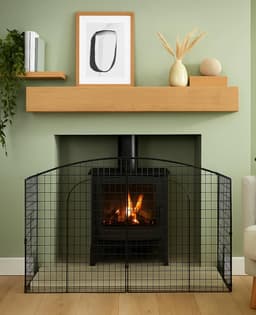
A folding screen has no wall fixing in these files. Set it on the hearth so it covers the opening and still leaves a gap from the fuel. The Milton reviews say it arrives assembled. Selby reviews split between a recess that holds the screen and one that knocks over. The Stanton at 1.25 kg is the one most often described as falling. Optional hearth clips are not in the Fire Vida box, and adding them does not create a BS 8423 nursery guard.

Mesh tape

Mesh covers use neither clips nor a hearth stance. The JINGEGECOME sheet, 100 cm by 80 cm and 50 g, is tape and Velcro. One UK review could not use the bottom strips and piled cushions in front. Cushions are not a fixing. The CLKUEH sheet uses hook-and-loop tape with a self-adhesive backing. Stick mesh only on a cold surround you do not intend to heat. A 50 g sheet is not a barrier if a child pulls a corner. If you smell flue gases, stop and get a competent solid-fuel person.

Common questions

Do I need wall plugs for a nursery guard?
Yes, for the Safetots Original and the Babylo Premier. Both are screw-fixed. The Safetots sheet refers to screw eyes and wall plugs. Plugs need brick, block, or a stud you have located. Plaster alone is not a fixing. If the packet is short of plugs or screw eyes, pause and ask the seller for the missing parts before you improvise.
How wide should I set the Safetots or Babylo panels?
Set them to the opening you measured, inside the stated range. Safetots adjusts from 84.5 cm to 155 cm. Babylo is listed up to 133 cm. Do not stretch either guard past its maximum. A 150 cm hearth is a Safetots width in this set, not a Babylo width.
What if the clips or screw eyes are missing?
Do not fit the guard half-held. UK buyers already report fiddly Safetots plates and a Babylo carton that does not match the pictured door. Contact the seller for the missing fixings, and keep the guard off the fire until they arrive. Cable ties and string are not a substitute for the clips the standard-style guard is designed around.
Where do I place a freestanding spark screen?
On a flat hearth, covering the width of the opening, with the panels opened so the screen does not stand as a single flat sheet that tips. The Milton is about 96 cm wide. Check height too: the Kingson arch is only 54 cm. Leave a gap from the fuel. Nothing in these screen files screws the panel to the wall.
Can I use cable ties the way some reviewers do?
A cable tie around a mantel or a radiator pipe is not the screw-eye system on a wall-fixed guard. Use the fixings supplied, or proper hearth clips sold for freestanding guards, and stop if the wall will not take a plug.
Do mesh covers use the same fixings?
No. The mesh listings use double-sided tape, Velcro, or self-adhesive hook-and-loop. They do not use the Safetots clips. Fit mesh on a cold opening only. A lit fire and a toddler are the jobs of the metal guards, not of a 50 g sheet.

Related pages

Sources

Public UK sources used for this comparison. amazon.co.uk prices, stars and review counts were taken from the listings on 19 October 2026.

  1. GOV.UK, Fire safety for parents and child carers (retrieved 19 October 2026)
  2. BS 8423:2010+A2:2022 scope (retrieved 19 October 2026)
  3. BSI catalogue, domestic fireguards (retrieved 19 October 2026)
  4. BS 3248:1986, freestanding sparkguards (retrieved 19 October 2026)
  5. RoSPA, Keeping kids safe: fires (retrieved 19 October 2026)
  6. Scottish Fire and Rescue, chimney safety (retrieved 19 October 2026)
  7. Devon and Somerset Fire and Rescue, open fires (retrieved 19 October 2026)
  8. HETAS, standards list (retrieved 19 October 2026)