Independent comparisons. We may earn from shop links. More info

How to fit an X-Sense smoke alarm

Updated: 21 October 2026

You have the carton open and a ceiling that still has the old plate. How to fit an X-Sense smoke alarm is the sequence after the purchase: the right room, a fixing that will still be there in winter, then a test you can hear. London Fire Brigade's advice is to screw the alarm, not glue it, and to put a heat alarm in the kitchen rather than a smoke head. Fire Kills asks for an alarm on every level, tested at least monthly. The twelve amazon.co.uk listings were captured on 19 October 2026. The [X-Sense smoke detector comparison](/hub/fire-protection/x-sense-smoke-detector) holds the prices. The nation split is on the [X-Sense smoke alarm buying guide](/hub/fire-protection/x-sense-smoke-detector/sub/x-sense-smoke-detector-buying-guide).

You have the carton open and a ceiling that still has the old plate.

Our top picks

X-Sense X-Sense SD11

Best overall

X-Sense X-Sense SD11
8.6/10about £11.99
X-Sense X-Sense XS0G-SN

Best value

X-Sense X-Sense XS0G-SN
8.4/10about £20.39
X-Sense X-Sense HS21

Alternative

X-Sense X-Sense HS21
6.8/10about £47.99
On this page

Choose the room before you mark the ceiling

A photoelectric smoke head goes on the ceiling of a hall, a landing or a living room. An SD11, an XS01 or an XS01-M is a smoke sensor. Steam from a grill will trip it. In this set only the HS21 includes a heat alarm, the XH02-W, which the listing says reacts from 54°C to 65°C and is not triggered by smoke, dust or cooking vapour. The heat head is the kitchen unit and the two SD19-W smoke alarms stay out of it.

Screw the bracket, and treat the pad as a limit

A magnetic pad on the XS01, the XS0G-SN and the SD11-MR31 is an option for a warm, flat surface, not a substitute for screws. The XS01 listing says to use the pad above 15°C, warm the surface for 1 to 3 minutes, then press for 30 seconds. One XS01 review says the pad was not sticky enough. One XS0G-SN review says a ceiling pad lasted about two days. If the pad will not hold, use the screws and anchors in the same box.
X-Sense X-Sense SD11

Testsieger

X-Sense X-Sense SD11
8.6/10about £11.99

Power it, hush it, and test it every month

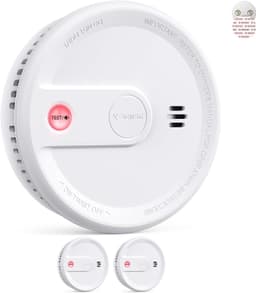
Fit the head to the bracket only after the room and the fixing are settled. On a sealed SD11 the cell is already inside, and you cannot swap it. The listing claims a 10-year cell and states a 5-year quality warranty. UK reviews include sealed cells that died at about 2, 2.5 and 4 years. If it will not sound, you replace the whole unit. A chirp after mounting is not, by itself, a sign that the bracket is loose. The SD11 manual describes silence of about 9 minutes. That hush is for a known nuisance, such as burnt toast in the next room, and it is not a way to live with a head in the wrong room. Fire Kills asks you to test at least monthly by pressing the button until the alarm sounds. An app screen that says the unit is online is not that test.

Check that linked heads actually answer

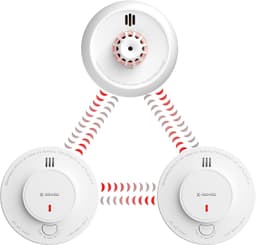
Press the test on one HS21 head and walk to the other smoke head and the kitchen heat alarm. Each of them should sound. On an FS31 or an SD11-MR31, use the app if you want, then still stand under a second head and confirm the horn. A head sold without the SBS50 only proves itself until the base is powered. Direct Wi-Fi models do not interlink. Phone alerts and whole-home sirens are separated on the standalone versus SBS50 page. Call an electrician for a 230 V Grade D circuit or a Welsh rented storey.

Common questions

Can I use the magnetic pad instead of screws?
Only on a warm, flat surface, and only on the models that include a pad. The XS01 listing limits the pad to above 15°C, with the surface warmed for 1 to 3 minutes and then pressed for 30 seconds. One review says that pad was not sticky enough, and one XS0G-SN review says a ceiling pad lasted about two days. London Fire Brigade's preference is screws, not glue. If the pad fails, use the screws and anchors in the same carton.
How do I test an X-Sense alarm properly?
Press the button on the ceiling unit and hold it until the horn sounds. Fire Kills asks for that test at least monthly. A green tick or an online line in the X-Sense app is not a substitute, because a phone can see a head that the landing cannot hear. On a sealed SD11, silence lasts about 9 minutes in the manual, and that hush does not replace the monthly press.
Do I need to test every linked head in a Link+ or SBS50 system?
Yes. On an HS21, a test on one SD19-W should make the other smoke head and the kitchen heat alarm sound. On an FS31 or SD11-MR31, the app can start a test, and you still walk to a second head and listen. A head sold without the SBS50, such as a lone XS01-M, can only prove itself until the base is powered.
Can I install a smoke alarm in the kitchen?
A smoke head in the kitchen is the wrong sensor. Cooking vapour sets it off, and you then learn to silence it, which is how a real alarm gets ignored. The HS21 heat alarm is the kitchen unit in this set. The listing says it reacts from 54°C to 65°C and is not triggered by smoke, dust or cooking vapour. An SD11, XS01 or SD11-MR smoke head stays in the hall or living room. One SD11-MR31 review makes the same point about the kitchen.
What if the alarm chirps after I have mounted it?
A chirp is the low-battery or fault pattern in the UK reviews, not proof that the screws are wrong. On a sealed SD11 you cannot change the cell. Reviews include units dead at about 2, 2.5 and 4 years, against a listing that claims 10 years and states a 5-year quality warranty. Replace the whole unit when it will not pass the button test. On a CR123A model, fit the cell the carton actually contains before you decide the head is faulty.

Related pages

Sources

Public UK sources from the research digest, last checked on 19 October 2026. Prices, stars, and review counts are the amazon.co.uk lines captured that day.

  1. GOV.UK — Smoke and carbon monoxide alarms, landlord booklet (retrieved 19 October 2026)
  2. Scottish Government — fire and smoke alarms, where and what to buy (retrieved 19 October 2026)
  3. Scottish Fire and Rescue Service — smoke and heat alarms (retrieved 19 October 2026)
  4. legislation.gov.uk — Wales, WSI 2022/6 (retrieved 19 October 2026)
  5. Northern Ireland Department for Communities — smoke, heat and carbon monoxide alarms (retrieved 19 October 2026)
  6. London Fire Brigade — smoke alarms and heat alarms (retrieved 19 October 2026)
  7. Fire Kills — detect (retrieved 19 October 2026)
  8. X-Sense SD11 user manual (retrieved 19 October 2026)