Independent comparisons. We may earn from shop links. More info

X-Sense smoke alarm buying guide

Updated: 21 October 2026

You are looking at a row of X-Sense boxes and the prices do not behave like one product. An X-Sense smoke alarm on amazon.co.uk, in the twelve listings captured on 19 October 2026, runs from a sealed SD11 at about £11.99 to a three-pack of direct Wi-Fi heads at about £72.23. Some cartons beep on their own ceiling. Some stay quiet until an SBS50 base station is in the house. Some send a phone alert and never sound the landing. The Products Compared editorial team read those listings and did not run a lab test. A qualifying purchase can earn us a commission at no extra cost to you. The price table is on the [X-Sense smoke detector comparison](/hub/fire-protection/x-sense-smoke-detector).

You are looking at a row of X-Sense boxes and the prices do not behave like one product.

Our top picks

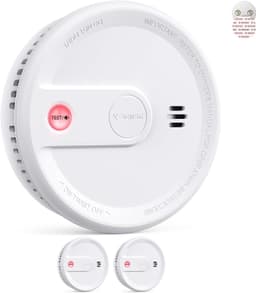
X-Sense X-Sense SD11

Best overall

X-Sense X-Sense SD11
8.6/10about £11.99
X-Sense X-Sense XS0G-SN

Best value

X-Sense X-Sense XS0G-SN
8.4/10about £20.39
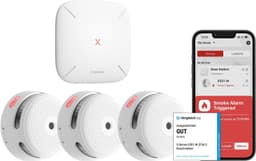
X-Sense X-Sense FS31

Alternative

X-Sense X-Sense FS31
8.2/10about £63.99
On this page

Five checks before the star rating

Start with where the alarm has to satisfy a rule, not with the app icon. The checks, in order, are nation, family, room, power, then network. A smoke head in the kitchen is the wrong sensor, and in this set only the HS21 includes a heat alarm, set to react between 54°C and 65°C. The SD11 listing's quality warranty is five years, while the battery line says 10. Wi-Fi on these products is 2.4 GHz only. A phone push is not every head in the house sounding. If you already know the job, use the best X-Sense smoke detector page.

What each nation actually asks you to buy

In England a private landlord needs a smoke alarm on every living storey. The penalty after a remedial notice can reach £5,000. Battery alarms are allowed, and GOV.UK's booklet prefers a sealed cell. A sealed SD11 can sit inside that pattern if you cover every storey and replace a unit that will not sound. It does not become a Scottish install because the bullet says EN 14604. Scotland, from 1 February 2022, wants interlinked ceiling smoke alarms plus a kitchen heat alarm, sealed or mains. A replaceable CR123A fails that buying note. Wales, under WSI 2022/6, wants mains smoke alarms linked on each rented storey. None of these twelve is that circuit. Northern Ireland private tenancies want interlinked ceiling smoke and heat alarms.
X-Sense X-Sense SD11

Testsieger

X-Sense X-Sense SD11
8.6/10about £11.99

Standalone, Link+, SBS50 and direct Wi-Fi

Standalone and sealed, with no app, are the SD11, the XS01, the XS0G-SN two-pack and the SC07. They do not call the other floors. Link+ is the HS21, two smoke alarms and one heat alarm, listed as already interlinked. The bullets say sealed 10-year cells and the included list also names three CR123A batteries. The FS31 and the SD11-MR31 put the SBS50 in the box. The XS01-M, the XP0A-MR and the XS0B-MR require the base and do not include it. About £19.54 is not a finished system. About £63.99 is the listing that includes the hub. Direct Wi-Fi with no interlink is the SC07-WX and the XS0B-iR, and German is the default voice on the XS0B-iR. The hub question is standalone versus the SBS50. A BS 1363 plug is not confirmed on these listings.

Marks, kitchens and the monthly test

EN 14604 on a bullet is not a BSI Kitemark. No Kitemark number is printed on these twelve listings. The SD11 manual cites EN 14604:2005+AC:2008. These battery heads resemble BS 5839-6 Grade F1 when the cell is sealed, or Grade F2 when you can change it. They are not Grade D mains. Hall and landing take a screwed smoke head. Kitchen: the heat alarm in the HS21. Carbon monoxide beside a fuel-burning appliance is on the X-Sense smoke and carbon monoxide alarm page. Fire Kills asks you to test at least monthly with the button. Call an electrician for a mains Grade D install and for a Welsh rented storey.

Common questions

Which X-Sense alarm family should I start with?
Start from the nation and the room, then pick the family. An existing English home that needs one hall ceiling can start with a sealed standalone such as the SD11. A home that must hear every floor, without a phone, looks at Link+ or an SBS50 kit that includes the base. A single room with a fuel-burning appliance looks at a combination head. A Welsh rented storey needs mains interlink, which none of these twelve listings is.
Will a Wi-Fi X-Sense alarm count as interlinked in Scotland?
No. Scottish guidance treats interlink as radio or a wire, and says Wi-Fi is not required for that link. A listing that says the heads do not interlink, which is the case for the SC07-WX and the XS0B-iR, does not meet that pattern however reliable the phone alert is. A phone notification is not every ceiling sounding at once.
Does EN 14604 on the box mean a Kitemark?
No. EN 14604 is the smoke-alarm standard named on some of these bullets and in the SD11 manual as EN 14604:2005+AC:2008. A Kitemark is a BSI certification mark with a licence number. No Kitemark number and no LPCB number is printed on this capture. Read the claim as a standard reference, and check whether your nation also asks for a sealed cell, interlink or mains.
What is Link+ compared with the SBS50 app system?
Link+ on the HS21 is radio between the heads in that pack, with no app and no base station. The listing says the multi-pack arrives already interlinked. The SBS50 is a powered hub: 2.4 GHz Wi-Fi, an app that can test and silence, and a louder base, up to the 100 dB figure on the hub page. You only get that behaviour from listings that include the base, or from heads you add after you already own one.
When should I call an electrician?
Call an electrician when the install is mains, which is the Grade D pattern and the Welsh rented-storey rule. These twelve alarms are battery heads. Also get help if people in the house will not wake to about 85 dB, because a louder base or a different system is then a design job, not a basket add-on. Suspected carbon monoxide is an emergency: leave and call 999, and in Great Britain the gas emergency number is 0800 111 999.

Related pages

Sources

Public UK sources from the research digest, last checked on 19 October 2026. Prices, stars, and review counts are the amazon.co.uk lines captured that day.

  1. GOV.UK — Smoke and carbon monoxide alarms, landlord booklet (retrieved 19 October 2026)
  2. Scottish Government — fire and smoke alarms, where and what to buy (retrieved 19 October 2026)
  3. Scottish Fire and Rescue Service — smoke and heat alarms (retrieved 19 October 2026)
  4. legislation.gov.uk — Wales, WSI 2022/6 (retrieved 19 October 2026)
  5. Northern Ireland Department for Communities — smoke, heat and carbon monoxide alarms (retrieved 19 October 2026)
  6. London Fire Brigade — smoke alarms and heat alarms (retrieved 19 October 2026)
  7. Fire Kills — detect (retrieved 19 October 2026)
  8. X-Sense SD11 user manual (retrieved 19 October 2026)