Independent comparisons. We may earn from shop links. More info

Heat alarm buying guide

Updated: 20 October 2026

You have decided the kitchen needs a heat alarm, and the amazon.co.uk titles still look the same: 10-year, kitchen, sometimes a British Standard and sometimes not. This heat alarm buying guide is the checklist behind our [heat detector comparison](/hub/fire-protection/heat-detector), using the nine listings captured on 19 October 2026, from about £8.99 to about £32.91. It separates the product standard from a system grade, a sealed cell from interlink, and a real review file from a star line built on two reviews. The Products Compared editorial team used those listings and public UK sources. We did not lab-test a unit. A qualifying purchase can earn a commission at no extra cost to you.

You have decided the kitchen needs a heat alarm, and the amazon.co.uk titles still look the same: 10-year, kitchen, sometimes a British Standard and sometimes not.

Our top picks

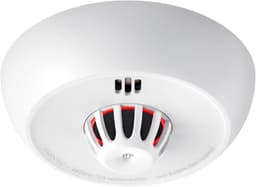
X-Sense X-Sense XH02

Best overall

X-Sense X-Sense XH02
7.7/10about £15.29
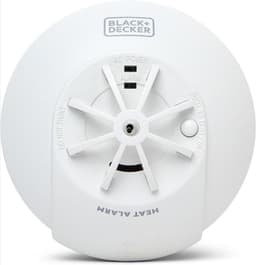
BLACK+DECKER BLACK+DECKER BD/MHE/FF

Alternative

BLACK+DECKER BLACK+DECKER BD/MHE/FF
6.5/10about £16.99
On this page

The mark on the box

In this set the BLACK+DECKER sealed model, BD/BHE/10, cites BS 5446-2:2003 and also prints EN 14604 on an install bullet. Read that as a clash to notice, not as extra cover. A Kitemark or a KM number is the next line, when the page actually has one. The FireAngel FA6720-R prints BS 5446-2:2003 and KM 694292. The Kidde 4899 says BSI certified to BS 5446-2:2003. Both BLACK+DECKER interlink models claim a Kitemark to that standard. The WISUALARM puts “BS 5446” in the title and Class A1 in the bullets, which is weaker than a full standard line plus a Kitemark. The Status bullets, at about £8.99, do not mention the standard at all. Do not give that listing a mark it does not claim. Price bands in this capture are a rule of thumb, not a certificate. Entry, under £13, is the Status, the FireAngel at about £11.97 and the AEGISLINK at about £11.99. Mid, about £15 to £18, is the sealed BLACK+DECKER, the X-Sense, the BLACK+DECKER mains head and the WISUALARM. The radio BLACK+DECKER at about £24.90 and the Kidde at about £32.91 are the top of this basket. London Fire Brigade’s “around £10” matches the entry band only.

Class A1 is not a system grade

Class A1, where a listing prints it, is a sensor class. The WISUALARM states 54–65°C. The AEGISLINK states a trigger at 54°C. The X-Sense states Class A1 and does not give a degree. The FireAngel amazon bullets do not repeat a degree band, though the maker’s own FA6720-R page describes Class A1 at 54–65°C. Use the figure that is on the listing you are buying. Do not average every alarm in the table to one trip temperature. Northern Ireland’s private-tenancy regulations define a heat alarm as a thermistor set to respond above 58°C. That definition belongs to those regulations. It is not a shared trip point for England, and it is not a reason to reject a Class A1 band of 54–65°C on a WISUALARM if you are an owner-occupier choosing a kitchen head. The heat alarm requirements UK page keeps those duties apart.
X-Sense X-Sense XH02

Testsieger

X-Sense X-Sense XH02
7.7/10about £15.29

Sealed battery or 230 V

For a householder fitting one kitchen alarm, a sealed ten-year lithium cell is the practical power source. You do not change a PP3, and you do not open a ceiling rose. In this set that pattern is the FireAngel, the WISUALARM, the sealed BLACK+DECKER BD/BHE/10, the X-Sense and, with a thinner file, the AEGISLINK, which says 10-year battery without saying sealed. The Status says batteries are included and does not say which kind. Mains is the other honest pattern: 230 V with a backup, fitted by an electrician. London Fire Brigade is clear that a mains alarm is not a DIY wiring job. Here that is the BLACK+DECKER BD/MHE/FF, with a 9 V alkaline backup, and the Kidde 4899, also with a 9 V alkaline backup. The “10-year” line on the BLACK+DECKER mains listing is the stated life of the alarm, not a sealed cell. The Kidde warranty is six years.

What to do with a thin listing

Review counts under about twenty cannot carry a reliability sentence. In this capture that is the AEGISLINK at 19, the BLACK+DECKER mains head at eight, the radio head at four, and the Status at two. Stars can look tidy on a tiny file. 4.5 from eight is not the same kind of evidence as 4.6 from 898 or 4.8 from 202. Read the count before you read the star. Thin listings still have a use. The radio and mains BLACK+DECKER rows are how this basket expresses interlink, and the Kidde row is how it expresses a long-reviewed mains swap even though that one is not thin. Use them when the job is that job. Do not use the Status’s about £8.99, or the AEGISLINK’s 54°C line alone, to skip the standard. Siting distances belong on the fitting page, not in this basket.

Common questions

What does BS 5446-2 mean on a heat alarm?
BS 5446-2:2003 is the British Standard for heat alarms that Scottish fire-detection guidance names for the kitchen unit. On a listing it means the seller is claiming that product standard, sometimes with a Kitemark or a KM number. It does not mean we tested the alarm, and it does not mean the alarm interlinks. If the line is missing, as on the Status page in this set, do not fill it in from the category name.
Is EN 14604 the right mark for a kitchen heat alarm?
No. BS EN 14604 is the smoke-alarm standard. A kitchen heat alarm is specified to BS 5446-2. One sealed BLACK+DECKER listing in this set prints both. Treat the EN 14604 line as something to question, not as proof that the head will ignore cooking fumes. If you wanted a smoke alarm for the hall, you are on the wrong row of the comparison.
Is a sealed 10-year battery the same as Grade F1?
A sealed long-life lithium cell is the kind of battery-only alarm Scottish guidance allows, as against a user-replaceable PP3. Grade F1 is Aico’s label for that idea inside BS 5839-6. These amazon.co.uk listings do not print Grade F1 in the captured fields, so you should not add it. Check whether the page says sealed. “10 Year Battery” on the Status title does not say sealed.
When do I need a mains alarm with a 9 V backup instead?
Choose mains when you are replacing a mains head or extending a wired family, and when an electrician is doing the work. In this set that is the BLACK+DECKER BD/MHE/FF or the Kidde 4899. The 9 V cell is a backup, and on these listings it is the alkaline type you can replace. It is the wrong default if you only wanted to screw one sealed alarm to a kitchen ceiling beside smoke alarms you already have.
Does interlink work across brands?
Not on the evidence in this set. The two BLACK+DECKER listings that interlink stay inside that brand, one by radio and one by wire. FireAngel says not to mix its alarms with other makers. The X-Sense XH02 states that it has no interconnect. Buying two well-reviewed sealed alarms of different brands gives you two local sounds, not one system. If the law where you are requires interlink, match the family before you match the price.
Does a five-year warranty contradict a 10-year battery claim?
It limits it. The FireAngel listing states both: a 10-year battery in the title and a five-year warranty in the small print. Reviews include early failures. A warranty is how long the maker’s promise runs, not a measurement of how long every cell lasts. Read both numbers. Do not let the larger one delete the smaller one, and do not treat stars as a ten-year life test.

Related pages

Sources

Public UK sources and the amazon.co.uk listing lines saved on 19 October 2026. No laboratory test.

  1. London Fire Brigade — smoke alarms and heat alarms (retrieved 19 October 2026)
  2. London Fire Brigade — cooking (retrieved 19 October 2026)
  3. Scottish Government — fire and smoke alarms in Scottish homes (retrieved 19 October 2026)
  4. Scottish Government — tolerable standard, fire and carbon monoxide detection (retrieved 19 October 2026)
  5. GOV.UK — smoke and carbon monoxide alarms, landlord Q&A booklet (retrieved 19 October 2026)
  6. Department for Communities — smoke, heat and carbon monoxide alarms in private rentals (retrieved 19 October 2026)
  7. Aico — BS 5839-6:2019 grades (retrieved 19 October 2026)
  8. GOV.UK — Approved Document B fire safety FAQ (retrieved 19 October 2026)