Sprinkler leaking at hose connector: find the fault
Find out why your sprinkler leaks at the hose connector, how to tell a washer fault from an O-ring problem, and when to return a faulty head without guesswork.
On this page

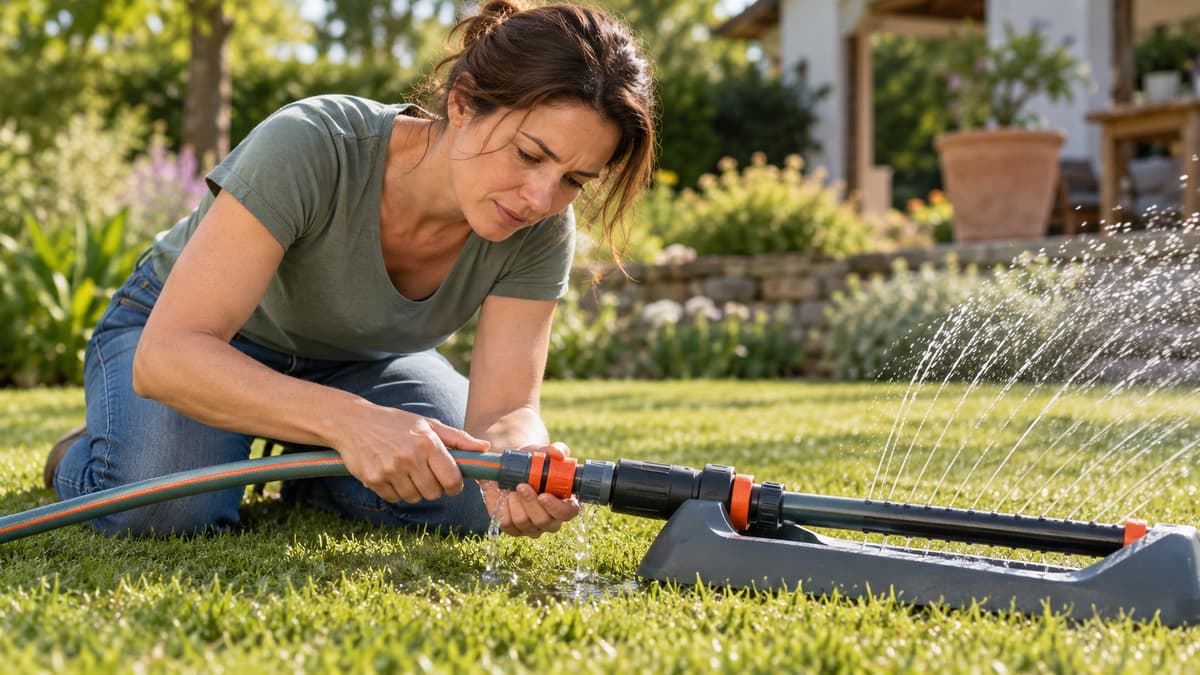
You turn on the outdoor tap and water gathers where the hose meets the new sprinkler. A sprinkler leaking at the hose connector is not automatically a failed sprinkler: the water may be escaping at the tap adaptor, the hose end, a quick-connect seal or the threaded inlet. Finding the first wet joint saves you from replacing the wrong part or overtightening plastic.
In short
Dry every connection, open the tap gradually and watch for the first point that becomes wet. A threaded adaptor generally relies on a flat washer, while a click fitting generally relies on an O-ring; the thread or locking collar mainly holds those sealing surfaces together. Stop if the fitting will not lock, keeps unscrewing, has a cracked inlet or leaks from the sprinkler body itself.
Find which joint is wet
Water travels along a hose and can make the lowest connection look guilty. Start with the tap off, release trapped pressure, then disconnect and dry the tap, hose and sprinkler with a cloth. Reconnect without forcing anything, lay the hose so it is not pulling sideways, and open the tap only part-way. Watch from the tap towards the sprinkler; the first bead of water is the useful clue.
There are four leak points. At the wall, water may escape between the outdoor tap and its threaded adaptor. At either hose end, it may escape where the hose enters the connector. At the sprinkler, it may appear between the female quick connector and the male plug, or where an adaptor screws into the inlet. A leak from a seam in the moulded body is a different fault and is not solved with a hose washer.
Use a strip of dry kitchen paper around each stationary joint if the source is hard to see. The first strip to darken identifies the joint. Keep your face away from the fitting and do not hold a connector together under pressure: staged reports include fittings coming apart. If the head also refuses to sweep, diagnose the leak first, then use the guide to a sprinkler that will not move. A sealed mechanism is not an invitation to prise open its gearbox.
What the connector needs
A thread, washer and O-ring do different jobs. On a typical threaded tap adaptor, tightening draws a flat washer against a flat face, and that washer makes the seal. On a typical quick connector, an O-ring inside the female body seals around the smooth male plug while the collar keeps the parts engaged. Threads and clips hold the joint; they do not replace a missing or displaced seal.
The wrong remedy can make the joint worse. PTFE tape around the smooth plug of a click fitting does not replace its internal O-ring and may stop the plug locking. Extra washers can stop a threaded adaptor seating squarely. Use the specified replacement seal, or replace the compatible connector when its internal seal is damaged.
Several product-review signals behind our sprinkler comparison show why you should inspect the supplied parts. Buyers reported some budget heads arriving without washers, connectors loosening under pressure, and fittings that fitted poorly until replaced. One review of the Kärcher OS 5.320 SV reported a leaking grey end fitting out of the box. These are individual reports, not a finding that every unit has the same fault. It was listed at £36.00 on amazon.co.uk, with 4.5 stars from 2,322 reviews when this page was prepared. Prices and ratings can change. We did not pressure-test the sprinkler in a lab. If you buy through a qualifying affiliate link, we may earn a commission at no extra cost to you.
Do not identify a pipe thread by eye
Nominal British pipe sizes are easy to misunderstand. A 3/4-inch BSP fitting does not mean every visible diameter measures three quarters of an inch, and a thread about one inch across is not automatically a one-inch fitting. Match the marked standard and the adaptor specification. Do not force two parts together because their diameters look close.
Repair the right part
Work on one joint at a time so you know which action changed the result. This sequence covers the common external faults without opening the sprinkler body.
- Turn off the tap and release pressure. Disconnect only after the flow has stopped. A pressurised connector can separate suddenly.
- Check that the hose is fully seated. If water escapes where the hose enters its connector, undo the collar and inspect the end. A hardened, oval or ragged hose may not seal evenly. Follow the maker's instructions for trimming rather than cutting repeatedly.
- Inspect the quick connector. Look for an O-ring that is twisted, nicked, flattened or missing, and for grit holding the collar open. Push it on until it locks, then tug it gently with the supply still off.
- Inspect the threaded adaptor. Confirm the correct flat washer is present where the design calls for one. Seat it squarely and tighten by hand on plastic garden fittings.
- Support the hose and retest slowly. Leave enough slack that the first metre cannot twist the adaptor as it fills. Increase flow in stages and stop if the connector creeps, balloons or starts to release.
Do not exceed the sprinkler's or fitting's stated maximum pressure. Repeated tightening will not make a lightweight connector pressure-rated, and a serious leak can make a capable head look weak. Read how sprinkler area claims relate to pressure before treating a short throw as a nozzle problem.
If an adaptor repeatedly rotates loose, look for torque rather than pliers. A coiled hose can unwind as it pressurises, and a bent hose can pull sideways. Leave slack and orient the sprinkler before opening the tap. If the thread still backs out, or the quick connector separates, replace the fitting or return the head. Tools can crack a plastic inlet without fixing a mismatch.
When the tap is the leak
The sprinkler may be downstream of the actual fault. One staged Gardena review described a sprinkler problem that eased once the outdoor tap was repaired; the head then leaked less and threw further. Every leak before the head diverts flow, but that is one user's experience, not a guaranteed coverage improvement.
Repeat the dry-paper check around the tap spindle, spout, check valve and tap adaptor. Water above the hose adaptor points away from the sprinkler. A leaking washer at the spout may be a fitting job. Water from the tap body, the wall or a damaged valve needs a plumber. Do not dismantle fixed plumbing to prove that a £36 sprinkler works.
An outside tap can also include backflow protection that should not be bypassed to improve flow. Its purpose and position are covered in our guide to the outdoor tap double check valve. If the valve discharges, is frost-damaged or behaves unexpectedly, replacing it with an unverified open adaptor is not an appropriate leak repair.
When to return the sprinkler
A consumable hose connector and a defective new sprinkler are not the same thing. It is reasonable to reseat a supplied washer, clean grit from an external coupling or try a known-compatible hose connector. It is not reasonable to machine a new thread, glue a cracked inlet, wedge a collar shut or open a sealed sprinkler body to make a newly delivered product usable.
Stop when the leak comes from a moulded seam, an internal housing or the base around a non-serviceable inlet. Stop too when a compatible connector cannot lock because the male plug is malformed, the inlet thread arrives split, or a part promised in the listing is absent. Record the dry-to-wet test and the supplied parts, then contact the retailer rather than modifying the fault.
An adaptor that does not fit at all may be an incomplete or wrongly described package, not a missing washer. A staged Amazon Basics review reported a blanked outlet and an adaptor that would not fit. That account does not diagnose every unit. Inspect specified external seals and compatible detachable fittings. Do not improvise a repair on a cracked body, a bad thread, unsafe retention or a sealed internal fault. Once a fitting has blown off, loosened again after correct assembly or shown visible damage, turn the tap off and return or replace it.
Common questions
Is the sprinkler broken if water appears at the join?
Were washers supposed to be in the box?
Do I need a flat washer or an O-ring?
Will PTFE tape fix a click fitting?
What if the connector unscrews itself?
Is a one-inch thread the same as one inch across?
Why did repairing the tap improve the throw?
When is a leak a return rather than a washer job?

Peter F. is the editor for DIY & tools at productscompared.co.uk. Comparisons in this category are checked against amazon.co.uk listings, review evidence and public UK sources.
Related articles

When a sprinkler will not move
Separate a hose-joint leak from an oscillator or spinner that has stopped moving.
The check valve on an outdoor tap
See how the valve at your outside tap affects a connected hose and sprinkler.

How to read a sprinkler area claim
Understand why pressure, fittings and flow affect the area a sprinkler reaches.