Independent comparisons. We may earn from shop links. More info

Stone glue for marble repair: thin glue or a paste

Updated: 23 October 2026

A marble chip, a granite edge or a snapped stone pot looks like one job until you try to fill it. Stone glue for marble repair is either a drop that stays in a closed joint or a knife-grade paste you leave proud and hone back. The thin one runs out of an open gap. The paste is the wrong tool for a hairline you can pinch shut. This page uses the two repair listings on the [natural stone adhesive comparison](/hub/fillers-adhesives-and-sprays/natural-stone-adhesive): Zynthor’s bottles and Harbro Stonebond. It is not a tile bed and not a gravel path. A qualifying purchase can earn us a commission at no extra cost to you.

A marble chip, a granite edge or a snapped stone pot looks like one job until you try to fill it.

Our top picks

On this page

Match the glue to the break

If the faces meet and you can hold them still, you want a thin cyanoacrylate. A gap, a missing corner or an edge that has to be built back needs a paste that will not slump. Zynthor is the reviewed thin glue here. Harbro is the knife-grade polyester, with no amazon.co.uk reviews. Neither beds a floor. A tile search belongs on the natural stone adhesive buying guide. Clean the break. Dust, polish and a wet face stop both chemistries. A crack across a tap hole is a restorer’s job. Clear on the label does not make the repair invisible.

Thin stone glue

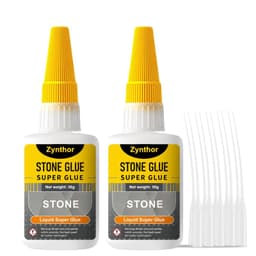
Zynthor is two 30 g bottles at £7.99. It sets in about 30 to 60 seconds, cures in 24 hours, and names stone, marble, granite and artificial stone. A feature field says waterproof, heat-resistant and UV-stable. That is the listing line, not a soak test. It scores 4.6 from 29 reviews, ranked in Super Glue. One reviewer repaired a stone pot so the join disappeared. Others say the glue is as thin as water and runs off an open joint. More liquid will not fill a wide chip. Tips clog after 15 to 20 minutes, so cap the bottle and wipe squeeze-out. Hold a closed break for a minute, then leave the 24-hour cure. Who else should skip it is on the best natural stone adhesive page.

Knife-grade polyester

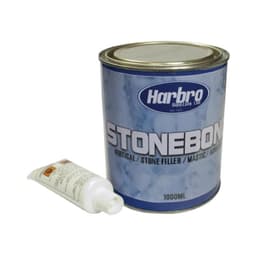
Harbro Stonebond is a clear knife-grade polyester at £18.95 for 1,000 g, resin and hardener included, for marble, granite, onyx and travertine. It can be polished. The water field says moisture resistant, not waterproof. There is no review line and no cure time in minutes. Harbro’s own site showed £12.95, a different offer, not a discount on this listing. Knife grade means the paste stays on a vertical face. Leave the fill proud, then hone it back once it is hard. The listing does not give a mix ratio. Do not borrow another brand’s 35-minute clock. A clear resin is not an invisible vein match. Skip it for a hairline you can pinch shut, for gravel and for a slab bed.

Fingers, fumes and cracks that move

Cyanoacrylate bonds skin in seconds. NHS Greater Glasgow and Clyde’s note for clinical spills is the first aid: warm soapy water, roll the skin apart, do not pull. An eye is medical help. The Health and Safety Executive’s SR22 sheet is a workplace note on cyanoacrylates, not a review of Harbro. For the polyester, ventilate, mix a little, and do not work in a closed room. A moisture-resistant bullet is not permission to fill a wet edge in the rain. A crack that opens and closes is not a job for either listing. Neither claims a structural stitch. A single chip on a dry ornament is the DIY remainder: paste if the gap is open, a drop if the faces meet.

Common questions

Can super glue fix a marble chip?
Only if the chip is really a closed break. Zynthor’s thin glue, £7.99 for two 30 g bottles, sets in about 30 to 60 seconds on the listing and cures in 24 hours. Reviewers repaired a stone pot with a join they could not see, and they also say the liquid runs off an open joint. A missing corner needs a knife-grade paste. More super glue does not become a filler.
When is knife-grade polyester the one to mix?
When the edge or chip is open and the paste has to stay on a vertical face while it hardens. Harbro’s listing is that type for marble, granite, onyx and travertine, with hardener in the pack. Leave the fill proud and finish it after it is hard. A hairline you can pinch shut is still the thin glue. Polyester is the wrong buy for a path or a tile bed.
Does Harbro include hardener, and how long until I sand it?
Resin and hardener are both in the included components, and the unit count is 1,000 g at £18.95. The listing does not give a set time in minutes. Faber’s 35 minutes at 22°C is a different product, GL 88, so do not sand Harbro on that clock. Wait until the paste is hard, then hone the proud fill back. There is no amazon.co.uk review line to tell you how long other buyers waited.
What if I glue my fingers?
Warm soapy water and roll the skin apart. Do not pull. That is the first aid NHS Greater Glasgow and Clyde gives for cyanoacrylate used as a tissue adhesive, and it matches a thin stone glue that sets in well under a minute. If it is in an eye, get medical help. A clogged tip is a reason to stop and cap the bottle, not to pinch the nozzle with a bare nail.
Can I use either product on a crack that keeps moving?
No. A joint that opens with temperature or with a slab that rocks will open again, whether you used a drop of thin glue or a polyester fill. Neither listing is a structural adhesive for a moving crack. Stabilise the piece or leave the crack.

Related pages

Sources

Public UK sources used for this comparison. amazon.co.uk prices, stars and review counts were taken from the listings on or before 19 October 2026.

  1. ARDEX X 32 technical datasheet (retrieved 19 October 2026)
  2. ARDEX S 27 W (retrieved 19 October 2026)
  3. Weber UK, tiling natural stone (retrieved 19 October 2026)
  4. Contract Flooring Journal, fixing natural stone (retrieved 19 October 2026)
  5. BSI BS 5385-3:2024 (retrieved 19 October 2026)
  6. Class F hard surfaces, General Permitted Development Order 2015 (retrieved 19 October 2026)
  7. HSE SR22, cyanoacrylates (retrieved 19 October 2026)
  8. NHS Greater Glasgow and Clyde, tissue adhesives (retrieved 19 October 2026)