Independent comparisons. We may earn from shop links. More info

Gravel glue binder for a border, not a drive

Updated: 23 October 2026

Pea gravel or bark is leaving the bed, the pot or the short path by the back door, and the bottles on amazon.co.uk talk as if a litre of glue were a resin driveway. A gravel glue binder coats stones you already have. It does not build a surface you can specify like a resin-bound system, and a crust that looks solid is not automatically permeable. This page covers the four bottles on the [natural stone adhesive comparison](/hub/fillers-adhesives-and-sprays/natural-stone-adhesive), how UK brands say to put a binder on, and the rain and planning limits. A qualifying purchase can earn us a commission at no extra cost to you.

Pea gravel or bark is leaving the bed, the pot or the short path by the back door, and the bottles on amazon.co.uk talk as if a litre of glue were a resin driveway. A gravel glue binder coats stones you already have.

Our top picks

On this page

What a gravel binder is

The liquid wets pebbles, mulch or bark and dries into a crust on the top layer. You are not laying a new resin-bound wearing course. Easihold separates a decorative spray from a mix-in for foot traffic. Gilmore’s note on a 5 litre Easihold can says it is not resin-bound paving and is for light foot traffic. None of the four listings here names a UV-stable resin, a kiln-dried aggregate and a driveway base. The natural stone adhesive buying guide splits those chemistries. A coat that wets only the top stones will shed pebbles when a foot scuffs.

How much bottle you are actually buying

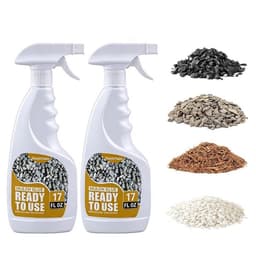
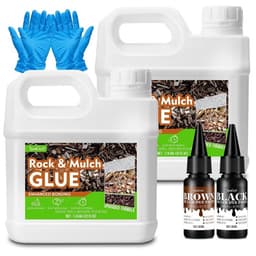
A rule of thumb for a pour-on is about 1 litre per square metre, the kind of figure GravelHold publishes for stones up to about 20 mm. It is not a test of these listings. SomVibes is about 1 litre at £15.99, 4.1 from 10 reviews, with a 5 m² feature line. Reviewers say a litre is a small area, so do not plan five square metres from that line. YumCraft is 2 litres at £11.99, 3.6 from 12. Houbobo is two 500 ml bottles at £16.89, and its one review calls the bottle a touch-up. NBOFOL is 120 ml at £7.99 and 2.2 from six, a coaster against 1 litre per square metre. The least mismatched small-border bottle is on the best natural stone adhesive page.

Dry stone, then pour, spray or mix

Start with dry, dust-free stones. Easihold’s sequence is spray, compact, spray again, about 72 hours above 5°C. GravelHold uses pour-on where nobody walks and mix-in where they do. Copy the sequence, not a SuDS line these listings do not print. SomVibes says pour or spray with no mixing. Diluting it is off the listing, even if some reviewers do it. YumCraft allows neat use or 1 part water to 10 parts glue, in two or three coats, and not more water than that. Houbobo is premixed and dries in 12–24 hours. NBOFOL’s cure field says 24 hours, while one field says water resistant and another says waterproof. A second light coat beats a flood that skins on top. Bark is the weaker case: a YumCraft reviewer saw mulch lumps fall off while gravel stayed.

Rain, pets and a front garden

Keep rain off for the cure on your bottle. SomVibes’ field says waterproof, and reviewers report a cured coat that stayed through rain. That is a small-bed comment, not a driveway guarantee. YumCraft and Houbobo say water resistant. Keep pets off the wet liquid even where a bullet says non-toxic. About 72 hours above 5°C belongs to Easihold and GravelHold, not to a measurement of these listings. A cold damp week, under a tarp that traps moisture, is a bad time to start. In England, Planning Portal says a hard surface over 5 m² in front of a house must be permeable, or drain to the garden, to stay within permitted development. A clear crust does not prove that. These listings do not claim SuDS compliance. A new front drive is a base and a planning check, not a second bottle.

Common questions

How much do I need for one square metre?
A rule of thumb for a pour-on is about 1 litre per square metre, which is the kind of figure GravelHold publishes for stones up to about 20 mm. SomVibes is about 1 litre and prints 5 m² as a feature. Reviewers say a litre is a small area. NBOFOL’s 120 ml will not do a square metre.
Can I dilute it?
Only if that listing says so. YumCraft’s bullet allows neat use or 1 part water to 10 parts glue, and says not to add more water, in two or three coats. SomVibes bullets say no mixing, while some reviewers dilute it. Diluting a no-mix product is your experiment, not the instruction. Houbobo is sold premixed.
How long before rain or feet?
Use the bottle in your hand. SomVibes says touch-dry in 4 hours and fully dry in 72 hours. Houbobo says 12–24 hours on the bullet. NBOFOL’s cure field says 24 hours. YumCraft does not print a cure. One reviewer waited 48 hours. Do not walk the patch because a different brand’s clock has finished.
Will it hold bark as well as pebbles?
Pebbles are the stronger case in the reviews we have. SomVibes reviewers kept pea shingle and rubber bark in a play area. A YumCraft reviewer said gravel held and mulch lumps fell away. Bullets on these packs list bark and wood chips beside pea gravel. That is a claim of use, not a promise for a deep mulch bed. Loose, dusty bark wastes glue.
Does a clear dried glue make the drive permitted development?
No. In England, Planning Portal says a hard surface over 5 m² in front of a house needs to be permeable or drain to a permeable area if you want to avoid an application. A clear binder does not prove the surface is permeable, and these listings do not claim SuDS compliance. A small bed is not that rule. A new front drive is a planning question.

Related pages

Sources

Public UK sources used for this comparison. amazon.co.uk prices, stars and review counts were taken from the listings on or before 19 October 2026.

  1. ARDEX X 32 technical datasheet (retrieved 19 October 2026)
  2. ARDEX S 27 W (retrieved 19 October 2026)
  3. Weber UK, tiling natural stone (retrieved 19 October 2026)
  4. Contract Flooring Journal, fixing natural stone (retrieved 19 October 2026)
  5. BSI BS 5385-3:2024 (retrieved 19 October 2026)
  6. Class F hard surfaces, General Permitted Development Order 2015 (retrieved 19 October 2026)
  7. HSE SR22, cyanoacrylates (retrieved 19 October 2026)
  8. NHS Greater Glasgow and Clyde, tissue adhesives (retrieved 19 October 2026)