Liquid vs granular rose fertiliser
You have a watering-can concentrate in one tab and a twice-yearly carton in the other, and amazon.co.uk will sell you both in one box. Liquid vs granular rose fertiliser is the form decision: granules hold the season on a border, liquid tops up pots and the flowering weeks, and you buy both only if you will use both. The [rose fertiliser liquid comparison](/hub/fertiliser-soil-and-bark-mulch/rose-fertiliser-liquid) shows the form column. This page keeps one recommendation with a condition, including the Topline bundle in this set. We compared amazon.co.uk listings and public UK sources. This is not a laboratory test.
You have a watering-can concentrate in one tab and a twice-yearly carton in the other, and amazon.co.uk will sell you both in one box.
You have a watering-can concentrate in one tab and a twice-yearly carton in the other, and amazon.co.uk will sell you both in one box. Liquid vs granular rose fertiliser is the form decision: granules hold the season on a border, liquid tops up pots and the flowering weeks, and you buy both only if you will use both. The rose fertiliser liquid comparison shows the form column. This page keeps one recommendation with a condition, including the Topline bundle in this set. We compared amazon.co.uk listings and public UK sources. This is not a laboratory test.
Our top picks
| Badge | Product | Form | Pack | Role | Note | Price | Offer |
|---|---|---|---|---|---|---|---|
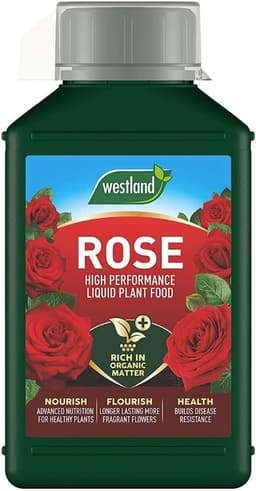
| Best overall |  Westland Westland rose liquid 1 L | Liquid | 1 × 1 L | Liquid rose concentrate | 9.4 | about £6.58 | View offer |
| Alternative |  Topline Miracle Grow rose liquid and granule bundle | Granules and liquid | Bundle | Rose and shrub bundle | 9.2 | about £16.99 | View offer |
| Best value |  Empathy Empathy After Plant rose feed 1 L | Liquid (item form also says granules) | 1 × 1 L | After-plant rose feed | 9.0 | about £6.99 | View offer |


On this page
What each form is for
Pots, borders, and using both
The bundle is two products
The recommendation, with a condition
Common questions
Should I buy liquid or granules for roses?
Can I use both?
What is in the Miracle Grow bundle?
Do pot roses still need granules?
How often is each form?
Is liquid a waste if I already use Toprose?
When do I stop each form?
Related pages
Sources
Public UK and maker sources used for this page in October 2026. Prices, stars and review counts are from the eight amazon.co.uk listings as of 21 October 2026. An organic title is not a named control body. A feed does not treat black spot. Maker NPK and dilution lines that are missing on Amazon are marked as maker pages, not as listing text.
- RHS, growing roses (retrieved 21 October 2026)
- RHS, fertilisers (retrieved 21 October 2026)
- RHS, rose black spot (retrieved 21 October 2026)
- Defra, UK fertilisers regulatory reform 2026 (retrieved 21 October 2026)
- GOV.UK, product marking by sector (retrieved 21 October 2026)
- B&Q, Westland rose liquid plant feed 1 L (retrieved 21 October 2026)
- Peter Beales, feeding your roses (retrieved 21 October 2026)
- Neudorff, Azet Rose Feed (retrieved 21 October 2026)