Independent comparisons. We may earn from shop links. More info

Herb fertiliser buying guide for UK pots, beds and boxes

Updated: October 2026

A basil pot on a British windowsill can look tired by June while rosemary in a trough still looks fine, and a herb fertiliser buying guide has to start there. Pots hold little compost, so a hungry leaf herb runs out of food, and a bed often does not. This page is from Peter F., the DIY and tools editor, on 20 October 2026. The four amazon.co.uk listings are on the [herb fertiliser comparison](/hub/fertiliser-soil-and-bark-mulch/herb-fertiliser), read with Royal Horticultural Society and GOV.UK pages. Nobody here grew a trial. A qualifying Amazon purchase can earn a commission at no extra cost to you.

A basil pot on a British windowsill can look tired by June while rosemary in a trough still looks fine, and a herb fertiliser buying guide has to start there.

Our top picks

On this page

When a UK herb pot actually needs feed

The Royal Horticultural Society says container plants are usually ready for feed about six weeks after planting, and that you should not fertilise after September. A supermarket basil you potted last weekend is still on the compost's starter charge. A second feed on a bag that already feeds for months stacks two supplies in a small root space. BBC Gardeners' World makes the same point for pots: liquids are easier to control than a heavy solid dose, and you do not feed a plant that is already wilting. Water it, let it recover, then decide. Open ground is the case where a bottle is often optional. A herb in decent soil, not cut to the stalk every week, may need one light dose in the season or none.

Hungry herbs and lean herbs

Basil, parsley, chives and mint use more food in a pot than rosemary, thyme, sage and oregano. Plantura's UK feeding page groups them that way and links extra nitrogen with softer growth that smells and tastes less. A pale basil can want a light regular feed. The same fortnight on thyme can push sappy shoots you did not want. On the RHS note for Mediterranean herbs, a general-purpose liquid every two or three weeks comes only after a couple of months, and many people feed rosemary far less often. If one trough holds both kinds, follow the lean herb and give basil its own pot if you want a shorter clock. The hungry crops, including supermarket pots, are on fertiliser for basil.

What to read on the label

Read four things before the price. First, a dose in millilitres, drops or sticks, plus how often. A ratio printed as 1:X is not a dose. Second, which plants and which place: a pot, a balcony box, or the garden. Third, what an organic line actually says. GOV.UK's organic food rules mean a herb you sell as organic food needs a certified control body. Suitable for organic farming, or certified in organic farming, is a claim about the input. None of these four listings shows a Soil Association code. Fourth, any pet or child line, and whether the listing answers it. An unanswered question is not a yes. None of the four amazon.co.uk listings prints a numeric NPK. Shelf prices in the listings sit between about £5.98 and about £12.40.

How the four listings differ before you rank them

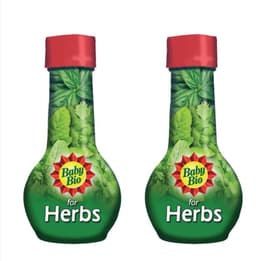
Treat the four as label examples. Who should buy which one stays on the main comparison. The about £5.98 Baby Bio pack says every two weeks and prints 1:X. The about £10.50 twin prints 5–10 drops per 0.5 litre or half a capful per litre, and does not say how often. Substral's 30 sticks at about £12.40 name basil and parsley, and the saved reviews are marked Reviewed in Germany. Neudorff's 250 ml liquid at about £7.81 says certified in organic farming and safe for pets, with no dose and no star line. If you need a number you can mix tonight, the about £10.50 page is the one that prints it. That still does not make it the right bottle for rosemary. Mixing steps are on how to use herb fertiliser.

Common questions

Do herbs in pots need fertiliser at all?
Often yes, once any starter charge is spent, and often no in the first six weeks. The RHS puts container feeding about six weeks after planting and says not to fertilise after September. If the bag already feeds for months, do not add a second programme on day one. A wilted plant needs water before it needs a dose.
Should I buy a herb feed or a tomato feed?
Choose a balanced feed for leaves when the label is for herbs. RHS container guidance points away from a high-potassium tomato food, which is built for fruit. On basil, a push toward flowers fights the leafy habit you want in the kitchen. A herb listing that never states a dose is still a weak buy, even when it is not a tomato food.
Why is NPK missing on these Amazon listings?
A statement in scope of the Fertilisers Regulations 1991 shows nitrogen, P2O5 and K2O, plus the marketer and the net volume. These four listings do not contain a numeric NPK we can quote. Do not fill the gap with a blog ratio or a shop analysis that is not on the Amazon page. If you need the numbers before you order, this set does not give them.
Does organic on the bottle make the herb organic food?
No. GOV.UK says organic food wording needs a control body. Certified in organic farming on a fertiliser is a claim about the input, and this set shows no Soil Association code. You can still prefer vegetable raw materials. You cannot call sprigs you sell organic food on the back of these bullets alone.
Is about £5.98 with no usable dose worse than about £10.50 with a dose line?
If you need the strength from the listing, yes. The about £5.98 Baby Bio pack states every two weeks and prints 1:X. The about £10.50 pack states 5–10 drops per 0.5 litre or half a capful per litre, and it does not state the interval. You are not paying for a lab test.

Related pages

Sources

Public UK sources from the research digest, used for this page in October 2026. Prices, stars and review counts are from the four amazon.co.uk listings captured on 20 October 2026. An organic-farming line is not an organic-food certificate. Texts marked Reviewed in Germany are not UK reviews. This is not a laboratory test or a taste test.

  1. RHS, Growing herbs in containers (retrieved 20 October 2026)
  2. RHS, How to feed plants (retrieved 20 October 2026)
  3. RHS, Mediterranean herbs in a pot (retrieved 20 October 2026)
  4. GOV.UK, Manufacturing and marketing fertilisers (retrieved 20 October 2026)
  5. The Fertilisers Regulations 1991 (retrieved 20 October 2026)
  6. GOV.UK, Organic food labelling (retrieved 20 October 2026)
  7. Plantura, Feeding herbs (retrieved 20 October 2026)
  8. BBC Gardeners' World, feeding pots (retrieved 20 October 2026)