When to apply autumn lawn feed: the UK timing guide

Learn when to apply autumn lawn feed in the UK, when to skip it, and why leftover high-nitrogen spring feed is the wrong choice before winter.
On this page
You reach September with half a bag of spring lawn fertiliser still in the shed. Knowing when to apply autumn lawn feed prevents two common mistakes: feeding a lawn that does not need it, and using a high-nitrogen product simply to empty the bag. In the UK, consider an autumn feed while grass is still growing in September or mild October weather, and stop once frost and saturated ground have taken over.
In short
Apply a purpose-made autumn lawn feed only if the lawn needs support and conditions remain mild enough for growth. Choose a lower-nitrogen seasonal product, follow its labelled rate, and avoid frozen, waterlogged, parched or dormant grass. Leftover spring or summer feed should wait until its stated season returns.
Does your lawn need autumn feed?
Autumn feed is optional. The Royal Horticultural Society's autumn lawn guidance recommends feeding only where a lawn needs it, rather than treating fertiliser as a fixed September chore. If the grass is reasonably dense, has a healthy colour and is still growing evenly, another application may add cost without correcting a real problem.
Look at the whole lawn. Compaction, shade, scalping, drought and poor drainage can weaken turf, and fertiliser will not fix those causes.
An autumn feed is easier to justify where growth is generally weak despite sensible mowing and moisture, or where recent care gives a clear reason to replace nutrients. Use the minimum labelled rate. The Substral lawn fertiliser comparison helps you separate stated application windows, so you do not assume every lawn bag covers autumn.
The best time to apply autumn lawn feed
For much of the UK, September is the practical starting point, while the soil is still warm and grass is still growing. Early or mid-October can suit in a mild spell, but it is not a deadline. A Highland garden can close sooner than a sheltered southern plot.
Feed only during active growth, on moist but workable soil, in a settled spell. Do not spread in strong wind or just before a downpour. Pack instructions come first, including any watering-in.
The window ends when cold weather stops meaningful growth, or the ground is regularly frozen or saturated. Feeding because the calendar still says autumn misses the point. RHS October lawn advice specifically warns against leftover summer feed at this stage. If a suitable spell never arrives, skip the job.
November is often too late. If growth has stopped, frost is likely, or the soil is saturated, wait for the next feeding season.
Why not use leftover spring feed?
Spring and summer lawn fertilisers are built to drive leafy growth while days are longer. That usually means more nitrogen. In early autumn you do not want a flush of soft leaves heading into cold, damp weather. The bag can still be sound, but only at the time, rate and purpose printed on it.
Check the application months, analysis, dose, coverage and watering directions, not only the words lawn feed on the front. A spring-to-August or March-to-September claim does not make that bag right for October, and potassium alone does not make an autumn formulation.
The RHS spring and summer lawn guidance gives August as the stop for high-nitrogen summer feeding. Put the spring bag away when that season has ended, even if only a little remains.
Store an out-of-season bag in its original packaging, sealed and dry, and keep the directions with it. If the pack is damaged, the granules are wet, or you can no longer identify the product, do not guess a rate.
How to choose an autumn lawn feed
Choose a product explicitly labelled as an autumn lawn feed, then check that its window matches your weather. Autumn formulations generally use less nitrogen than spring and summer products and put more weight on nutrients meant to support turf through colder weather. Low nitrogen is a clue, not a substitute for the label.
NPK numbers show the declared balance of nitrogen, phosphate and potash. A ratio such as 6-5-10 can look autumn-oriented because potash sits above nitrogen, but you still need the dose, a lawn recommendation for autumn, and the application method. A garden fertiliser with a promising ratio is not automatically safe on turf.
Compare stated square-metre coverage at the autumn rate, not simply the bag weight or the price in GBP. Measure the lawn without patios, beds and paths, then allow for the actual dose.
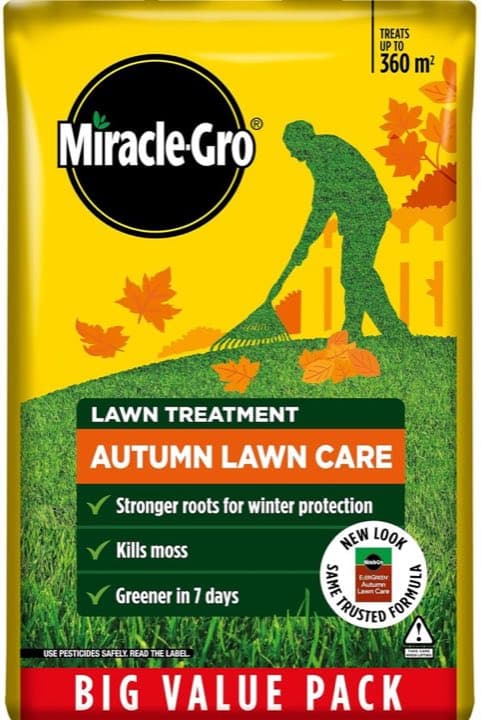
The autumn top pick on the WOLF-Garten lawn fertiliser comparison is Miracle-Gro 4-in-1 autumn lawn care, 360 m², at about £24.75, with 5.0 from two amazon.co.uk ratings. Two ratings are a thin base. Check the delivered weight, because that listing's part number also matches a smaller bag. The directions on the pack you receive still decide the application.
A combined weed or moss claim is not plain fertiliser. Buy that sort of bag only if you need the treatment and can follow the whole label. Leaf pictures and an autumn shelf label are weaker evidence than the manufacturer's directions.
How to apply it safely and evenly
Measure the lawn in square metres and take the amount from the labelled rate. Do not judge the dose by how full the spreader looks. Twice the quantity is not twice the benefit, and overlap raises the chance of scorch, stripes and waste.
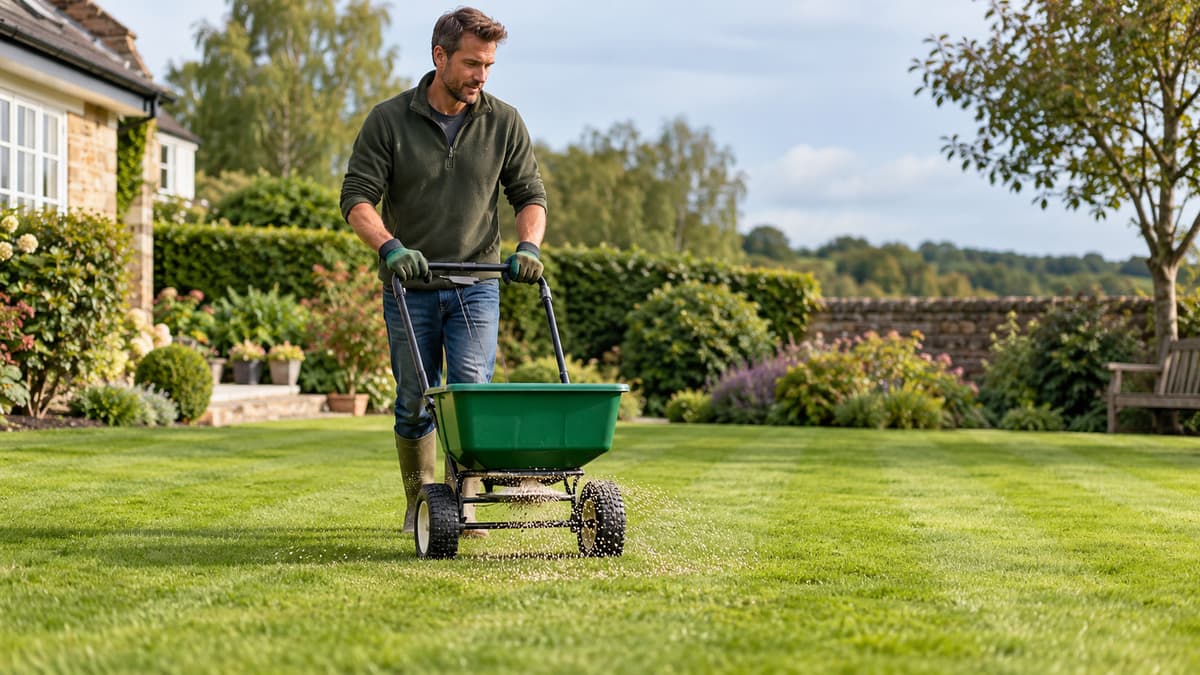
If the instructions allow it, split a granular dose in half. Spread one half in parallel passes and the other at right angles, at an even pace. Fill the spreader on a hard surface, not on the grass, so a spill does not leave a concentrated patch.
Keep granules off paving, ponds and drains, and sweep spills back onto the lawn. Follow the pack on protection, children and pets, and wash your hands.
Where the label asks for watering-in and rain is uncertain, water evenly without run-off. Check any local water-use restriction first. Dew is not a substitute when the label requires watering. A tidy cut can make spreading easier, but do not scalp the lawn first, lay granules on clippings, or mow again before rain or watering has taken the product into the soil.
When to skip feeding
Skip the feed when the ground is waterlogged. Roots short of air will not be rescued by more nutrients, and a spreader on saturated soil makes compaction worse. Stay off until it firms, and look again at drainage.
Do not feed frozen turf or apply just before a frost. In a dry autumn spell, pause if the lawn is stressed and you cannot water as the label requires. Waiting, or dropping the autumn application, is a sound decision.
New turf and newly sown grass follow the supplier's or seed producer's establishment programme, not the routine for an established lawn. If those directions and the fertiliser pack do not clearly agree, do not improvise.
Skip a second dose inside the product's stated interval, and note the date, product and rate. Plain autumn fertiliser does not prevent or kill moss. Shade, moisture, compaction, weak grass or acidic conditions need their own look, and a moss-control combination must be used on its own label.
A simple September-to-winter decision
Ask whether the lawn has a real need, or is only slowing for the season. If shade, compaction, mowing damage or standing water is the cause, fix that. If the whole lawn is weak, feed only while it is still growing and the soil is moist without being saturated, using a pack with clear autumn directions and a rate you can measure.
Avoid frost, strong wind and heavy rain, and water in if the label requires it. An autumn feed is not meant to copy a high-nitrogen spring flush. Judge the lawn over the following weeks and keep to the reapplication interval. Once winter stops growth, close the season.
Products Compared used public Royal Horticultural Society guidance and the seasonal claims in this hub's lawn-fertiliser comparisons. There was no laboratory or garden trial. If you buy through a qualifying link, Products Compared may earn a commission at no extra cost to you. The label on your pack remains the instruction.
Common questions
What month should I apply autumn lawn feed in the UK?
Does every lawn need an autumn feed?
Can I use summer lawn feed in October?
What nutrients should an autumn lawn feed contain?
Can I apply autumn lawn feed before frost?
Should I water in autumn lawn fertiliser?
Is an NPK ratio of 6-5-10 automatically suitable for autumn?
How was this guidance prepared?

Products Compared publishes British-English buying guides based on amazon.co.uk listings and public UK sources. We do not run a lab and we do not invent test scores.
Related articles
How to feed a UK lawn
Apply lawn feed evenly, at the labelled rate and in suitable weather.

How often to feed a lawn
Plan feeds around grass growth rather than an automatic monthly routine.

Moss in lawns: feed, rake, or leave it
Work out whether moss needs treatment before reaching for another lawn product.