How often to fertilise a lawn: a practical UK schedule
Learn how often to fertilise a UK lawn, when a second treatment helps, why monthly feeding is risky, and when to switch to an autumn lawn feed instead.
On this page
It is easy to turn lawn feeding into a monthly habit: the grass looks pale, the spreader is in the shed and another dose feels like useful maintenance. Yet how often to fertilise a lawn depends on its condition, the season and the instructions on the product you actually bought. For many established UK lawns, one spring application followed by a proper review is a better starting point than an automatic series of feeds.
In short
Feed an established lawn only when it needs nutrients and is actively growing. Start with one suitable spring feed, reassess after the interval on the label and add a second treatment only if the pack permits it and the grass still needs help. Do not continue high-nitrogen feeding after August.
Zero feeds can be the right number
A lawn does not need fertiliser merely because spring has arrived. If the turf has an even colour, recovers well after mowing and grows steadily rather than excessively, leaving it unfed can be sound. Returned clippings recycle some nutrients, which matters if you prefer a less intensively managed lawn.
Check whether nutrition is really the limit. Thin grass under a tree may be short of light and facing root competition. Hard ground may need aeration, and a lawn cut extremely short can look weak because too much leaf is removed. Dry, dormant grass will not be repaired by granules, and feeding before heavy rain can wash nutrients away.
A close-cut family lawn needs more management than a relaxed grass-and-clover area. Wildflower lawns generally do better with lower fertility, because rich conditions let vigorous grasses crowd out flowers. Treat zero feeds as a choice: inspect growth, colour, moisture and the forecast, and mow at a sensible height. If the lawn stays healthy, there is no prize for using every application printed on the packet.
Start with one spring feed
For a conventional lawn that looks hungry, one mid-spring application is a sensible baseline. The grass should be growing, the soil moist enough, and the product suited to the season. The Royal Horticultural Society's spring and summer lawn guidance recommends feeding in mid-spring and considering another application only when the lawn still looks poor.
Spring is not one date across the UK. Growth can start earlier in a sheltered southern garden than on an exposed site in Scotland, and a cold or waterlogged March is not made suitable by the calendar. Let growth, soil conditions and the pack's weather instructions set the day.
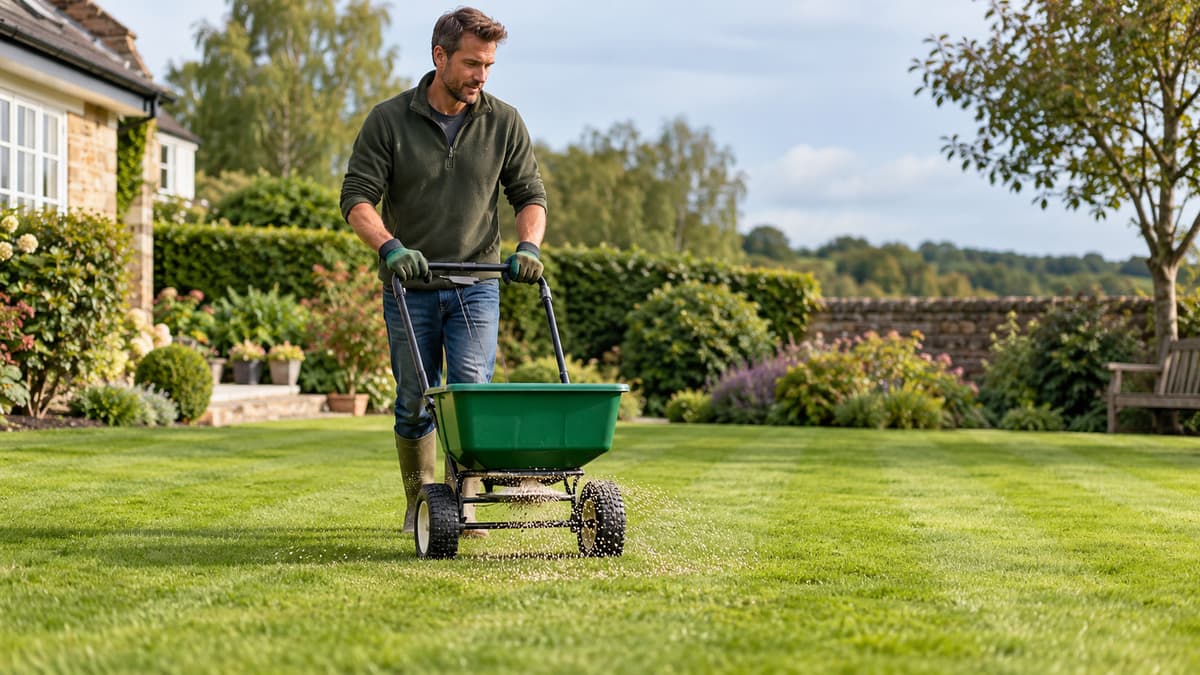
Measure the lawn and calibrate the dose. A product at 35 grams per square metre is not interchangeable with one at a different rate, even if both are called spring lawn feeds. Filling a spreader on the turf can leave a spill that scorches a patch. Compare coverage, method and the stated programme, not bag size alone, in our Substral lawn fertiliser comparison and WOLF-Garten lawn fertiliser comparison. The label in your hand remains the authority for dose and timing.
Decide whether a second feed is justified
A second lawn feed is an option, not the next compulsory step. Wait for the minimum interval on the same product, then look at the whole lawn. Persistently weak or generally pale turf during active growth can justify it. Isolated yellow patches may have another cause and should not trigger a blanket treatment.
Some programmes use six to eight weeks between a first spring application and a second. Rolawn describes that gap in its turf fertilising guidance. It is an example, not a universal lawn fertiliser interval. Slow-release products, liquids and combined weed-and-feed treatments can have different limits.
A liquid tonic that contains nutrients still counts, and so does a combined lawn treatment. Alternating products can hide the nitrogen total, because each container states its own instructions. Write the date, product and rate down before you put the bag away.
Skip the second dose if growth is already lush, drought is starting, or you cannot follow the watering directions. Slight underfeeding is easier to correct than too much nitrogen, which can create weak, lush growth. A domestic lawn does not need a sports-turf programme.
Do not make monthly feeding the default
Can you fertilise a lawn every month? Only if that label explicitly allows it inside the approved season, and the lawn still needs it. For most gardens, monthly is the wrong rule, because it ignores release period, application count, weather and earlier treatments.
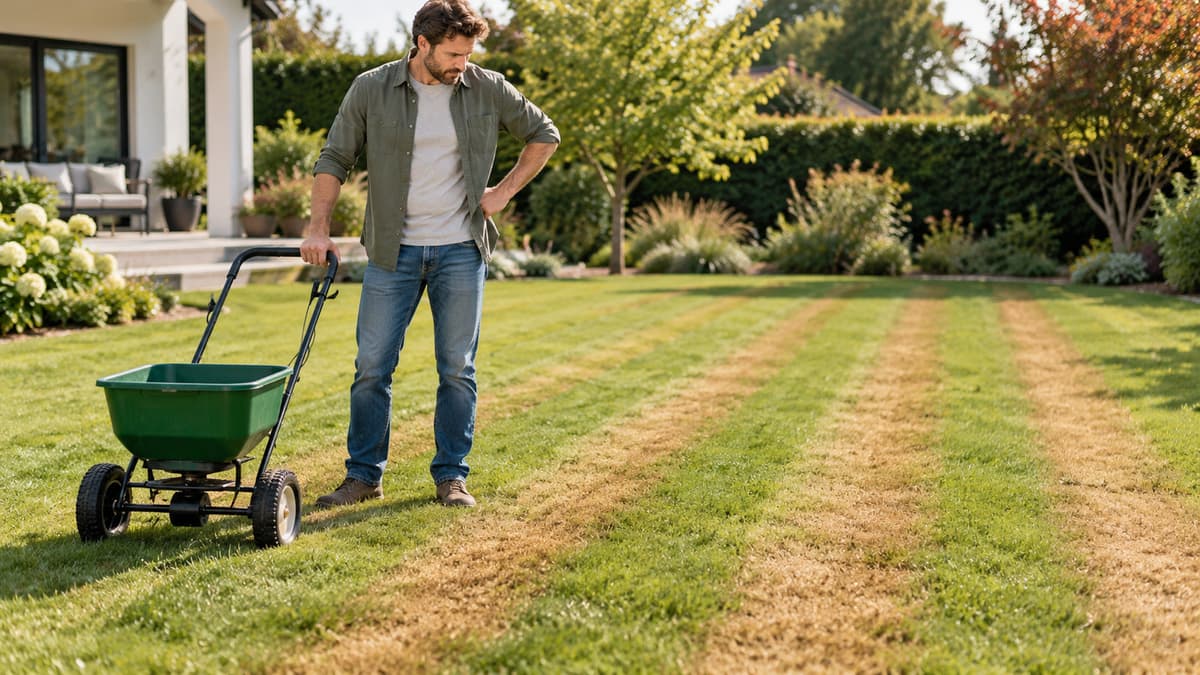
Concentrated fertiliser can draw moisture from leaves and roots, leaving brown stripes where spreader passes overlap. Extra nitrogen can also push soft growth that needs more mowing. Feeding a dry lawn raises that risk without replacing the missing water.
If one application feeds for up to two months, that claim is a duration, not permission for another full dose in each of those months. An early repeat overlaps the first dose.
Keep the packet, record every application and do not exceed the rate or the maximum count. If you move fertiliser into a sealed container, keep the original label with it. Do not copy the schedule from a different brand, even when the nutrient numbers look similar.
Change course after August
The RHS advises against spring or summer lawn fertiliser after August, because higher nitrogen can encourage soft growth that is vulnerable to autumn disease and cold. A third summer-style feed is not a useful way to finish an open bag.
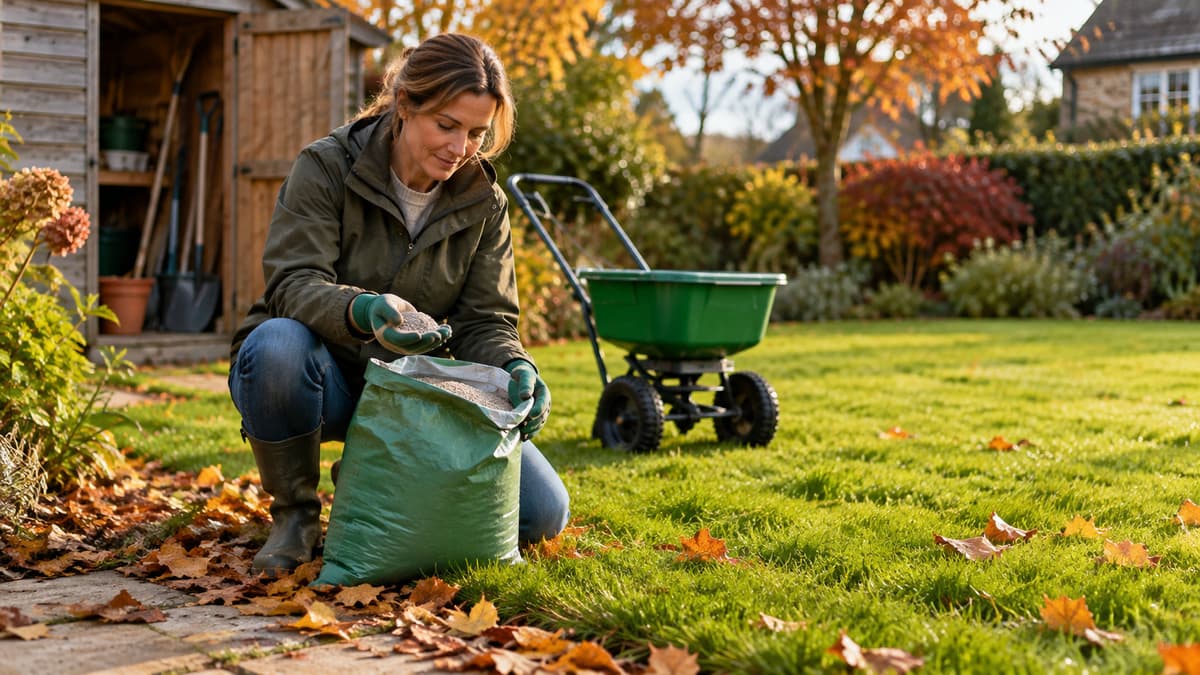
A healthy lawn may need no autumn product. Keep mowing, lift heavy leaves and deal with drainage or compaction when the ground allows. If an autumn feed is justified, use one labelled for that season and only in its stated months. Autumn formulas are not simply weaker spring feeds.
Do not apply granules to frozen, waterlogged or drought-stressed ground, or just before extreme rain. Some products need watering in; others need dry foliage. Store leftover spring feed sealed, dry and out of reach of children and pets, and check the label next year. Wet or clumped product forced through a spreader leaves bands of too little and too much.
Read the application count with the season
A front claim of two to three applications is incomplete on its own. Find the permitted months, minimum interval, rate per square metre and maximum number of treatments, and read them together. Three applications from March to August do not authorise a feed in March, August and October.
Up to three applications is a count. Feeds for up to two months describes one dose. Apply as necessary still sits under the rate, interval and seasonal limits printed elsewhere. Up to is a ceiling, not a target. Mark the treatment date, the earliest permitted repeat and the end of the seasonal window, then choose yes or no from the lawn. The date is not an appointment.
A pack used in April with a six-week minimum can be reviewed in late May or June. Even growth means you record no feed. If the lawn is still generally weak, conditions suit another dose and the label allows it, apply it accurately. By late summer the next step is no treatment or a separate autumn product.
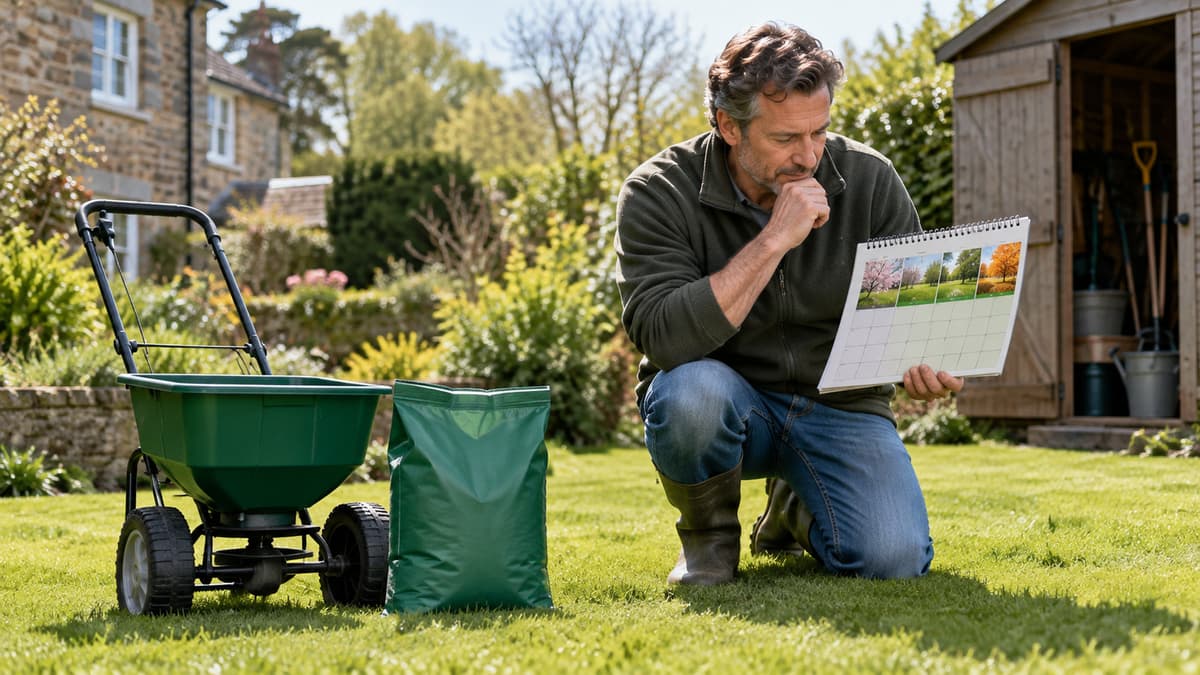
A simple annual decision calendar
In early spring, repair winter damage and wait for sustained growth on ground that is neither cold nor saturated. In mid-spring, apply one suitable feed only if the lawn needs it, at the labelled rate, and note the date.
Reassess in late spring or early summer after the minimum interval. Poor colour only in shade or on compacted ground is not a reason to feed the whole lawn. A second feed belongs only on actively growing grass, with a clear need and label permission. In hot, dry weather, pause: a browned lawn is protecting itself, and fertiliser does not replace moisture.
After August, stop high-nitrogen spring and summer formulas. If the lawn is poor, find the cause before considering a labelled autumn feed. Through winter, feeding is normally unnecessary. Plan drainage, aeration, mowing and the spring assessment instead.
Common questions
Is feeding a lawn once a year enough?
When should I apply a second lawn feed?
Can I fertilise my lawn every month?
What does two to three applications mean on lawn feed?
Does slow-release lawn feed change the interval?
Should I feed a wildflower lawn?
Can I use spring lawn feed after August?

Products Compared publishes British-English buying guides based on amazon.co.uk listings and public UK sources. We do not run a lab and we do not invent test scores.