Independent comparisons. We may earn from shop links. More info

12V or mains electric fence energiser

Updated: October 2026

The title offers 12V, mains and solar on one box. A 12V or mains electric fence energiser decision is about where the fence sits and whether it has to stay there. A temporary line you will move, with no socket in the field, wants a 12V battery unit. A line beside a socket, or a Countryside Stewardship FG3 permanent fence, wants mains. The [12V electric fence energiser comparison](/hub/fencing-and-wire/electric-fence-energiser-12v) ranks the battery listings in the 19 October 2026 capture. Peter F. compared those listings, not a lab install. A qualifying purchase can earn a commission at no extra cost to you.

The title offers 12V, mains and solar on one box. A 12V or mains electric fence energiser decision is about where the fence sits and whether it has to stay there.

Our top picks

liusukeji liusukeji 3 J energiser

Best overall

liusukeji liusukeji 3 J energiser
7.0/10about £42.49
tuotian tuotian C1403

Best value

tuotian tuotian C1403
8.2/10about £52.68
XSTOP XSTOP BA80

Rank 3

XSTOP XSTOP BA80
8.8/10about £54.99
On this page

When 12V is the right power source

Choose 12V when you will move the fence and you will charge a leisure battery. AHDB describes battery fencing as the fit for temporary lines: portable, often cheaper to set up, and dearer to run because the battery is the fuel. Strip-grazing that shifts every few days stays on 12V even if a socket exists at the yard, provided you bring the battery in to charge. The XSTOP BA80 is the 12V-only unit in this set, at about £54.99, 0.6 J, with 4.0 from 2,118 reviews. It does not pretend to be a plug-in energiser. Short leads in the BA80 and liusukeji reviews mean the battery sits near the unit or you add cable. A poor rod feels like a dead fence. That is an earth problem, not by itself a reason to switch to mains.

When mains is the right power source

Choose a mains energiser when the socket is close and the fence will stay, or when the fence has to meet FG3. AHDB says mains is usually cheaper to run, with no battery to change. The same note says the underground lead-out can be expensive, that mains fencing is a poor fit where the public can reach it, and that professional advice is essential. A mains unit belongs under cover and out of children’s reach. This page is not that wiring guide. GOV.UK says the FG3 item needs a mains-operated energiser fitted to the maker’s recommendations, on a fence at least 1.05 m with at least four plain wires. A 12V battery unit does not meet that sentence. The wider mains-led set is the electric fence energiser comparison.
liusukeji liusukeji 3 J energiser

Testsieger

liusukeji liusukeji 3 J energiser
7.0/10about £42.49

What dual-input on these listings does and does not do

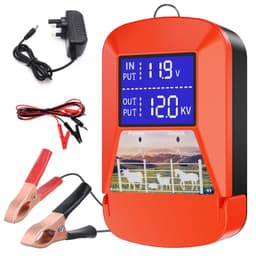
Several titles say mains or 12V. The liusukeji at about £42.49 states a UK mains adapter, with the battery extra, and it has six reviews. The AUSTUFF units at about £45.99 say 110–240 V or 12V. One WTR003 reviewer says a mains converter was supplied, and the plug was too bulky to close a covered outdoor socket. The W-EF-01 and the Trsaow also name mains or 12V, and the Trsaow has no reviews. On all of them the battery is not in the box. A solar-panel input is not a solar energiser. A title that mentions mains does not make the box an FG3 energiser. Where the file does not say BS 1363, the UK 13 A plug is unconfirmed. A Schuko-only lead is the wrong plug for a UK socket. The XSTOP does not offer this ambiguity. It is 12V only.

The decision in one fence

You are strip-grazing a pony and you move the tape every few days. Stay on 12V, charge a leisure battery, and use the comparison for the joule and the review sample. The BA80 is the large-sample 0.6 J option. The tuotian at about £52.68 is the 2 J option with 48 reviews if 0.6 J is already too light. You still buy the rod if the box does not contain one. A permanent paddock with a socket on the same wall wants mains, under cover, with the professional advice AHDB says is essential. For FG3, do not submit a battery setting and call it mains. If the line meets a right of way, AHDB says mains is a poor fit and the local authority is the ask.

Common questions

Should I buy 12V or mains?
Buy 12V for a temporary fence you will move, where you can charge a leisure battery and there is no socket in the field. Buy mains when the socket is close and the fence stays, or when FG3 requires a mains-operated energiser. Public access is a reason mains can be the wrong choice even next to a socket.
What if the socket is in a shed fifty metres away?
Fifty metres is a lead-out, not a free socket. AHDB says that underground cable can cost more than the energiser. If you will still move the fence every few days, 12V remains the simpler setup and you carry the battery. If the fence is permanent, price the cable and ask for the professional mains advice AHDB says is essential, with the energiser under cover.
Does a dual-input unit count as mains for a grant?
Not on battery power, and not merely because the title says AC. FG3 says you must install a mains-operated energiser in accordance with the manufacturer’s recommendations. The liusukeji, AUSTUFF, W-EF-01 and Trsaow listings mention mains and still exclude the battery. A grant claim wants the mains install, not a crocodile-clip mode. The plug also has to suit a UK socket.
Is a 12V unit legal on a permanent paddock fence?
A permanent paddock that is not in the FG3 grant is not banned from battery power by the sources used here. You take the higher running cost and the charging habit. FG3 is different: that item is written around a mains-operated energiser and a stated post and wire build, at least 1.05 m and at least four plain wires. Public rights of way are a separate limit.
Why do battery fences cost more to run?
The battery is the running cost. AHDB contrasts that with mains, which has no battery to change once the cable is in. A car starter battery is the wrong economy: it may pulse on day one and then fail. The XSTOP guide of 60 days or more on an 85 Ah battery is the maker’s figure at 30 mAh, not your winter bill.

Related pages

Sources

Public UK sources used for this comparison. amazon.co.uk prices, stars and review counts were taken from the listings on 19 October 2026.

  1. BSI, BS EN IEC 60335-2-76:2021+A11:2021 (retrieved 19 October 2026)
  2. AHDB, Components of an electric fence (retrieved 19 October 2026)
  3. AHDB, How to set up electric fencing (retrieved 19 October 2026)
  4. GOV.UK, Countryside Stewardship FG3 (retrieved 19 October 2026)
  5. Cornwall Council, electric fence guidance (retrieved 19 October 2026)
  6. Rappa, guide to earthing (retrieved 19 October 2026)
  7. Kramer, fence energiser guide (retrieved 19 October 2026)
  8. XSTOP BA80 product page (retrieved 19 October 2026)