Independent comparisons. We may earn from shop links. More info

12V electric fence energiser for horses

Updated: October 2026

The paddock is two fields from the yard socket, and the listing says “for horses” on a 0.6 J box and on a 3 J box. A 12V electric fence energiser for horses has to answer whether that pulse is enough, and what the tape, the signs and a bridleway change. The [12V electric fence energiser comparison](/hub/fencing-and-wire/electric-fence-energiser-12v) is the ten-listing table from the 19 October 2026 amazon.co.uk capture. Peter F. did not lab-test any horse against these units. A qualifying purchase can earn a commission at no extra cost to you.

The paddock is two fields from the yard socket, and the listing says “for horses” on a 0.6 J box and on a 3 J box.

Our top picks

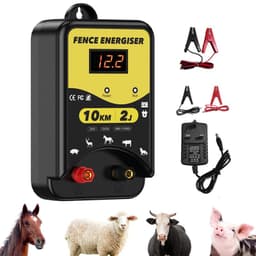
xueyang xueyang C1403

Best overall

xueyang xueyang C1403
7.6/10about £56.59
tuotian tuotian C1403

Best value

tuotian tuotian C1403
8.2/10about £52.68
XSTOP XSTOP BA80

Rank 3

XSTOP XSTOP BA80
8.8/10about £54.99
On this page

What horses need from the fence

Horses have to see the fence and feel a short pulse they can step back from. Tape is how UK shops make the wire visible. The widths those shops list include 12.5 mm, 20 mm and 40 mm. None of those widths is a legal minimum in the sources used here, and wind wears a wide tape. Thin wire can carry a pulse a horse does not notice until it is in the wire. A higher joule figure on an invisible strand is a weak plan next to clear tape and a modest unit. The British Horse Society says a shock can make a horse jump or react hard, so enough is not the same word as safe. Do not electrify barbed wire.

What 0.6 J did in this set

The horse sample with a large review file is the XSTOP BA80 at about £54.99, 0.6 J, 4.0 from 2,118 reviews. The listing says horses and other animals. Reviewers describe a click horses notice, including a stallion held beside mares. The same capture includes a feeble result on a short rope and about 150 m of three-strand rope, so earth and vegetation sit in the same decision as the joule figure. One buyer who left a 0.6 J unit for the AUSTUFF WTR003, 2 J at about £45.99, said the horses were more wary. The components were not in the box. The tuotian, also 2 J, has 48 reviews and a missing-rod complaint. A short, clean, taped line points at the BA80. Horses already testing a long or weedy tape point at a stated 2 J unit, not a six-review 3 J average.
xueyang xueyang C1403

Testsieger

xueyang xueyang C1403
7.6/10about £56.59

Signs, gates, and a horse route

If people or riders can meet the fence, signs are part of the install. AHDB’s setup note says signs near a footpath every 50 m or less. The British Horse Society says signs where a horse route starts and ends, and at intervals no greater than 50 m, visible from horseback. A sign on the gate and nothing for the next hundred metres is the miss those notes describe. Cornwall’s guidance says a rider must pass a gate without the horse touching a live wire, with the wire insulated around the gate. West Berkshire’s sheet says electric fencing should not cross a public bridleway. Those are council notes, not one statute. Ask the highway authority before you clip tape across a route. If the authority says the fence should not be there, take it down.

When this is the wrong energiser

Do not use this horse decision for sheep in a full fleece. DAERA says electric mesh is not for horned sheep. The Briidea states 3 J and 10,000 V, and a reviewer argued that is too much for a pet dog. That argument is not a horse sizing chart. Leave the 12V horse box when the socket is in the yard and the fence will stay, or when the fence is a Countryside Stewardship FG3 item, because that item asks for a mains-operated energiser. A long weedy boundary or a thick winter coat is the moment to step up to a stated 2 J unit with a review sample you can read. If the only gap is the earth, fix the rod on the install page before you buy a second energiser.

Common questions

How many joules do horses need on a 12V unit?
Kramer’s guide says under 1 J for easy horses on a short, clean fence, and more when the fence is longer or horses test the tape. Horse & Hound says generally about 0.5–1.5 J. Both are guides, they do not agree, and neither is a minimum for the BA80. In this set the large horse sample is 0.6 J on short, clean, visible tape.
Is 0.6 J enough for a paddock?
It was enough in many XSTOP reviews for horses that noticed the click, including a stallion kept beside mares, at about £54.99 and 4.0 from 2,118 reviews. It was not enough in every report. A feeble result on a short rope and about 150 m of three-strand rope is in the same capture.
Why do people use tape rather than thin wire?
Horses have to see the fence before they touch it. UK shops sell tape in widths such as 12.5 mm, 20 mm and 40 mm. That is a product range, not a required width, and wide tape takes more wind. A thin live wire can be in a horse’s chest before the horse has seen a boundary.
Will the same unit hold sheep?
Do not assume it. Wool insulates, and a horse-page choice of 0.6 J is the wrong lesson for sheep in a fleece. DAERA says electric mesh is not for horned sheep. If sheep are the stock, use a unit whose stated output matches that heavier load, and read the vegetation notes on the buying guide. A single “horses and other animals” line on the XSTOP is not a sheep specification.
Do I need signs if the fence is only in my field?
If the public cannot meet it, the footpath rule is not the one you are in. You still want the tape visible to the horses, and you still should not use barbed wire. If a path, a horse route, or a gate the public uses touches the fence, AHDB and the BHS both point to signs at intervals no greater than 50 m.

Related pages

Sources

Public UK sources used for this comparison. amazon.co.uk prices, stars and review counts were taken from the listings on 19 October 2026.

  1. BSI, BS EN IEC 60335-2-76:2021+A11:2021 (retrieved 19 October 2026)
  2. AHDB, Components of an electric fence (retrieved 19 October 2026)
  3. AHDB, How to set up electric fencing (retrieved 19 October 2026)
  4. GOV.UK, Countryside Stewardship FG3 (retrieved 19 October 2026)
  5. Cornwall Council, electric fence guidance (retrieved 19 October 2026)
  6. Rappa, guide to earthing (retrieved 19 October 2026)
  7. Kramer, fence energiser guide (retrieved 19 October 2026)
  8. XSTOP BA80 product page (retrieved 19 October 2026)