Wireless doorbell range through walls
You pressed the button on a brick semi, the kitchen chime answered, and the landing stayed quiet. Wireless doorbell range through walls is that gap: the metre on the box against the rooms you use. The eight kits in our [wireless doorbell comparison](/hub/electronic-surveillance/wireless-doorbell) quote 150 m, 300 m, or about 400 m, as maker open-air figures on amazon.co.uk on 15 October 2026, not a walk through your house. Products Compared editorial team, 15 October 2026. No laboratory test. A qualifying purchase can earn us a commission at no extra cost to you.
You pressed the button on a brick semi, the kitchen chime answered, and the landing stayed quiet. Wireless doorbell range through walls is that gap: the metre on the box against the rooms you use.
You pressed the button on a brick semi, the kitchen chime answered, and the landing stayed quiet. Wireless doorbell range through walls is that gap: the metre on the box against the rooms you use. The eight kits in our wireless doorbell comparison quote 150 m, 300 m, or about 400 m, as maker open-air figures on amazon.co.uk on 15 October 2026, not a walk through your house. Products Compared editorial team, 15 October 2026. No laboratory test. A qualifying purchase can earn us a commission at no extra cost to you.
Our top picks
| Badge | Product | Open-air range | Receivers in box | Receiver power | Note | Price | Offer |
|---|---|---|---|---|---|---|---|
| Best overall |  TECKNET TECKNET Wireless Doorbell, IP65 Waterproof Twin Plug-in Door Bell, Black | Over 400 m open air | 2 | Plug-in | 7.8 | about £17.99 | View offer |
| Best value |  TECKNET TECKNET Wireless Doorbell, Wall Plug-in Door Bells Wireless Cordless | 400 m open air | 1 | Plug-in | 7.6 | about £9.99 | View offer |
| Alternative |  Byron Byron Wireless Portable Doorbell, 150 m Range, 16 Melodies, IP44 | 150 m open air | 1 | Battery | 6.0 | about £9.00 | View offer |

Best overall
TECKNET TECKNET Wireless Doorbell, IP65 Waterproof Twin Plug-in Door Bell, Black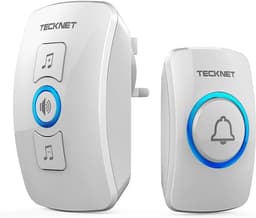
Best value
TECKNET TECKNET Wireless Doorbell, Wall Plug-in Door Bells Wireless Cordless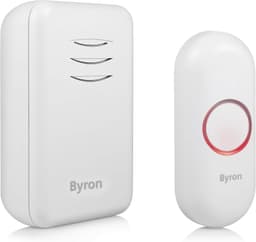
On this page
What the metre on the box means
Walls, metal, and a second chime
Testsieger
TECKNET TECKNET Wireless Doorbell, IP65 Waterproof Twin Plug-in Door Bell, BlackFlats and other people's doors
Interference, and what not to add
Common questions
Will a 400 m doorbell work through brick walls?
Why does it ring near the door and not upstairs?
Do I need a second receiver?
Is range a problem in a flat?
Can neighbours set my chime off?
Does a metal door block a wireless doorbell?
Will a kinetic button reach as far?
Related pages
Sources
Public UK sources from the research digest. Listings dated 15 October 2026. Page updated 16.10.2026.
- Ofcom IR 2030: short-range device power and duty cycle (retrieved 15.10.2026)
- Ofcom: short-range devices and interference protection (retrieved 15.10.2026)
- Ofcom: radio spectrum and the law (retrieved 15.10.2026)
- Electrical Equipment (Safety) Regulations 2016, regulation 35 (retrieved 15.10.2026)
- RNID: doorbells and hearing (retrieved 15.10.2026)
- Expert Reviews: wireless doorbell range claims (10 January 2025) (retrieved 15.10.2026)
- Which?: faulty products and the Consumer Rights Act 2015 (retrieved 15.10.2026)