Best wireless doorbell UK: two sockets or one
You want one wireless doorbell for a normal UK house, and the star ratings will not tell you whether you have two spare sockets or whether the chime has to come into the garden. The best wireless doorbell UK, in this set, is conditional. Our [wireless doorbell comparison](/hub/electronic-surveillance/wireless-doorbell) covers eight amazon.co.uk radio kits on 15 October 2026, from £9.00 to £22.94. The top pick is the twin plug-in TECKNET 470867 when two sockets are free and you want a flash-only mode. The best value, if one socket is enough, is the TECKNET WA658 at £9.99. A qualifying purchase can earn us a commission at no extra cost to you.
You want one wireless doorbell for a normal UK house, and the star ratings will not tell you whether you have two spare sockets or whether the chime has to come into the garden.
You want one wireless doorbell for a normal UK house, and the star ratings will not tell you whether you have two spare sockets or whether the chime has to come into the garden. The best wireless doorbell UK, in this set, is conditional. Our wireless doorbell comparison covers eight amazon.co.uk radio kits on 15 October 2026, from £9.00 to £22.94. The top pick is the twin plug-in TECKNET 470867 when two sockets are free and you want a flash-only mode. The best value, if one socket is enough, is the TECKNET WA658 at £9.99. A qualifying purchase can earn us a commission at no extra cost to you.
Our top picks
| Badge | Product | Receivers in box | Silent or flash-only | Weather rating | Note | Price | Offer |
|---|---|---|---|---|---|---|---|
| Best overall |  TECKNET TECKNET Wireless Doorbell, IP65 Waterproof Twin Plug-in Door Bell, Black | 2 | Yes | IP65 | 7.8 | about £17.99 | View offer |
| Best value |  TECKNET TECKNET Wireless Doorbell, Wall Plug-in Door Bells Wireless Cordless | 1 | Yes | IP65 | 7.6 | about £9.99 | View offer |
| Alternative |  Byron Byron Wireless Portable Doorbell, 150 m Range, 16 Melodies, IP44 | 1 | No | IP44 | 6.0 | about £9.00 | View offer |

Best overall
TECKNET TECKNET Wireless Doorbell, IP65 Waterproof Twin Plug-in Door Bell, Black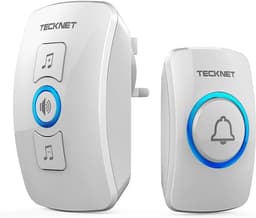
Best value
TECKNET TECKNET Wireless Doorbell, Wall Plug-in Door Bells Wireless Cordless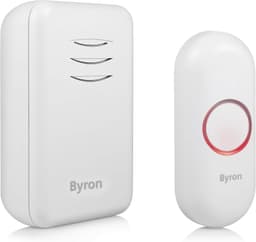
On this page
Top pick for two rooms
Best value if one socket is enough
Testsieger
TECKNET TECKNET Wireless Doorbell, IP65 Waterproof Twin Plug-in Door Bell, BlackWhen the portable Byron or the kinetic button wins
Who should leave this shortlist
Common questions
Which wireless doorbell should I buy for a normal UK house?
Is the dearest kit in this set the best?
What if I only have one free socket?
What if I need to carry the chime into the garden?
Is the kinetic button the better buy because it has no battery?
Do I need a video doorbell instead?
Related pages
Sources
Public UK sources from the research digest. Listings dated 15 October 2026. Page updated 16.10.2026.
- Ofcom IR 2030: short-range device power and duty cycle (retrieved 15.10.2026)
- Ofcom: short-range devices and interference protection (retrieved 15.10.2026)
- Ofcom: radio spectrum and the law (retrieved 15.10.2026)
- Electrical Equipment (Safety) Regulations 2016, regulation 35 (retrieved 15.10.2026)
- RNID: doorbells and hearing (retrieved 15.10.2026)
- Expert Reviews: wireless doorbell range claims (10 January 2025) (retrieved 15.10.2026)
- Which?: faulty products and the Consumer Rights Act 2015 (retrieved 15.10.2026)