Plug-in or battery wireless doorbell
You are in a UK hallway with one spare socket, or a garden room with none, and the box only says wireless. A plug in or battery wireless doorbell is three jobs: the cell in the button, the batteries in the chime, and the mains plug. A kinetic button is a third column, and it still needs a powered receiver. This page chooses the power. It does not rank the eight kits in our [wireless doorbell comparison](/hub/electronic-surveillance/wireless-doorbell), from £9.00 to £22.94 on amazon.co.uk on 15 October 2026. Products Compared did not laboratory-test them. A qualifying purchase can earn us a commission at no extra cost to you.
You are in a UK hallway with one spare socket, or a garden room with none, and the box only says wireless.
You are in a UK hallway with one spare socket, or a garden room with none, and the box only says wireless. A plug in or battery wireless doorbell is three jobs: the cell in the button, the batteries in the chime, and the mains plug. A kinetic button is a third column, and it still needs a powered receiver. This page chooses the power. It does not rank the eight kits in our wireless doorbell comparison, from £9.00 to £22.94 on amazon.co.uk on 15 October 2026. Products Compared did not laboratory-test them. A qualifying purchase can earn us a commission at no extra cost to you.
Our top picks
| Badge | Product | Receiver power | Receivers in box | Silent or flash-only | Note | Price | Offer |
|---|---|---|---|---|---|---|---|
| Best overall |  TECKNET TECKNET Wireless Doorbell, IP65 Waterproof Twin Plug-in Door Bell, Black | Plug-in | 2 | Yes | 7.8 | about £17.99 | View offer |
| Best value |  TECKNET TECKNET Wireless Doorbell, Wall Plug-in Door Bells Wireless Cordless | Plug-in | 1 | Yes | 7.6 | about £9.99 | View offer |
| Alternative |  Byron Byron Wireless Portable Doorbell, 150 m Range, 16 Melodies, IP44 | Battery | 1 | No | 6.0 | about £9.00 | View offer |

Best overall
TECKNET TECKNET Wireless Doorbell, IP65 Waterproof Twin Plug-in Door Bell, Black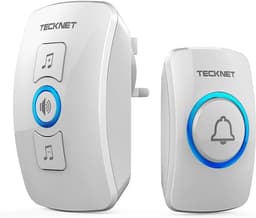
Best value
TECKNET TECKNET Wireless Doorbell, Wall Plug-in Door Bells Wireless Cordless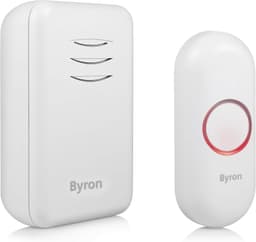
On this page
Plug-in chimes
Battery chimes
Testsieger
TECKNET TECKNET Wireless Doorbell, IP65 Waterproof Twin Plug-in Door Bell, BlackWhich one, on what condition
Common questions
Should I buy a plug-in or a battery doorbell?
What is a kinetic doorbell?
Will a plug-in chime work in a power cut?
Which kits do not include the chime batteries?
Do two plug-in receivers mean two sockets?
Is the self-powered button quieter?
Related pages
Sources
Public UK sources from the research digest. Listings dated 15 October 2026. Page updated 16.10.2026.
- Ofcom IR 2030: short-range device power and duty cycle (retrieved 15.10.2026)
- Ofcom: short-range devices and interference protection (retrieved 15.10.2026)
- Ofcom: radio spectrum and the law (retrieved 15.10.2026)
- Electrical Equipment (Safety) Regulations 2016, regulation 35 (retrieved 15.10.2026)
- RNID: doorbells and hearing (retrieved 15.10.2026)
- Expert Reviews: wireless doorbell range claims (10 January 2025) (retrieved 15.10.2026)
- Which?: faulty products and the Consumer Rights Act 2015 (retrieved 15.10.2026)