How to install a wireless doorbell
You have a button, a chime, and a door, and you would rather not open the consumer unit for a job that only needs a fixing and a socket you already have. This is how to install a wireless doorbell of the radio-chime kind: height, screws or tape, where the sounder sits, and the point where you stop. It is not a price ranking. Our [wireless doorbell comparison](/hub/electronic-surveillance/wireless-doorbell) is the table of eight amazon.co.uk kits. Products Compared editorial team, 15 October 2026. We did not time these fits in a lab. A qualifying purchase can earn us a commission at no extra cost to you.
You have a button, a chime, and a door, and you would rather not open the consumer unit for a job that only needs a fixing and a socket you already have.
You have a button, a chime, and a door, and you would rather not open the consumer unit for a job that only needs a fixing and a socket you already have. This is how to install a wireless doorbell of the radio-chime kind: height, screws or tape, where the sounder sits, and the point where you stop. It is not a price ranking. Our wireless doorbell comparison is the table of eight amazon.co.uk kits. Products Compared editorial team, 15 October 2026. We did not time these fits in a lab. A qualifying purchase can earn us a commission at no extra cost to you.
Our top picks
| Badge | Product | Receiver power | Weather rating | Receivers in box | Note | Price | Offer |
|---|---|---|---|---|---|---|---|
| Best overall |  TECKNET TECKNET Wireless Doorbell, IP65 Waterproof Twin Plug-in Door Bell, Black | Plug-in | IP65 | 2 | 7.8 | about £17.99 | View offer |
| Best value |  TECKNET TECKNET Wireless Doorbell, Wall Plug-in Door Bells Wireless Cordless | Plug-in | IP65 | 1 | 7.6 | about £9.99 | View offer |
| Alternative |  Wesstun Wireless Doorbell, 300m Range with 39 Melodies, Easy Install, Black | Plug-in | IP67 claimed | 1 | 7.5 | about £9.99 | View offer |

Best overall
TECKNET TECKNET Wireless Doorbell, IP65 Waterproof Twin Plug-in Door Bell, Black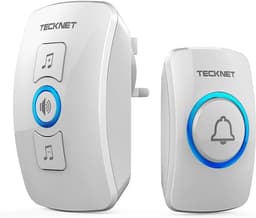
Best value
TECKNET TECKNET Wireless Doorbell, Wall Plug-in Door Bells Wireless Cordless
Alternative
Wesstun Wireless Doorbell, 300m Range with 39 Melodies, Easy Install, BlackOn this page
Tape only when the surface is smooth and dry
Testsieger
TECKNET TECKNET Wireless Doorbell, IP65 Waterproof Twin Plug-in Door Bell, BlackPut the chime where you will hear it
Stop before the consumer unit
Common questions
Where do I put the button?
Should I use tape or screws?
Where do I plug the chime in?
I rent. Do I need to drill?
What do I do with the old wired doorbell?
When do I call an electrician?
Can I fit this on a metal door?
Related pages
Sources
Public UK sources from the research digest. Listings dated 15 October 2026. Page updated 16.10.2026.
- Ofcom IR 2030: short-range device power and duty cycle (retrieved 15.10.2026)
- Ofcom: short-range devices and interference protection (retrieved 15.10.2026)
- Ofcom: radio spectrum and the law (retrieved 15.10.2026)
- Electrical Equipment (Safety) Regulations 2016, regulation 35 (retrieved 15.10.2026)
- RNID: doorbells and hearing (retrieved 15.10.2026)
- Expert Reviews: wireless doorbell range claims (10 January 2025) (retrieved 15.10.2026)
- Which?: faulty products and the Consumer Rights Act 2015 (retrieved 15.10.2026)