Independent comparisons. We may earn from shop links. More info

IP65 or IP66 floodlight: what the two digits mean on a PIR head

Updated: 23 October 2026

You are comparing a wall head that says IP66 with a sensor that says IP54, and the title still says waterproof. Those words are not the same claim. An IP65 or IP66 floodlight is a code from IEC 60529: one digit for dust, one for water, sometimes on the body and a lower pair on the detector. This page is only that code. It does not rank the eleven heads, and it does not tell you where to aim. The scored listings are on the [LED floodlight with motion sensor](/hub/electronic-surveillance/led-floodlight-with-motion-sensor) comparison. We read amazon.co.uk listings saved around 19 October 2026. We did not spray-test these heads.

You are comparing a wall head that says IP66 with a sensor that says IP54, and the title still says waterproof. Those words are not the same claim.

Our top picks

Steinel Steinel FL 1400 S, 4000 K

Best overall

Steinel Steinel FL 1400 S, 4000 K
8.6/10about £55.49
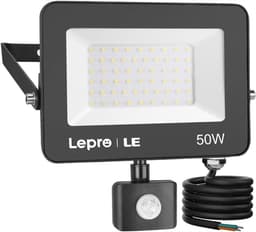
Lepro Lepro 50 W, 4,200 lm

Alternative

Lepro Lepro 50 W, 4,200 lm
8.1/10about £19.98
MEIKEE MEIKEE 25 W, 2,100 lm

Best value

MEIKEE MEIKEE 25 W, 2,100 lm
8.4/10about £17.99
On this page

Two digits, not an adjective

A 5 is dust protected and a 6 is dust-tight. For water, 4 is splashing, 5 is jets, 6 is powerful jets, and 7 is temporary immersion. Glamox and the CSA Group describe the IEC 60529 jet tests as laboratory sprays, not a pond. IP65 is jets. IP66 is the heavier jet. Neither is IP67. Waterproof is an adjective until digits are printed. Vision Lighting treats IP65 as usual on an exposed wall, IP66 for a hose or driving rain, and IP44 under a real cover. IK is impact, not rain. UKCA is a conformity mark, not a weather grade. Where this sits in the buying order is on the buying guide.

When the detector is a lower code

Integral LED notes that many PIR floods rate the sensor lower than the body. Lepro prints IP65 on the lamp and IP54 on the detector, which is splash, not the jet test. MEIKEE and CLY print IP66 on the head and IP65 on the sensor. The Jsdoin title does that split, while the table says IP65. Rain hits the cowling first, and a jet-rated body does not upgrade the lens. One UK Lepro review says the unpacked label was not the IP65 in the bullets. If carton and listing disagree, read the product in your hand. A wet-PIR review does not rewrite the cell, and the cell does not prove that review wrong.
Steinel Steinel FL 1400 S, 4000 K

Testsieger

Steinel Steinel FL 1400 S, 4000 K
8.6/10about £55.49

What this set actually prints

Lepro is IP65 / IP54, with that label dispute and mentions of water. MEIKEE and CLY are IP66 on the body and IP65 on the sensor. Jsdoin’s title says the same split and its table says IP65. Hoysicy, GRIFEMA, NATPOW and both vighep rows print a single IP66. One vighep review found the PIR full of water after a few months. The FL 1400 S has no IP cell and the Amazon table says not water resistant, with CE, RoHS and UKCA on the spec line. A B&Q page prints IP44. We are not copying that over the Amazon cell. The XLED table says water resistant. One review names IP44, and there is no IP66 cell. Do not promote a blank to IP65 because the head is sold as outdoor.

Quote the code you can see

Quote a code only when it is printed, including a second code if the sensor differs. A single IP66 does not prove the sensor was in the test. A review of one wet winter does not invent a new grade either. Nuisance and aim stay on the driveway security light PIR page. A qualifying purchase can earn a commission at no extra cost to you.

Common questions

What do the two digits mean?
The first digit is dust, 5 or 6. The second is water: 4 splash, 5 jets, 6 powerful jets, 7 temporary immersion. IP65 and IP66 are both jet tests. The difference is how hard the IEC 60529 spray is. One digit is not a full code.
Is IP66 waterproof in the sense of a pond?
No. IP66 is a powerful-jet test. Immersion is digit 7, as in IP67. Hose-down on a wall is not a puddle, a pond, or a flooded light well. The word waterproof does not add that digit.
Why is the sensor a lower code?
The detector is a separate opening. Integral LED describes the pattern. Lepro is IP65 on the body and IP54 on the sensor. MEIKEE and CLY are IP66 and IP65. The lower number is the one on the lens.
Is IP44 enough on an open gable?
IP44 is splash. Trade notes treat it as a covered-porch grade, not the default on an open gable. Here it is a B&Q print for the FL 1400 S and one review’s name for the XLED, not an agreed Amazon cell.
Does waterproof on amazon.co.uk equal an IP code?
No. The FL 1400 S table says not water resistant and has no IP cell, even with UKCA on the spec line. The XLED says water resistant without a number. Missing digits mean the grade is not stated.
Which kept rows print a split code?
Lepro prints IP65 and IP54. MEIKEE and CLY print IP66 and IP65. Jsdoin’s title prints that split and the table says IP65. Hoysicy, GRIFEMA, NATPOW and vighep print a single IP66. The Steinel tables do not print an IP pair.
Why do reviews still report water in an IP66 PIR?
A code is a lab claim. A review is one seal. Vighep prints IP66 and one review found the PIR full of water. Prefer a printed sensor code and a large sample. That still does not guarantee a dry lens.
Where does UKCA sit relative to IP?
UKCA is a market mark, not a water test. The FL 1400 S can list UKCA and still say not water resistant. Quote IP65 or IP66 only when those characters are printed.

Related pages

Sources

Public UK sources from the digest first, then the amazon.co.uk listings compared on this page. Prices and stars were taken on 19 October 2026.

  1. Approved Document P (2013 PDF) (retrieved 19 October 2026)
  2. GOV.UK, Approved Document P (retrieved 19 October 2026)
  3. GOV.UK, artificial light nuisances (retrieved 19 October 2026)
  4. GOV.UK, using the UKCA marking (retrieved 19 October 2026)
  5. Lighting Products Regulations 2021, Schedule 12 (retrieved 19 October 2026)
  6. GOV.UK, energy labelling of products (retrieved 19 October 2026)
  7. Glamox, IP classification (retrieved 19 October 2026)
  8. IET, Part P frequently asked questions (retrieved 19 October 2026)