Independent comparisons. We may earn from shop links. More info

Driveway security light PIR: light the tarmac, not the street

Updated: 23 October 2026

A 50 W head high on the gable looks like the obvious driveway security light PIR until the beam fills a neighbour’s bedroom and every pedestrian on the pavement restarts the timer. You need the drive lit, the main beam aimed down, and the sensor watching your ground rather than the footway. This page is about place and aim. It does not repeat the buying checklist, and it does not teach the dial procedure step by step. The comparison is the [LED floodlight with motion sensor](/hub/electronic-surveillance/led-floodlight-with-motion-sensor) table. We used amazon.co.uk listings from around 19 October 2026, GOV.UK nuisance guidance, and council lighting notes. We did not measure lux on a drive.

A 50 W head high on the gable looks like the obvious driveway security light PIR until the beam fills a neighbour’s bedroom and every pedestrian on the pavement restarts the timer.

Our top picks

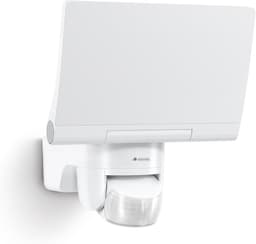
Steinel Steinel FL 1400 S, 4000 K

Best overall

Steinel Steinel FL 1400 S, 4000 K
8.6/10about £55.49
MEIKEE MEIKEE 25 W, 2,100 lm

Best value

MEIKEE MEIKEE 25 W, 2,100 lm
8.4/10about £17.99
On this page

Cover the drive, not the street

Aim the beam down onto the tarmac you use. Test Valley’s note, echoed by several councils, asks for a main beam at or below about 70° from the wall, and not so high that covering the drive throws light across the boundary. That 70° figure is a rule of thumb, not a measurement of these ASINs and not a national lux limit. Tilted up at eaves height, the beam clears your bonnet and lands opposite. Drop it until the bright patch ends at your gate. These heads have little optical control, so do not point them at windows. Two lower heads usually beat one lamp on the gable if one head would light the street. Where height is stated, Hoysicy and Jsdoin say 3–5 m, and the CLY 3.5–5 m.

Aim the PIR separately if you can

Point the sensor at your own ground, not the pavement. A field that includes the footway trips for every passer-by. Walk the drive, then walk the pavement. If the pavement lights the lamp, the sensor is too wide. The FL 1400 S includes cover plates. XLED reviews say the lamp and the PIR aim independently. Many cheaper heads move both together. The Lepro PIR has only a little up-and-down tilt. The CLY distance is factory-set from 0–12 m, so you solve pavement trips by where the whole unit points. A hedge or a bin at the boundary moves, and a wide field treats it as a person. Dial steps are on the how to set a PIR floodlight page.
Steinel Steinel FL 1400 S, 4000 K

Testsieger

Steinel Steinel FL 1400 S, 4000 K
8.6/10about £55.49

How much light this set actually claims

Council notes still mention 150 W halogens and about 1,000–2,000 lumens. That is not a legal cap, and it does not describe a 10,000 lumen LED. Porch scale here is MEIKEE at 2,100 lumens or GRIFEMA at 2,200. Drive-scale claims are Lepro and Hoysicy at 4,200, or Jsdoin at 4,500. The vighep twin claims 3,000 lumens a head but only to 5 m. NATPOW’s 10,000 lumens is a glare risk on a terrace unless a downward beam still ends on your ground. The FL 1400 S at 1,375 lumens (4000 K) and the XLED at 1,550 (3000 K) will not copy a 4,200 lumen patch. They are easier beside a close window. 6500 K looks harsh on wet tarmac. 3000 K falls off more kindly.

Complaints and the stop line

In England a security light can be a statutory nuisance if it unreasonably interferes with a home. GOV.UK sets no lux level, and a council can still serve an abatement notice. Scotland, Wales and Northern Ireland are not that page. Re-aim and shorten the time before you argue about a number nobody has set. Keep the sensor off the pavement. Where the head allows it, point the lamp off the glass while the PIR still sees the drive. XLED reviews describe that split. Take a 10,000 lumen head off the wall if you cannot aim it down. Do not answer a complaint by raising the lamp. Which row fits is on the best LED floodlight with motion sensor page. A qualifying purchase can earn a commission at no extra cost to you.

Common questions

How many lumens for a drive?
Context notes talk about a few thousand lumens for a drive. Lepro and Hoysicy claim 4,200, Jsdoin 4,500, MEIKEE 2,100. NATPOW’s 10,000 is not the terraced-drive default. The Steinel heads at 1,375 and 1,550 lumens are a shorter, warmer wash.
How do I stop the beam hitting a window?
Tilt the glass down until the bright patch stops at your boundary, about 70° or less from the wall in council leaflets. On an XLED, aim the lamp off the window and leave the sensor on the drive. Raising a combined head sends the beam further opposite.
How do I stop pavement walkers triggering it?
Walk the footway. If the lamp comes on, narrow the field with cover plates, as on the FL 1400 S, or re-aim so the edge is your hedge. The CLY will not let you turn the 0–12 m distance down. TIME only shortens each trip.
Is there a legal lux limit in England?
No. GOV.UK names no lux threshold for a security light that may be a statutory nuisance. Councils can still investigate. The 70° aim and older lumen comments are guidance. The test is the effect on the home.
Should the lamp and the sensor point the same way?
The lamp should hit the tarmac and the sensor the route you walk. A combined bracket forces one aim. Reviews give the XLED separate aim, and the FL 1400 S has swivel and cover plates. If you cannot split them, use a lower output.
Is a 10,000 lumen twin a driveway default?
No. It is a large-yard claim on 18 reviews. Use NATPOW only where a downward beam finishes on your ground. For one bay, Lepro’s 4,200 lumens, or a Steinel at 1,375–1,550, is the ordinary match.
What do I do if a neighbour complains?
Re-aim down, shorten the on-time, and take the sensor off the pavement. If you still light their room, use a lower claim or a shielded fitting. England does not require a lux number before a council can treat the light as a nuisance.

Related pages

Sources

Public UK sources from the digest first, then the amazon.co.uk listings compared on this page. Prices and stars were taken on 19 October 2026.

  1. Approved Document P (2013 PDF) (retrieved 19 October 2026)
  2. GOV.UK, Approved Document P (retrieved 19 October 2026)
  3. GOV.UK, artificial light nuisances (retrieved 19 October 2026)
  4. GOV.UK, using the UKCA marking (retrieved 19 October 2026)
  5. Lighting Products Regulations 2021, Schedule 12 (retrieved 19 October 2026)
  6. GOV.UK, energy labelling of products (retrieved 19 October 2026)
  7. Glamox, IP classification (retrieved 19 October 2026)
  8. IET, Part P frequently asked questions (retrieved 19 October 2026)