Independent comparisons. We may earn from shop links. More info

LED floodlight with motion sensor: what to check before you buy

Updated: 23 October 2026

You are at an outdoor junction box with a dead halogen, and the titles shout 20 W, 30 W or 50 W. Watts do not tell you how much light lands on the path, whether the sensor sleeps in daylight, or whether the flying lead reaches the box. An LED floodlight with motion sensor here is a mains PIR head with a lumen claim, a colour, a night-only control, a printed IP code, and a cable often shorter than the photo. The scored table is on the [LED floodlight with motion sensor](/hub/electronic-surveillance/led-floodlight-with-motion-sensor) comparison. Figures are from amazon.co.uk listings saved around 19 October 2026. We did not lab-test these heads.

You are at an outdoor junction box with a dead halogen, and the titles shout 20 W, 30 W or 50 W.

Our top picks

Steinel Steinel FL 1400 S, 4000 K

Best overall

Steinel Steinel FL 1400 S, 4000 K
8.6/10about £55.49
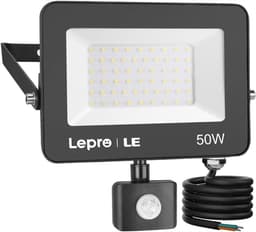
Lepro Lepro 50 W, 4,200 lm

Alternative

Lepro Lepro 50 W, 4,200 lm
8.1/10about £19.98
MEIKEE MEIKEE 25 W, 2,100 lm

Best value

MEIKEE MEIKEE 25 W, 2,100 lm
8.4/10about £17.99
On this page

Lumens and colour, not watts

A 50 W LED is not a 50 W halogen, and two 50 W rows here do not match. Lepro and Hoysicy claim 4,200 lumens, Jsdoin 4,500, and GRIFEMA 2,200 from 20 W. Harbro Electrical’s note is to compare lumens, not watts. APM’s bands are planning context, not a test of these ASINs: about 800–1,500 lumens for a porch, 1,500–2,500 for a passage, and 2,500–4,000 for a driveway. MEIKEE at 2,100 and GRIFEMA at 2,200 sit with a side door. The vighep remote at 2,400 and the CLY at 2,820 sit around a passage. Claims of 4,200–4,500 lumens are driveway figures. NATPOW’s 10,000 lumen claim sits outside those bands. Most rows are 6000–6500 K. Lepro is 5000 K, the FL 1400 S is 4000 K, and the XLED is 3000 K.

Night-only, time, and range

LUX decides whether the sensor may switch on. TIME is how long it stays on after the last movement. SENS is range or eagerness. Lepro and GRIFEMA use three dials. MEIKEE steps are 10, 45, 120 and 600 seconds. CLY steps are 5, 45, 120 and 600 seconds, plus day or night. The vighep remote uses steps of 10 seconds, 30 seconds, 2, 5 and 10 minutes, and a night mode below 20 lux. The CLY’s 0–12 m distance is factory-set, so a pavement in the field is an aiming problem. MEIKEE and CLY state up to 12 m. The vighep twin states only up to 5 m. A long TIME looks stuck because each detection restarts the timer. The walk-test is on the how to set a PIR floodlight page.
Steinel Steinel FL 1400 S, 4000 K

Testsieger

Steinel Steinel FL 1400 S, 4000 K
8.6/10about £55.49

Printed IP and the flying lead

The weather line is a code, not the word waterproof. Lepro prints IP65 on the body and IP54 on the detector. MEIKEE, CLY and the Jsdoin title print IP66 on the body and IP65 on the sensor; the Jsdoin table says IP65. Hoysicy, GRIFEMA, NATPOW and both vighep rows print IP66. The FL 1400 S table says not water resistant and has no IP cell. A B&Q page prints IP44, which we have not copied over the Amazon cell. The XLED table says water resistant, and one review names IP44. Read the digits on the IP65 or IP66 floodlight page. Hoysicy states 50 cm. GRIFEMA lists 30 cm; reviews measure about 20–28 cm. Vighep and CLY state 1 m. NATPOW states 1.5 m. Jsdoin claims 2 m; reviews say under 1.4 m.

What the listing does not prove

NATPOW’s 4.9 from 18 reviews is a thinner record than MEIKEE’s 4.2 from 11,130, or Jsdoin’s 3.9 from 2,319. Efficiency letters do not line up: some say A+, others E or F. MEIKEE and CLY say there is no earth wire. That describes the head, not the circuit in the wall. If you cannot identify the conductors, if the joint would sit in the rain, or if you are adding a new outdoor circuit, stop and use a competent person. Approved Document P puts fixed outdoor lighting in scope in England. A straight swap on an existing circuit is generally not notifiable, but it still has to be safe. This checklist does not name a winner. A qualifying purchase through our links can earn a commission at no extra cost to you.

Common questions

Should I buy on watts or lumens?
Buy on the lumen claim, then colour, night-only control, the printed code and the lead. The FL 1400 S claims 1,375 lumens at 14.7 W and the Jsdoin 4,500 at 50 W. A shared wattage is not a shared output.
How many lumens for a porch versus a drive?
APM’s bands, as planning context, put a porch around 800–1,500 lumens, a passage around 1,500–2,500, and a driveway around 2,500–4,000. MEIKEE at 2,100 sits with a side door. Lepro at 4,200 sits with a drive. NATPOW’s 10,000 is not a legal cap.
What do TIME, SENS and LUX actually change?
TIME is the on-period after the last movement, and a new crossing restarts it. LUX is the darkness threshold. SENS is range, where a control exists. The CLY distance is preset. The vighep remote names a night mode below 20 lux.
Is IP66 better than IP65 on a house wall?
IP66 is the stronger jet test. IP65 is still jets, and neither means standing water. Trade notes often treat IP65 as enough on an ordinary wall. Lepro prints IP65 on the body and IP54 on the sensor, and the lower code is the part rain hits first.
How long a flying lead do I need?
Enough to reach a dry box, often more than half a metre through a cavity wall. Hoysicy states 50 cm. GRIFEMA lists 30 cm and reviews measure about 20–28 cm. CLY and vighep state 1 m. NATPOW states 1.5 m. Jsdoin claims 2 m; reviews say under 1.4 m.
Does “no earth wire” change my supply cable?
No. That line describes the MEIKEE or CLY head, not your supply. A green-and-yellow core may still need parking in the box. If you cannot identify the conductors, or the joint would be in the rain, stop.
Is a 4.9 from 18 reviews stronger than a 4.2 from 11,000?
No. NATPOW’s 4.9 from 18 ratings tells you less than MEIKEE’s 4.2 from 11,130. A large sample shows the failures. Eighteen reviews have not shown a winter.

Related pages

Sources

Public UK sources from the digest first, then the amazon.co.uk listings compared on this page. Prices and stars were taken on 19 October 2026.

  1. Approved Document P (2013 PDF) (retrieved 19 October 2026)
  2. GOV.UK, Approved Document P (retrieved 19 October 2026)
  3. GOV.UK, artificial light nuisances (retrieved 19 October 2026)
  4. GOV.UK, using the UKCA marking (retrieved 19 October 2026)
  5. Lighting Products Regulations 2021, Schedule 12 (retrieved 19 October 2026)
  6. GOV.UK, energy labelling of products (retrieved 19 October 2026)
  7. Glamox, IP classification (retrieved 19 October 2026)
  8. IET, Part P frequently asked questions (retrieved 19 October 2026)