Independent comparisons. We may earn from shop links. More info

How to set a PIR floodlight so it is not on all day

Updated: 23 October 2026

The head is already on the wall, and it is either blazing at noon or refusing to go out after you have walked inside. Before you decide the sensor is dead, the usual cause is a long TIME, a LUX dial left on daylight, or an override left on from the wall switch. This page is how to set a PIR floodlight: a walk-test, then dusk, then the point where you stop. It is not a ranking of the eleven heads, and it is not a Part P essay. The comparison is the [LED floodlight with motion sensor](/hub/electronic-surveillance/led-floodlight-with-motion-sensor) table. We used amazon.co.uk listings saved around 19 October 2026 and public UK setting notes. We did not lab-test the heads.

The head is already on the wall, and it is either blazing at noon or refusing to go out after you have walked inside.

Our top picks

Steinel Steinel FL 1400 S, 4000 K

Best overall

Steinel Steinel FL 1400 S, 4000 K
8.6/10about £55.49
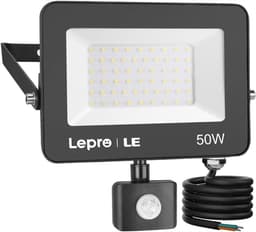
Lepro Lepro 50 W, 4,200 lm

Alternative

Lepro Lepro 50 W, 4,200 lm
8.1/10about £19.98
MEIKEE MEIKEE 25 W, 2,100 lm

Best value

MEIKEE MEIKEE 25 W, 2,100 lm
8.4/10about £17.99
On this page

The three controls

TIME is how long the lamp stays on after the last movement. A new crossing restarts it, so ten minutes on a busy path looks stuck. LUX toward the sun fires in daylight, which is right for a test and wrong at 3 pm. Toward the moon, it waits for dusk. SENS is range. Future House Store treats those three names as the usual analogue start. Lepro and GRIFEMA print TIME, SENS and LUX. MEIKEE steps through 10, 45, 120 and 600 seconds. CLY steps through 5, 45, 120 and 600 seconds, with day or night. The vighep remote adds a night mode below 20 lux. One XLED review says there is no SENS control. What the listing offers is on the buying guide.

Walk-test, then dusk

Walk-test in daylight. Set TIME to its shortest step and LUX fully toward the sun, then walk across the field, not straight at the lens. Timeguard’s Suretime manuals use that order: minimum time, daylight LUX, walk, then put TIME back. If the lamp stays dark, you may be outside the field, SENS may be at minimum, or the head may be a CLY whose 0–12 m distance is factory-set. Once a crossing lights it and it drops out, set LUX at the evening you want it to start. Turn toward the moon until a walk just triggers. Most dials show symbols, not lux. The vighep listing names a night mode below 20 lux. You still cross the drive.
Steinel Steinel FL 1400 S, 4000 K

Testsieger

Steinel Steinel FL 1400 S, 4000 K
8.6/10about £55.49

Stuck on, override, and water

A lamp that never goes dark may be doing what the dials say. TIME at 8 or 10 minutes, with people, a cat or a shrub in the field, restarts all evening. Set the shortest time and walk away. If it goes out, it was busy. DCC Electrics describes a wall-switch override that an isolation of about 30 seconds clears: switch off, wait, switch on, let the head settle. Full sun means LUX is still on daylight. Water is the case dials will not fix. Reviews describe a vighep PIR full of water, condensation in a Lepro, and water in an XLED sensor. That is a return. Do not open a wet enclosure on a live circuit.

When to stop

Isolate at the consumer unit before any joint, and prove the circuit is dead. If you cannot tell brown from blue from green-and-yellow, stop. Approved Document P puts fixed outdoor lighting in scope in England. A like-for-like swap on an existing circuit is generally not notifiable, and it still has to be safe. A new circuit is a different job. Stop if the joint would sit in the rain, if the lamp glows with the switch off, or if the supply is not yours to alter. A no-earth-wire line on MEIKEE or CLY describes the lamp, not permission to cut the earth. A 30 cm or 50 cm lead that cannot reach a dry box is the same stop. Glare belongs on the driveway security light PIR page. A qualifying purchase can earn a commission at no extra cost to you.

Common questions

What do TIME, SENS and LUX do?
TIME is the on-time after the last movement, and a new crossing restarts it. LUX is how dark it must be. SENS is range, where fitted. Lepro and GRIFEMA use dials. MEIKEE and CLY use buttons. One XLED review says there is no SENS dial.
How do I walk-test in daylight?
Set TIME to minimum and LUX to the sun mark, then walk across the field. The lamp should come on and drop out. Then lengthen TIME and set LUX at dusk. If it stays dark, check range and that you are not adjusting a CLY distance the listing says is preset.
Why is the light on all day?
LUX is usually still on daylight, or a wall-switch override has latched it. Turn LUX toward the moon and switch off for about 30 seconds. If it stays on in sun after that, treat it as a fault. Water in the PIR is one such fault.
Why does it never turn off?
TIME is long and something in the field keeps restarting it. Set the shortest time and leave. If it then goes out, re-aim or shorten the range. If the shortest time still holds it on, isolate and treat it as a failed output or a wet sensor.
How do I set dusk without a lux number?
At the light level you want, turn LUX from the sun toward the moon until a crossing walk just triggers. Most dials here are symbols. The vighep remote is the listing that names a night mode below 20 lux.
What if there is no SENS dial?
Aim the head. The CLY’s 0–12 m distance is already set, so pavement trips are fixed by the bracket. An XLED with no SENS dial can still aim lamp and sensor separately. The vighep remote puts sensitivity on the handset.
When do I stop and isolate?
Stop if you cannot identify the conductors, if the joint would be in the rain, if the lamp glows with the switch off, or if you are adding a circuit. Thirty seconds off at the switch can clear an override. Opening a wet PIR is not that step.

Related pages

Sources

Public UK sources from the digest first, then the amazon.co.uk listings compared on this page. Prices and stars were taken on 19 October 2026.

  1. Approved Document P (2013 PDF) (retrieved 19 October 2026)
  2. GOV.UK, Approved Document P (retrieved 19 October 2026)
  3. GOV.UK, artificial light nuisances (retrieved 19 October 2026)
  4. GOV.UK, using the UKCA marking (retrieved 19 October 2026)
  5. Lighting Products Regulations 2021, Schedule 12 (retrieved 19 October 2026)
  6. GOV.UK, energy labelling of products (retrieved 19 October 2026)
  7. Glamox, IP classification (retrieved 19 October 2026)
  8. IET, Part P frequently asked questions (retrieved 19 October 2026)