Independent comparisons. We may earn from shop links. More info

Portable power station vs home battery

Updated: October 2026

You searched for solar storage and you may want two different things: a box you carry to a pitch, or a battery that keeps the lights on from the consumer unit. A portable power station vs home battery comparison is mostly a scale check. The five Solar storage listings claim about 75 Wh to 111 Wh and cost £69.99 to £129.99. A home battery is usually several kilowatt-hours, fitted to the house, and notified to the network. One product plugs into appliances. The other feeds circuits. A purchase through the main table can earn a commission at no extra cost to you. The five boxes are on the [Solar storage comparison](/hub/electrical-equipment/solar-storage).

You searched for solar storage and you may want two different things: a box you carry to a pitch, or a battery that keeps the lights on from the consumer unit.

Our top picks

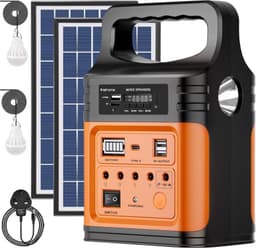
MARBERO MARBERO M82 88.8Wh

Best overall

MARBERO MARBERO M82 88.8Wh
8.4/10about £93.99
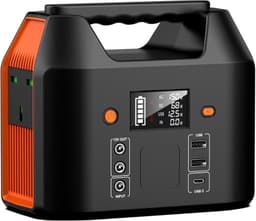
SinKeu SinKeu R150 99Wh

Rank 3

SinKeu SinKeu R150 99Wh
7.3/10about £109.99
On this page

Two products, one phrase

A watt-hour and a kilowatt-hour are a thousandfold apart, and the phrase hides that. Set 100 Wh beside a 5 kWh home battery and the home battery is about fifty times the energy. Their advice puts a 5 kWh system around £4,600, inside about £1,500 to £10,000. Those are installer prices, not amazon.co.uk shelf prices. None of these boxes runs a kettle or a lighting circuit. If the job is a weekend of phones, stay with the carry-box and use the portable power station buying guide.

Sockets on the box, or circuits in the wall

A portable station feeds the sockets on its own case. You plug a charger into USB, or a small mains load into the single AC outlet, and the house wiring is not involved. That is why these products do not need a network-operator form. A changeover is not a lead from a camping box into a double socket. Back-feeding is the version that looks clever and is refused. Powering Homes tells you not to feed the house through a BS 1363 socket. Charging the portable’s adapter from a wall socket is the opposite action, and the listings tell you to do that. Do not push the station’s output into a wall socket.
MARBERO MARBERO M82 88.8Wh

Testsieger

MARBERO MARBERO M82 88.8Wh
8.4/10about £93.99

What you must notify, and what stays prohibited

Fixed battery storage is notifiable. GOV.UK’s register-your-device guidance says you tell the distribution network operator. Guides often label the routes G98 and G99. These five carry-boxes are not that system. Do not call them G98 compliant because they are small. They are small because they never connect. Ofgem’s August 2026 decision on DCRP/MP/26/02 says plug-in electricity storage remains prohibited. SI 2026/848 defines a plug-in microgenerator in a way that leaves out devices designed to import from the installation, store it, and supply it back later. PAS 63100:2024 is for stationary batteries in dwellings. Portable appliances at or under 150 Wh sit outside that scope.

Which path to take

Take the carry-box if the loads are things you plug into the box: phones, a torch, USB lights, and one appliance under 80 W, 100 W or 150 W. You do not file a G98 form. The best small solar generator page assigns those jobs. How the adapter and a small panel refill the box is on how to charge a power station with solar. Take the installer path if you want roof solar for the evening or selected circuits in a power cut. Budget from the Energy Saving Trust band, not from £129.99. Do not buy the portable for now and plug it into the wall to imitate that installer.

Common questions

Can this power station run the house in a power cut?
No. These listings store about 75–111 Wh and, where they have a mains socket, offer 80–150 W continuous. A house wants circuits, kilowatt-hours, and a changeover an electrician has installed. A portable can charge phones and run one small plug-in device. It does not keep the ring main, the lights, or the boiler controls alive.
Can I plug it into a wall socket so the lights stay on?
No. Charging the station from a wall socket is how you refill it. Pushing it back into a wall socket to feed the house is back-feeding. Safety notes tell you not to do that with a BS 1363 socket. It can liven wiring that should be dead. Use the sockets on the box, or have a proper changeover installed.
What does a home battery cost compared with £130?
Energy Saving Trust puts a 5 kWh home system around £4,600, inside about £1,500 to £10,000, and another page puts a common spend around £5,000 to £8,000. Those are installed figures. The five portables are £69.99 to £129.99 because they store about a hundred watt-hours and do not connect to the consumer unit.
When do G98 and G99 apply?
They apply when storage connects to the network through the installation. GOV.UK says battery storage is notifiable: connect and notify on the small route, permission before installation on the larger route. These carry-boxes never make that connection, so they are not G98 compliant by being under 150 Wh. Do not file a camping battery as a home storage system.
Does PAS 63100 cover a 99 Wh power station?
No. PAS 63100:2024 is for stationary batteries in dwellings. Portable appliances at or under 150 Wh are outside that scope. A 99 Wh station is not banned by that document and is not installed to it. A wall battery is inside the stationary scope and is still wired to BS 7671.
Is plug-in solar the same as a power station?
No. The 2026 rule change is about a small generator that connects in a defined way. SI 2026/848 leaves out storage that imports from the installation to supply later, and Ofgem says plug-in electricity storage remains prohibited. A power station that only feeds its own sockets is a third thing: you charge it, then plug appliances in. It is not a licence to energise the house.

Related pages

Sources

Public UK sources are listed below. Shelf prices, watt-hour lines and star counts are the amazon.co.uk figures on the saved listings for B0F7DYT8M8, B0F59B6ZYS, B0F58Z48BX, B09MZ736CZ and B0H4LW9HJM.

  1. Energy Saving Trust: battery storage (retrieved October 2026)
  2. Energy Saving Trust: storing energy (retrieved October 2026)
  3. GOV.UK: register energy devices (retrieved October 2026)
  4. Ofgem decision on DCRP/MP/26/02 (retrieved October 2026)
  5. SI 2026/848, plug-in microgeneration (retrieved October 2026)
  6. Electrical Equipment (Safety) Regulations 2016, regulation 35 (retrieved October 2026)
  7. PAS 63100:2024, battery energy storage systems (retrieved October 2026)