Independent comparisons. We may earn from shop links. More info

Pure sine vs modified sine inverter

Updated: October 2026

You are choosing an inverter for a fridge in a van, a drill in a shed, or a laptop charger on a leisure battery, and two listings at similar watts claim different waves. Pure sine vs modified sine inverter, for this amazon.co.uk set, is that appliance decision. Pure sine is the closer match to UK mains at 230 V and 50 Hz. Modified sine is a stepped approximation, and a few pages here claim both. The Products Compared editorial team compared the waveform lines on 21 October 2026. There was no oscilloscope test. Shelf prices stay on the [2000W power inverter comparison](/hub/electrical-equipment/2000w-power-inverter). A qualifying purchase through our amazon.co.uk links can earn a commission at no extra cost to you.

You are choosing an inverter for a fridge in a van, a drill in a shed, or a laptop charger on a leisure battery, and two listings at similar watts claim different waves.

Our top picks

On this page

What each wave is for

Pure sine is the default when the load cares about the shape of the mains: a fridge or a compressor, a microwave’s motor load, audio, and tools with electronics or speed control. Energian calls modified unsuitable for fridges, microwaves, and many motors. REUK puts fridges, pumps, and many tools on pure sine. Willgen says brushed motors may run hotter or noisier on modified. Modified sine is what retailers still sell for simpler kit. Shield Batteries’ SEC UK sheet describes it as suitable for heat elements and many external adaptors. Caravan Tech, for a unit that is not an ASIN here, will name laptops, phone chargers, and low-watt heat, and does not recommend variable-speed tools, larger fridges, microwaves, compressors, audio, or medical kit. SEC says many computers work and that you should ask the laptop maker if you are unsure.

A kettle can be heat; a fridge is the other class

A kettle, a heater, or a toaster is mostly a resistive heat load. Modified sine can be enough if the continuous watts cover the element. A fridge is the other class. VeftBltrem’s own bullet says it is not compatible with compressors, refrigerators, air conditioners, and pumps. Microwave cooking watts are below the electrical input, so check the appliance plate. Cornwall Solar Company, a UK retailer rather than a lab, says modified sine can add heat on an inductive load.

What this set actually states

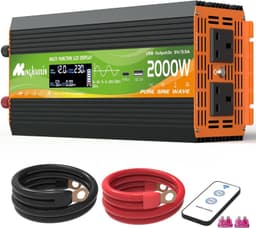
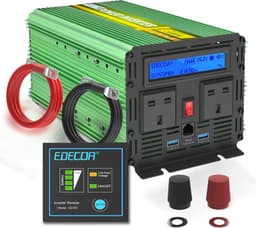
Modified sine, stated without a second wave on the same page, appears on EDECOA, VeftBltrem, and Delousiber. EDECOA states modified sine, 24 V only, and 2000 W continuous, with a 4000 W peak quoted for 10 ms. VeftBltrem rates 420 W. Delousiber rates 900 W continuous. Waveform does not promote the smaller figure. Pure sine stated without an internal contradiction appears on Renogy, DATOUBOSS, MINGHAOXIN, JARXIOKE, and both FT feiteeng listings. Renogy, DATOUBOSS, and MINGHAOXIN also state 2000 W continuous. A pure-sine title on Bekasa’s 900 W bullet is still a 900 W claim. EDECOA is £169 and DATOUBOSS is £119.99, so the modified unit is not the cheap one here. Job limits are on the best 2000W power inverter UK page. A camper that needs the wave and a leisure bank together is the 2000W inverter for a motorhome page.

When the listing contradicts itself

VexNook calls itself pure sine in a bullet and modified sine in the specification, and a UK review says the cables melted on a 400 W fan. Luqixcey says pure sine in the specification, and a UK review says the output is modified and that usable power is about 800 W. Leave both unmatched to a fridge, a charger you care about, or a tool with a speed dial. Pick pure sine for a fridge, a charger, audio, and tools with electronics. Use modified sine for simple heat only at the continuous watts the listing actually states. If the bullet and the specification disagree, do not average them.

Common questions

What is the practical difference on a 230 V 50 Hz appliance?
UK mains are a smooth 230 V supply at 50 Hz. Pure sine is the closer match to that shape. Modified sine is a stepped approximation. Motors, compressors, audio, and some chargers are where UK retailers tell you to prefer pure sine. This set was not measured on a scope.
Will a modified sine unit run a fridge or a compressor fridge?
Do not plan on it. Energian, REUK, and Caravan Tech point fridges and compressors away from modified sine, and VeftBltrem’s listing says it is not compatible with refrigerators, compressors, and pumps. If the van needs a fridge, use a listing that states pure sine, and still read the continuous watts.
What about a kettle, a heater, or a toaster?
Those are heat loads, and modified sine can be enough if the continuous rating covers the element. A 420 W bullet does not cover a typical kettle. A modified unit that states 2000 W continuous, such as the EDECOA on 24 V, is a different case from a 900 W Delousiber.
What about a laptop charger, a TV, or a speaker?
Speakers and other audio are a pure-sine job if you care about noise. SEC says many computers and external adaptors run on modified sine, and that you should ask the manufacturer when you are unsure. Do not treat a medical device as covered by either wave on the evidence in this file.
What about a drill or a tool with speed control?
Brushed tools may run hotter or noisier on modified sine, which is Willgen’s warning. Variable-speed tools and tools with electronics belong on pure sine. A charger brick for a cordless tool is closer to the laptop question, and the tool maker is the reference if the pack will not charge.
Does pure sine remove the need to check continuous watts?
No. Bekasa states pure sine and rates 900 W continuous. VeftBltrem states modified sine and rates 420 W. JARXIOKE states pure sine and does not give a continuous figure separate from 2000 W. A smooth wave at the wrong power still shuts down.

Related pages

Sources

Public UK sources from the research digest, last checked on 21 October 2026. Shelf prices and star lines are the amazon.co.uk figures in the display file.

  1. Electrical Equipment (Safety) Regulations 2016 (retrieved 21 October 2026)
  2. UKCA and CE recognition in Great Britain (retrieved 21 October 2026)
  3. Approved Document P (retrieved 21 October 2026)
  4. Electrical Safety First Best Practice Guide 2, isolation (retrieved 21 October 2026)
  5. ENA EREC G98 Issue 2 (2025) (retrieved 21 October 2026)
  6. Renogy PUH1 2000 W inverter manual (retrieved 21 October 2026)
  7. REDARC RS3 pure sine inverter install manual (retrieved 21 October 2026)
  8. 12 Volt Planet, Victron Phoenix 12 V 2000 VA (retrieved 21 October 2026)