Independent comparisons. We may earn from shop links. More info

How to install a 1500W inverter on a leisure battery

Updated: October 2026

You have a hard-wired 1500 W inverter and the lighter plug from the old trip still in mind. How to install a 1500W inverter, on a 12 V leisure battery, is mostly about the current on the DC side: a fuse on the positive next to the battery, a short cable that can carry it, the right polarity, and a first switch-on with nothing plugged in. The [1500W power inverter comparison](/hub/electrical-equipment/1500w-power-inverter) is where you choose the unit. This page is the connection order and the point where you stop. It is not a BS 7671 design. A qualifying purchase can earn us a commission at no extra cost to you.

You have a hard-wired 1500 W inverter and the lighter plug from the old trip still in mind.

Our top picks

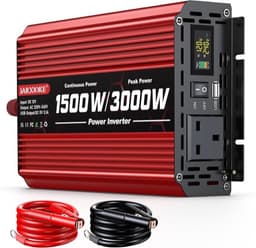
JARXIOKE JARXIOKE 1500W

Best overall

JARXIOKE JARXIOKE 1500W
9.6/10about £109.99
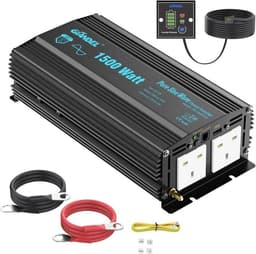
EDECOA EDECOA 1500RUK

Best value

EDECOA EDECOA 1500RUK
8.4/10about £99
On this page

What a 1500 W load asks of a 12 V battery

Divide the watts by the battery voltage before you look at the plug on the inverter. At 12 V, 1500 W is 125 A if the inverter were perfectly efficient. It is not. A working rule of thumb for this class, once losses are included, is about 140–150 A. These figures are arithmetic. They are not a clamp-meter reading we took on any ASIN in the set. A cigarette lighter cannot carry that. 12 Volt Planet’s published example for a 1000 W inverter is already 25 mm² cable, with the fuse on the positive lead next to the battery. Runtime, and what a kettle does to a leisure battery, sits on the 1500W inverter for a campervan page.

Cable, fuse, and a dry place to mount it

Keep the DC run short, then size the copper for the current, then fit the fuse at the battery end of the positive lead. For a short run at this power, a rule of thumb you will see repeated in UK 12 V guides is about 25–35 mm². That is a rule of thumb for a short run, not the only legal size. Put the fuse on the positive, within a short distance of the battery terminal. Choose the fuse rating from the cable you actually fitted, not from the 3000 W peak printed on the carton. Do not sit the inverter in the gas locker because the cable would be shorter. Which waveform you bought does not change any of this copper. That choice is on the pure sine versus modified sine page.
JARXIOKE JARXIOKE 1500W

Testsieger

JARXIOKE JARXIOKE 1500W
9.6/10about £109.99

Connection order and the first switch-on

Isolate the battery before you touch the posts. Fit the fuse holder on the positive lead close to the battery, with the fuse out until the rest of the run is finished. Connect red to battery positive and black to battery negative, and do not swap them to see if it runs. Leave the inverter switched off, then check that no appliance is in the AC socket. Put the fuse in, restore the battery, and switch the inverter on with the AC socket empty. You want a steady ready light, not a beep. A beep on these units is the usual sign of overload or low battery voltage. Do not feed a caravan hook-up inlet from the inverter. If the inverter has a remote, the remote does not replace the fuse.

When this stops being a DIY job

Stop when the job becomes the van’s 230 V system. Adding inverter output to a consumer unit, fitting an RCD, changing a hook-up inlet, or tying the inverter into site mains is work for a competent person. The Health and Safety Executive’s electricity guidance puts vehicle equipment outside BS 7671 and still expects you to use equipment within its rating. Also stop if the listing’s input voltage does not match the bank, if the output table says 110 V, or if you cannot identify positive and negative. The 1500W inverter buying guide is the check for waveform, output voltage, and the cable the box actually contains, before you buy the fuse.

Common questions

Can I plug a 1500 W inverter into the cigarette lighter?
No, not for a load near 1500 W. A lighter socket is a low-current outlet with its own small fuse. Listings in this set that weigh about 360–960 g and take power from a vehicle DC socket are accessories for light loads. They are not a hard-wired install. Use a fused cable at the leisure battery, or do not use the inverter at full rating.
Where does the fuse go?
On the positive lead, close to the battery terminal, so the cable run to the inverter is protected. 12 Volt Planet describes that position, and the Club’s 12 V guidance says to fuse each circuit. Size the fuse to the cable you fitted, from the cable maker’s table. Leave the fuse out until the polarity is checked and the inverter is switched off.
How long should the DC cables be?
Short enough that the inverter can sit near the battery. Several listings ship about 50–60 cm. EDECOA’s cable-length field says 2 m. A short lead is the right length only if the case really is next to the battery, and only if the cross-section matches the current. A longer route needs a voltage-drop calculation, not a thicker guess.
What do I do with the earth wire?
Fit it to the point the manufacturer specifies in the manual for that model. Giandel’s box line includes an earth wire. EDECOA’s box line includes a ground cable. The wire is not optional trim, and it is not a substitute for the DC fuse on the positive.
When do I stop and call an electrician?
Stop for a consumer unit, an RCD, a hook-up inlet, or any join between the inverter and site mains. Also stop if you are doing the work as a job, if you cannot match 12 V or 24 V to the battery, or if the first switch-on faults and you cannot explain it as overload or a flat battery. DC cabling to a leisure battery, with the right fuse and a short run, is the part this guide is for.

Related pages

Sources

Public UK sources from the research digest, last checked on 22 October 2026. Shelf prices and star lines are the amazon.co.uk figures in the display file.

  1. Electrical Equipment (Safety) Regulations 2016, GOV.UK (retrieved 22 October 2026)
  2. Regulation 35, SI 2016/1101 (retrieved 22 October 2026)
  3. HSE, Electricity at Work Regulations guidance (retrieved 22 October 2026)
  4. Caravan and Motorhome Club, 12-volt wiring (retrieved 22 October 2026)
  5. Caravan and Motorhome Club, mains installation (retrieved 22 October 2026)
  6. SEC UK power inverters info sheet (retrieved 22 October 2026)
  7. 12 Volt Planet FAQs (retrieved 22 October 2026)
  8. Quasar inverter selection guide (retrieved 22 October 2026)