Independent comparisons. We may earn from shop links. More info

1500W inverter for a campervan: battery first, then the kettle

Updated: October 2026

You want a hairdryer or a kettle in the campervan, and a 1500W inverter for a campervan looks, on the label, as if it should do both. It can, for a few minutes, only if that one appliance’s own label is inside 1500 W continuous and the leisure battery can actually supply the current. Named picks sit on the [best 1500W inverter](/hub/electrical-equipment/1500w-power-inverter/sub/1500w-power-inverter-best) page. The full table is the [1500W power inverter comparison](/hub/electrical-equipment/1500w-power-inverter). It is not a lab test. A qualifying purchase can earn us a commission at no extra cost to you.

You want a hairdryer or a kettle in the campervan, and a 1500W inverter for a campervan looks, on the label, as if it should do both.

Our top picks

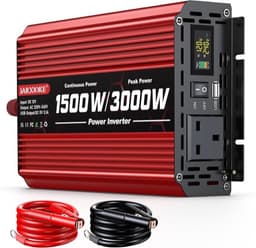
JARXIOKE JARXIOKE 1500W

Best overall

JARXIOKE JARXIOKE 1500W
9.6/10about £109.99
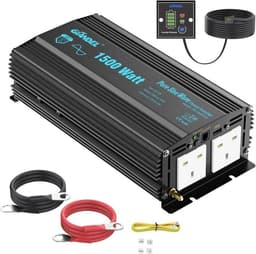
EDECOA EDECOA 1500RUK

Best value

EDECOA EDECOA 1500RUK
8.4/10about £99
On this page

Kettle, hairdryer, microwave, fridge

Match one appliance at a time to the continuous rating. Read the watts on the appliance, not the peak printed on the inverter. A kettle whose label is already around 1500 W sits on the continuous line for the whole time it boils. SEC’s UK sheet treats that kind of heat load as something modified sine can often run, and it treats a motor, a compressor, or a microwave as a reason to buy a pure-sine spec. If the kettle’s label is above 1500 W, this inverter is too small. EDECOA’s own bullet limits 3000 W to under 10 ms. Use that as a picture of how short a peak can be, not as a test of every brand. Modified versus pure sine is set out in the 1500W inverter buying guide.

What 1500 W does to a 12 V leisure battery

Take 1500 W, allow for about 85% efficiency, and divide by 12 V. That is about 147 A, inside the wider rule of thumb of 140–150 A. At 24 V the current is about half. A 100 Ah leisure battery will not give up every amp-hour at that rate. Mastervolt publishes a note of at least 160 Ah for its own 12 V, 1500 W true-sine model. Treat that as that maker’s minimum for that model, not as a universal law. Do not use the starter battery as the inverter bank. Fuse position and the connection order are on the how to install a 1500W inverter page.
JARXIOKE JARXIOKE 1500W

Testsieger

JARXIOKE JARXIOKE 1500W
9.6/10about £109.99

Hook-up limits are not the inverter rating

On a UK site the mains pedestal is often 16 A, and sometimes 10 A or less. The Club’s mains guidance uses about 1 kW as roughly 5 A at 230 V. That cap limits the site socket. It does not mean a 1500 W inverter will run happily because the post says 16 A. Off hook-up, the battery is the supply. Do not try to help a weak post by feeding the hook-up inlet from the inverter. Use the hook-up for the kettle when you have a post, and keep the inverter for a short heat load you have already matched to a large enough bank.

Listings that show up in van reviews

EDECOA 1500RUK, at £99.00, is the modified-sine row where reviewers mention a hairdryer in a motorhome. The same review file includes cut-out well under a sustained 1500 W. Giandel at £149.99 is 12 V, with a UK outlet in the highlight, and the spec table says pure sine. Novopal’s 24 V listing is the one to open only when the bank is 24 V. CDDCWZ, SKJJM, and CMANLNYK do not belong in a camper kettle plan. Their spec output is 110 V AC. VexNook and Luqixcey, under 1 kg, are vehicle-socket units.

Common questions

Will 1500 W run a kettle in a van?
Only if the kettle’s label is within 1500 W continuous, and only for as long as the leisure battery can supply the current at 12 V. A kettle at that rating is on the limit for the whole boil, not a light load. If the kettle’s label is above 1500 W, the inverter is too small. Peak watts on the carton do not add the missing power.
What battery size is a sensible minimum?
Treat about 160 Ah at 12 V as a published minimum from Mastervolt for its own 12 V, 1500 W true-sine model, not as a law for every brand. A 100 Ah battery is below that note. Use a leisure bank at or above that kind of capacity, and still expect a kettle to be a short, heavy event. At 24 V the current is lower, and the battery still has to be a leisure bank matched to a 24 V inverter.
Is a starter battery acceptable?
No. The Club’s 12 V guidance keeps the starter battery for starting and the leisure battery for habitation loads. An inverter at this rating can pull well over 100 A. Fit the inverter to the leisure battery, with its own fuse, and leave the starter leads alone.
Do I need pure sine for a compressor fridge?
Yes, if you are following SEC’s split: motors and compressors are the pure-sine case, and a kettle or a simple heater is where modified sine can be enough. EDECOA is the modified-sine listing in this set with motorhome hairdryer comments and with cut-out complaints. Giandel and the Novopal rows say pure sine in the spec table. Pure sine does not shrink the battery current.
Where should the inverter sit?
Next to the leisure battery, so the DC cables stay short, in a dry place with room for the fan to move air. The Club’s 12 V guidance treats the gas locker as the wrong place for this equipment because of fire risk. Supplied leads of 50–60 cm only make sense if the case really is that close.
Which listings in this set are not van inverters?
CDDCWZ, SKJJM, and CMANLNYK, because the spec output is 110 V AC. Do not buy them for a UK kettle in a camper, even if a bullet says UK compatible. VexNook and Luqixcey are lightweight vehicle-socket units, under 1 kg. A camper install in this set means a hard-wired 12 V or 24 V unit with 230 V or 240 V on the output line, and one appliance at a time inside the continuous rating.

Related pages

Sources

Public UK sources from the research digest, last checked on 22 October 2026. Shelf prices and star lines are the amazon.co.uk figures in the display file.

  1. Electrical Equipment (Safety) Regulations 2016, GOV.UK (retrieved 22 October 2026)
  2. Regulation 35, SI 2016/1101 (retrieved 22 October 2026)
  3. HSE, Electricity at Work Regulations guidance (retrieved 22 October 2026)
  4. Caravan and Motorhome Club, 12-volt wiring (retrieved 22 October 2026)
  5. Caravan and Motorhome Club, mains installation (retrieved 22 October 2026)
  6. SEC UK power inverters info sheet (retrieved 22 October 2026)
  7. 12 Volt Planet FAQs (retrieved 22 October 2026)
  8. Quasar inverter selection guide (retrieved 22 October 2026)