Drill bit for porcelain tiles
The spare says porcelain, or the box says fully vitrified, and a ceramic spear is the wrong tool for that tile. This is the drill bit for porcelain tiles once you can name the material, from the Products Compared editorial team on 15 October 2026. It uses BS EN 14411, UK tile-shop guidance, and the amazon.co.uk listings in our [tile drill bits](/hub/drilling-and-accessories/tile-drill-bit) comparison. A purchase through our links can earn us a commission at no extra cost to you. Leave the generic spear in the drawer. A diamond set around £6 can still stop after a millimetre. Ceramic and glass stay on [diamond or carbide tile drill bit](/hub/drilling-and-accessories/tile-drill-bit/sub/tile-drill-bit-diamond-vs-carbide).
The spare says porcelain, or the box says fully vitrified, and a ceramic spear is the wrong tool for that tile.
The spare says porcelain, or the box says fully vitrified, and a ceramic spear is the wrong tool for that tile. This is the drill bit for porcelain tiles once you can name the material, from the Products Compared editorial team on 15 October 2026. It uses BS EN 14411, UK tile-shop guidance, and the amazon.co.uk listings in our tile drill bits comparison. A purchase through our links can earn us a commission at no extra cost to you. Leave the generic spear in the drawer. A diamond set around £6 can still stop after a millimetre. Ceramic and glass stay on diamond or carbide tile drill bit.
Our top picks
| Badge | Product | Bit type | Sizes | Shank | Note | Price | Offer |
|---|---|---|---|---|---|---|---|
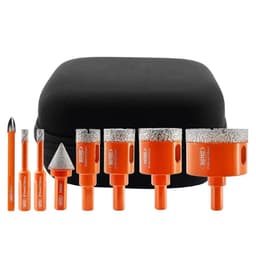
| Best overall |  BGTEC BGTEC 8-piece diamond hole-saw kit, up to 50 mm | Diamond hole-saw kit | 6, 6, 20, 25, 35, 50 mm | Straight | 6.9 | about £39.99 | View offer |
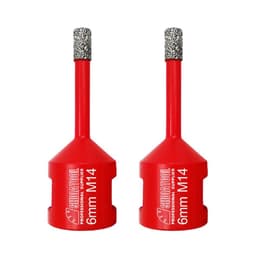
 SHDIATOOL SHDIATOOL 6 mm M14 dry diamond cores, pack of 2 | Dry diamond core | 6 mm only | M14 thread | 8.8 | about £15.99 | View offer | |
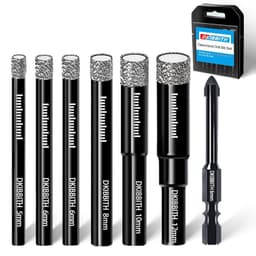
| Alternative |  DKIBBITH DKIBBITH 7-piece dry diamond set, 5–12 mm | Dry diamond core set | 5, 6, 6, 8, 10, 12 mm plus 6 mm masonry | Round | 8.3 | about £12.99 | View offer |
On this page
How you tell it is porcelain
What Topps and Homebuilding tell you to use
The carbide bit that is not a spear
What the listings in this comparison actually show
Depth, dust, and the floor you should not practise on
Common questions
How do you know a tile is porcelain?
Can you use a carbide spear if the packet says porcelain?
Is a dry wax diamond bit enough for a few bathroom holes?
Will a £6 diamond set get through porcelain?
What diameter do you need, and how deep is the diamond?
Related pages
Sources
Public UK sources and the amazon.co.uk listings in this comparison. Last checked 15 October 2026.
- Topps Tiles: what type of drill bit for tiles (retrieved 15 October 2026)
- Homebuilding: drilling into tile without cracking (retrieved 15 October 2026)
- Screwfix: how to drill into tile (retrieved 15 October 2026)
- Bosch Professional GB: EXPERT HEX-9 hard ceramic drill bit (retrieved 15 October 2026)
- HSE CIS36: silica dust when drilling and coring (retrieved 15 October 2026)
- BSI: BS EN 14411 ceramic tiles (retrieved 15 October 2026)
- Rubi: porcelain tile drill bits (retrieved 15 October 2026)
- amazon.co.uk listing B0751893Y2 (QWORK), checked 15 October 2026 (retrieved 15 October 2026)