Independent comparisons. We may earn from shop links. More info

Diamond or carbide tile drill bit

Updated: October 2026

You are holding two packets that both claim to drill tile, one a pointed spear and one a short hollow rim. This page chooses a diamond or carbide tile drill bit from the Products Compared editorial team on 15 October 2026. It uses public UK shop pages and the amazon.co.uk listings in our [tile drill bits](/hub/drilling-and-accessories/tile-drill-bit) comparison. A purchase through our links can earn us a commission at no extra cost to you. For glazed ceramic and a plug hole, UK shops point you at a tungsten-carbide spear. For porcelain or stone, they point you at diamond. Bosch HEX-9 is the carbide exception, and none of these twelve listings is that bit.

You are holding two packets that both claim to drill tile, one a pointed spear and one a short hollow rim.

Our top picks

On this page

Two shapes, not two brands

A tungsten-carbide spear scores the glaze and cuts a hole the size of its point. A diamond core grinds a ring and leaves a small slug. Rubi keeps a tungsten spade for small ceramic holes and off porcelain. UK Drills uses the same map: a spear for ceramic, glass, and mirrors, and diamond when a spear skates or the material is porcelain, hard tile, or granite. Toolstation says a carbide spear is for glazed ceramic and plugs, diamond is for dense porcelain and stone, and a hole cutter is the larger circle for a pipe or a waste. The word tile on both packets does not tell you the shape. Hole size and shank sit on the tile drill bit buying guide.

Ceramic wall tiles and a plug hole

For a glazed ceramic wall and a plug of about 6 mm, the usual shop answer is a tungsten-carbide spear. Topps says the point burns flat on porcelain. Homebuilding, quoting Mark Irving, puts a spear on ceramic and keeps it off porcelain. Toolpak's glass and tile bit at Toolstation excludes toughened glass, and wants low speed, water, and hammer mode off. QWORK, SabreCut, and HPMAISON are the spear sets here. Meccion's 14 mm cross carbide is already past a normal wall plug. A spear around £7 can be the sensible packet when the box says ceramic. If the box says porcelain, or fully vitrified, this section is the wrong family.

Porcelain, stone, and the carbide exception

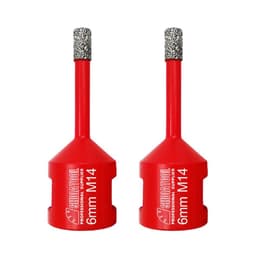
For porcelain or natural stone, Topps, Toolstation, UK Drills, and Homebuilding point you at diamond. Topps separates wax-filled dry diamond bits from bits you keep wet. Rubi describes wet diamond as grinding porcelain by friction, and prints 400–1,000 rpm for that wet method on its own page. Bosch sells the HEX-9, a fine-ground carbide, for hard tiles and porcelain, dry, on rotary only. "Up to 10x" compares it only with Bosch CYL-9. A spear whose title prints porcelain is still a spear. The 0.5% water-absorption check sits on the drill bit for porcelain tiles page. Reviews here still show diamond failing: DKIBBITH loses the leading edge, Zeeorymn both works when cooled and fails to cut, and SHDIATOOL burns if you force it.

Glass, mirrors, and a larger hole

Carbide spears are sold for ordinary glass and mirrors. Toolpak excludes toughened glass. A snapped tip in one Keratobleem review is a reason to wear eye protection. If the pane is toughened, or you cannot tell, leave it. Spears here run about 3–12 mm, with Meccion at 14 mm. An opening of 20–50 mm is a diamond hole saw: BGTEC and LEKOMESH. SHDIATOOL and LEKOMESH are M14, so they need an adapter or a grinder. Wax-filled dry bits follow a different cooling rule from Rubi's wet bits. ZNXIMER's "60% less friction" is a listing sentence, not a measurement.

What the twelve listings are, by family

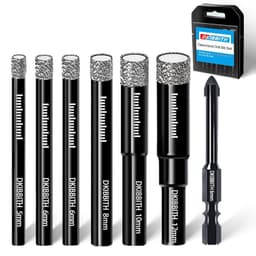
The carbide family here is QWORK, SabreCut, HPMAISON, Keratobleem, and Meccion. The diamond family is DECKRKAT, DKIBBITH, Zeeorymn, ZNXIMER, SHDIATOOL, BGTEC, and LEKOMESH. Who each row is for stays on the best tile drill bit page. Neither family drills the brick behind the tile. Once the glaze and the body are through, change bit, and leave hammer off until the tile bit is out. One condition covers the buy: a ceramic plug hole takes a carbide spear; porcelain or stone takes diamond, unless you have a HEX-9 and you follow Bosch's instructions for that bit.

Common questions

Is a carbide spear enough for a bathroom wall tile?
Yes, when the tile is glazed ceramic and the hole is a plug. Topps Tiles, Toolstation, UK Drills, and Homebuilding point a tungsten-carbide spear at that job, and they say the point burns flat on porcelain. If the spare's box says fully vitrified, a spear around £7 is the wrong family.
Why do diamond bits cost more if a spear is about £7?
You are paying for a grinding rim on a harder material. Entry sets here sit around £5.99 to £7.49, and the hole-saw kits reach about £39.99. On a ceramic plug the extra pounds are optional. On porcelain, Topps names diamond, and reviews here still include rims that lose their edge.
Is a hole saw the same as a 6 mm bit?
A 6 mm spear or core is a plug hole. A hole saw is a larger circle for a pipe or a waste. Spears here run about 3–12 mm, while BGTEC reaches 50 mm and LEKOMESH goes to 35 mm plus a 50 mm chamfer. The £39.99 kit is the wrong basket for a towel rail.
Does wax inside a diamond bit replace water?
Wax is the coolant in many dry diamond bits, and it melts as the rim heats. Topps treats that dry bit as different from a wet bit you keep wet for the whole cut. You still stop when the tile is hot. Rubi's wet method is a separate instruction on Rubi's own page.
Which carbide bit do the diamond-only pages leave out?
Bosch HEX-9. Bosch Professional sells it for hard tiles and porcelain, dry, on rotary only. "Up to 10x" compares it with Bosch CYL-9 only. Toolstation sells a HEX-9 set for hard tiles including porcelain. None of the twelve rows here is that bit.

Related pages

Sources

Public UK sources and the amazon.co.uk listings in this comparison. Last checked 15 October 2026.

  1. Topps Tiles: what type of drill bit for tiles (retrieved 15 October 2026)
  2. Homebuilding: drilling into tile without cracking (retrieved 15 October 2026)
  3. Screwfix: how to drill into tile (retrieved 15 October 2026)
  4. Bosch Professional GB: EXPERT HEX-9 hard ceramic drill bit (retrieved 15 October 2026)
  5. HSE CIS36: silica dust when drilling and coring (retrieved 15 October 2026)
  6. BSI: BS EN 14411 ceramic tiles (retrieved 15 October 2026)
  7. Rubi: porcelain tile drill bits (retrieved 15 October 2026)
  8. amazon.co.uk listing B0751893Y2 (QWORK), checked 15 October 2026 (retrieved 15 October 2026)