Wet or dry diamond core bit
You are in a UK hallway with a barrel in one hand and a tile cup in the other, and the listings do not describe the same job. One bullet says wet or dry, another says best used dry, and a small bit tells you not to add water while a coated cup says use water. Those are three cooling methods under one phrase, and the wrong one glazes the diamonds, packs the barrel, or leaves slurry with nowhere to go. The shortlist, with prices, is the [diamond core bit comparison](/hub/drilling-and-accessories/diamond-core-bit). The decision here is which cooling the material allows, and which sentence you must not turn into a water feed.
You are in a UK hallway with a barrel in one hand and a tile cup in the other, and the listings do not describe the same job.
You are in a UK hallway with a barrel in one hand and a tile cup in the other, and the listings do not describe the same job. One bullet says wet or dry, another says best used dry, and a small bit tells you not to add water while a coated cup says use water. Those are three cooling methods under one phrase, and the wrong one glazes the diamonds, packs the barrel, or leaves slurry with nowhere to go. The shortlist, with prices, is the diamond core bit comparison. The decision here is which cooling the material allows, and which sentence you must not turn into a water feed.
Our top picks
| Badge | Product | Cooling | Family | Fitment | Note | Price | Offer |
|---|---|---|---|---|---|---|---|
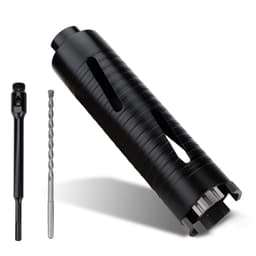
| Best overall |  MOXPIFY MOXPIFY 52 mm core bit set | Wet or dry, no feed stated | Masonry barrel set | 1/2 in BSP + SDS | 8.1 | about £31.99 | View offer |
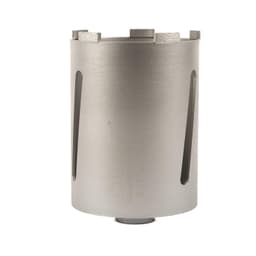
| Alternative |  Starrett Starrett BMC117 117 mm dry core | Dry cutting | Dry diamond core bit | Straight shank, bit only | 7.9 | about £29.91 | View offer |
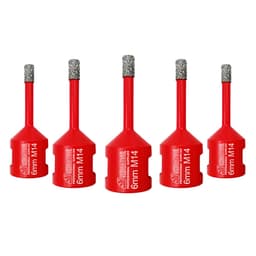
 SHDIATOOL SHDIATOOL 6 mm dry diamond tile bits | Wax, no added water | Vacuum-brazed tile bits | M14 grinder | 9.2 | about £28.99 | View offer |
On this page
Three cooling methods under one name
Facing brick and block, or dense concrete
What these listings actually print
What a wet or dry bullet does not prove
Common questions
When is dry coring the method HSE describes?
When does concrete need a water feed rather than a spray bottle?
What is wax cooling, and which bits name it?
Does wet or dry on a barrel mean the drill has a water swivel?
Should you add water to a wax-filled 6 mm bit?
What dust kit does a dry brick hole need?
Related pages
Sources
Public UK sources from the research digest, last checked on 20 October 2026. Shelf prices and star lines are the amazon.co.uk figures in the display file.
- HSE CN8, Diamond coring/hole cutting (retrieved 20 October 2026)
- HSE CN3, Drilling with hand-held rotary tools (retrieved 20 October 2026)
- HSE CIS65, Cable detection and isolation (retrieved 20 October 2026)
- BSI, BS EN 13236:2019 superabrasive safety (retrieved 20 October 2026)
- Mexco wax-filled M14 diamond tile drills (retrieved 20 October 2026)
- Premier P6-ATDM14 diamond tile drill sheet (retrieved 20 October 2026)
- Armeg dry-core instructions (retrieved 20 October 2026)
- Toolstation diamond core drill bits (retrieved 20 October 2026)