Independent comparisons. We may earn from shop links. More info

How to use a diamond core bit

Updated: 2026-10-23

You are in a British house with one hole to cut and a diamond bit you already own: a masonry barrel for a waste outlet in brick, or a small cup for a tap hole in porcelain. Hammer mode knocks the diamonds off the rim, dust left in the barrel overheats the bond, and a cup with no centre drill skates on the glaze. This is how to use a diamond core bit in rotation only, from the checks before the trigger to the point where the wall needs a professional. Choosing the bit starts with the [diamond core bit comparison](/hub/drilling-and-accessories/diamond-core-bit).

You are in a British house with one hole to cut and a diamond bit you already own: a masonry barrel for a waste outlet in brick, or a small cup for a tap hole in porcelain.

Our top picks

On this page

Before the trigger

If you cannot say where the cables run, HSE guidance on concealed services (CIS65) says to isolate the power before you drill a wall. A detector beep on the mark is a stop. Mark the centre and set the drill to rotation only. Hammer, impact and percussion stay off. The rim grinds. A hammer blow chips the segments and leaves a smooth lip that only polishes. CN8 wants M or H class extraction for dry brick where you can fit it, and a water feed plus a slurry plan for wet concrete. Past about 15 to 20 minutes of dry coring in a day, it points to protection rated APF 20. The box overrides a general preference for water. Which sentence the listing prints is on the wet or dry diamond core bit page.

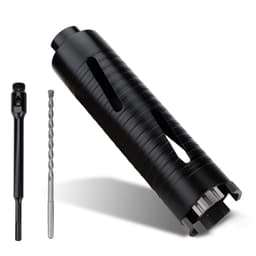
A masonry barrel

Start on a pilot so the full rim is not hunting for the centre. Some sets use a short centre bit and some an A-taper guide rod. Premier's notes assume a guide and a variable-speed drill of at least 850 W with a clutch.Keep the machine square to the wall. Withdraw the barrel every few seconds so the swarf can fall out. A bit left buried packs with brick dust and stalls. Armeg's dry-core sheet says never use hammer action, clear the debris as you go, and keep that dry range out of concrete. An SDS adaptor adds length that is not hole depth, so measure from the wall face to the cutting rim. Armeg says not to put 107 mm and 127 mm cores on an SDS Plus adaptor. Faithfull's sheet draws that brand's line at 78 mm on SDS-plus. Use the limit printed for the adaptor you are holding.

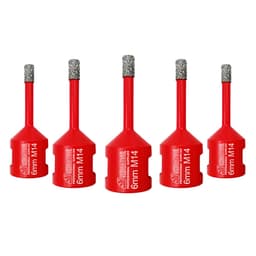
A tile cup

Read the cooling line before you add water. Meccion wants the drill vertical, water on the cut, the centring bit removed once a round slot has started, and about 500 to 800 rpm. SHDIATOOL's wax-filled bit says no added water, about 6,000 rpm recommended, 11,000 rpm as the stated maximum, and a 50 mm working depth. Water on a wax core washes out the coolant the wax was put there to supply. A cup with a centre drill stays on that pilot until the groove is continuous, then the pilot comes out so it cannot bottom and stall the cut. A cup with no centre drill, which several INQUIRLLY buyers describe, needs an angled start. Rest a short arc of the rim on the glaze, let a crescent form, then stand the drill upright. Starting flat is how the cup walks. If it stalls and you twist harder, the tile cracks, so ease off.

When to stop

One hole in sound brick, with the services checked and the drill in rotation only, is a careful DIY cut. Reinforced concrete, a lintel, a party wall or a run of holes is a builder or a diamond-drilling firm. A detector that marks a cable or a pipe on your centre is a stop. About 107 mm and above, on a light SDS drill, the core's weight wants a rig. That line sits beside Faithfull's 78 mm SDS-plus limit and Armeg's warning on 107 mm and 127 mm adaptors, and it replaces neither. Clearance for a 110 mm soil pipe is on the diamond core bit for a soil pipe page.

Common questions

Do you leave hammer mode on?
Leave it off until the core breaks through. A hammer strike chips the diamonds and leaves a lip that polishes. FACHLICH says no impact mode. A drill that only runs hammer and rotation together is the wrong machine.
How do you stop dust packing the barrel?
Draw the barrel back every few seconds so the swarf can fall clear, and keep the drill square. Armeg treats clearing debris as part of the cut. Use M or H class extraction where you can. Water belongs only on a listing that asks for it.
When do you take the pilot out?
Take it out once the rim has cut a continuous round slot. Meccion says to remove the centring bit then and keep the drill vertical. Leave it in and it bottoms, stalls the drill, and can crack the tile.
How do you start a tile cup that has no centre drill?
Tilt the cup so a short arc of the rim touches the glaze, let a crescent form, then stand the drill upright. INQUIRLLY buyers describe the cup wandering when they started it flat. A wax-filled cup still follows its no-water rule.
Which limit applies to a large core on SDS Plus?
Use the limit printed for the adaptor you are holding. Armeg says not to put 107 mm and 127 mm cores on an SDS Plus adaptor. Faithfull's sheet stops that brand at 78 mm on SDS-plus. No single UK figure replaces both lines.
When should you stop and call a professional?
Stop for reinforced concrete, a lintel, a party wall, a run of holes, or a detector that says a service is in the way. Stop around 107 mm and above on a light SDS drill. One hole in ordinary brick, services clear and rotation only, is the DIY case.

Related pages

Sources

Public UK sources from the research digest, last checked on 20 October 2026. Shelf prices and star lines are the amazon.co.uk figures in the display file.

  1. HSE CN8, Diamond coring/hole cutting (retrieved 20 October 2026)
  2. HSE CN3, Drilling with hand-held rotary tools (retrieved 20 October 2026)
  3. HSE CIS65, Cable detection and isolation (retrieved 20 October 2026)
  4. BSI, BS EN 13236:2019 superabrasive safety (retrieved 20 October 2026)
  5. Mexco wax-filled M14 diamond tile drills (retrieved 20 October 2026)
  6. Premier P6-ATDM14 diamond tile drill sheet (retrieved 20 October 2026)
  7. Armeg dry-core instructions (retrieved 20 October 2026)
  8. Toolstation diamond core drill bits (retrieved 20 October 2026)