Diamond core bit for a soil pipe
You are marking an outside wall for a new soil run, with a 110 mm pipe on the ground and a core bit whose number looks close enough. The bit has to clear the outside of that pipe, the socket or boss, and a little fall. UK guides split that hole between 117 mm and 127 mm. This page maps only the diameters in our [diamond core bit comparison](/hub/drilling-and-accessories/diamond-core-bit). Prices are amazon.co.uk figures from 20 October 2026. We cut no wall in a lab. A qualifying purchase through our links can earn us a commission at no extra cost to you.
You are marking an outside wall for a new soil run, with a 110 mm pipe on the ground and a core bit whose number looks close enough. The bit has to clear the outside of that pipe, the socket or boss, and a little fall.
You are marking an outside wall for a new soil run, with a 110 mm pipe on the ground and a core bit whose number looks close enough. The bit has to clear the outside of that pipe, the socket or boss, and a little fall. UK guides split that hole between 117 mm and 127 mm. This page maps only the diameters in our diamond core bit comparison. Prices are amazon.co.uk figures from 20 October 2026. We cut no wall in a lab. A qualifying purchase through our links can earn us a commission at no extra cost to you.
Our top picks
| Badge | Product | Diameter | Fitment | Cooling | Note | Price | Offer |
|---|---|---|---|---|---|---|---|
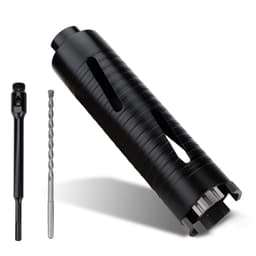
| Best overall |  MOXPIFY MOXPIFY 52 mm core bit set | 52 mm | 1/2 in BSP + SDS | Wet or dry, no feed stated | 8.1 | about £31.99 | View offer |
| Alternative |  MOXPIFY MOXPIFY 107 mm core bit set | 107 mm | 1/2 in BSP + SDS | Wet or dry, no feed stated | 7.2 | about £47.99 | View offer |
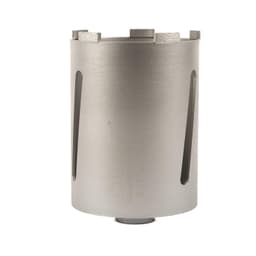
| Alternative |  Starrett Starrett BMC117 117 mm dry core | 117 mm | Straight shank, bit only | Dry cutting | 7.9 | about £29.91 | View offer |

On this page
The printed size is not the hole
Soil, flue and waste
What you can buy in this comparison
Before you drill that hole
Common questions
Will a 110 mm bit pass a 110 mm soil pipe?
Why do UK guides say both 117 mm and 127 mm?
Is the Starrett 117 mm a complete SDS kit?
Is 107 mm a soil-pipe bit or a flue bit?
What listed size sits near a 40 mm waste?
What size is missing from this comparison?
Related pages
Sources
Public UK sources from the research digest, last checked on 20 October 2026. Shelf prices and star lines are the amazon.co.uk figures in the display file.
- HSE CN8, Diamond coring/hole cutting (retrieved 20 October 2026)
- HSE CN3, Drilling with hand-held rotary tools (retrieved 20 October 2026)
- HSE CIS65, Cable detection and isolation (retrieved 20 October 2026)
- BSI, BS EN 13236:2019 superabrasive safety (retrieved 20 October 2026)
- Mexco wax-filled M14 diamond tile drills (retrieved 20 October 2026)
- Premier P6-ATDM14 diamond tile drill sheet (retrieved 20 October 2026)
- Armeg dry-core instructions (retrieved 20 October 2026)
- Toolstation diamond core drill bits (retrieved 20 October 2026)