Independent comparisons. We may earn from shop links. More info

How to use a Bosch combi drill

Updated: 22 October 2026

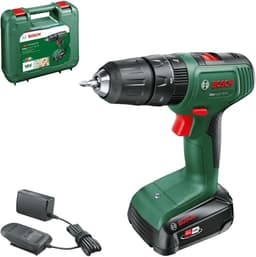
The drill is already in the house. How to use a Bosch combi drill is three collar positions: screwdriving, drilling and impact drilling. The wrong one strips the screw, hammers the timber, or lets the chuck walk off the bit. The [Bosch combi drill comparison](/hub/drilling-and-accessories/bosch-combi-drill) holds the ten models if you are still choosing. The steps follow the EasyImpact 18V-40 manual and the HSE vibration notes. A qualifying purchase can earn a commission at no extra cost to you.

The drill is already in the house. How to use a Bosch combi drill is three collar positions: screwdriving, drilling and impact drilling.

Our top picks

On this page

Three positions, and only one of them slips

On the EasyImpact 18V-40 the mode ring has screwdriving, drilling and impact drilling. The numbered ring works only in screwdriving. In the other two modes the clutch is locked out. The en-GB manual describes 20 stages. A Bosch DIY cell prints “torque settings 2”. This page follows the manual. The GSB 18V-110 C is 25+2, so do not assume every Bosch combi has 20. For a wood screw, start lower than you think, drive a test screw, and go up until the head sits flush and the clutch clicks. Use the drilling symbol in timber or metal. Keep hammer for masonry. A MAX symbol on manual 160992A916 belongs to that revision, not automatically to a GSB.

Gear 1 for force, gear 2 for a small bit

On the EasyImpact, gear I is for screws and a large hole. Gear II is for a small bit and more speed. Change gear only when the chuck has stopped, not at full load. Forcing the collar while the motor pulls is how a gearbox gets damaged. Fit the bit first, and take the battery off if your hand is in the chuck. Forward and reverse will not move while the trigger is pressed. If the tool cuts out or the pack is hot, let it cool. Do not wedge the trigger.

The chuck has to stay tight

UK reviews return to one fault: the chuck loosens and the bit falls out, loudest on the cardboard GSB 18V-110 C and the UniversalImpact 18. The one-pack EasyImpact 18V-40 is quieter in its first 50 UK reviews, which is not a guarantee. Seat the bit, tighten the sleeve, and pulse in the air. If the bit drops, stop. Auto-Lock on the EasyImpact means you retighten only after the chuck has stopped. A pack that will not click in is a different fault, on the green or blue page.

Hammer is for masonry, and then you stop

Impact drilling is still a combi. Bosch describes two ribbed discs that click when you press. An SDS uses a piston. Do not use hammer mode on wood, metal or plastic: the clutch is locked out. The EasyImpact 18V-40 manual states up to 24,450 blows per minute and 13 mm in masonry. When the hole is no longer a plug, that is the masonry page. Stop if a cable or pipe may be in the wall, if the fixing is structural, if the tool sparks, if the chuck will not grip, or if the battery will not release. At work, PUWER 1998 applies.

The vibration figure is not a timer

The GSB 18V-110 C declares 2.5 m/s² in metal and 15.5 m/s² in masonry impact, each with K 1.5 m/s². Those are not safe minutes. The vibration regulations set an action value of 2.5 m/s² A(8) and a limit of 5.0 m/s² A(8), a daily exposure. HSE’s INDG175, for employers, says a hammer-action tool often reaches the action value after about 15 minutes and the limit after about one hour. That note is not a conversion of 15.5 m/s² on this GSB. All-day use is the employer’s assessment, not a DIY timer.

Common questions

Which symbol is for screws, which for holes, and which for brick?
Screwdriving uses the torque ring, and the clutch can click. Drilling is for wood or metal, with the clutch locked out. Impact is for masonry. On the EasyImpact 18V-40 those are the three positions in the en-GB manual. Hammer on timber is the mistake the third symbol invites. Concrete is a different tool.
What do the clutch numbers do, and where do I start?
In screwdriving, a higher stage allows more torque before the clutch clicks. Start low, drive a test screw, and move up until the head sits flush and the clutch clicks. The EasyImpact manual describes 20 stages and no single best number. The ring does nothing once you are in drill or hammer mode.
When do I use gear 1 and gear 2?
Gear I is the slower, higher-force gear for screws and larger bits. Gear II is the faster gear for a small drilling diameter. That is Bosch’s wording on the EasyImpact 18V-40. Shift only when the chuck has stopped, and do not change gear at full load. If you are unsure, start in gear I for any screw.
How do I stop the chuck loosening?
Seat the bit, tighten the keyless sleeve firmly, and pulse the chuck before you touch the work. Retighten only when the chuck has stopped. The EasyImpact manual describes Auto-Lock after you release the trigger. If the bit still falls out, or the sleeve feels crunchy, stop. Repeated UK reviews on some bodies in this set describe exactly that fault, so it is not something you drill through.
Can I change gear while it is spinning?
No. Change gear only when the chuck has stopped, and not under full load. The EasyImpact manual states that limit. Forcing a spinning gearbox is a way to damage it. Release the trigger, let Auto-Lock finish its job, then move the collar.
Does the vibration number tell me how many minutes I can drill?
No. The 2.5 m/s² and 15.5 m/s² figures on the GSB 18V-110 C are declarations, each with K 1.5 m/s². The action and limit values are 2.5 and 5.0 m/s² A(8), which are daily exposures. INDG175’s “about 15 minutes” is an employer note, not a conversion of 15.5 m/s².

Related pages

Sources

Public UK sources from the research digest, last checked on 19 October 2026. Shelf prices and star lines are the amazon.co.uk figures in the display file.

  1. Bosch Professional AMPShare FAQ (retrieved 19 October 2026)
  2. POWER FOR ALL battery FAQ (retrieved 19 October 2026)
  3. Bosch DIY AdvancedImpact 18V-80 (retrieved 19 October 2026)
  4. Bosch Professional GSB 18V-110 C (retrieved 19 October 2026)
  5. Bosch Professional GSB 18V-65 (retrieved 19 October 2026)
  6. Bosch Professional GSB 18V-25 (retrieved 19 October 2026)
  7. HSE vibration regulations (retrieved 19 October 2026)
  8. BSI scope for BS EN 62841-2-1 (retrieved 19 October 2026)