Independent comparisons. We may earn from shop links. More info

Full overlay vs half overlay hinges

Updated: October 2026

You are in a UK kitchen with the cupboard door shut, about to order a replacement, and the closed door still does not show which arm you need. Full overlay vs half overlay hinges is that split. A full-overlay hinge suits a door that covers the carcase edge on its own, including a cabinet at the end of a run. A half-overlay hinge suits two doors that share one centre panel. The screws only trim the gap, so the wrong crank stays wrong. Peter F. compared the amazon.co.uk listings in our [hinge comparison](/hub/door-and-window-security/hinges) with public UK fitting notes in October 2026. We did not run a lab test. A qualifying purchase through our links can earn us a commission at no extra cost to you.

You are in a UK kitchen with the cupboard door shut, about to order a replacement, and the closed door still does not show which arm you need. Full overlay vs half overlay hinges is that split.

Our top picks

On this page

Read the closed door

Look at the closed door before you look at the hinge arm. One door that covers its own carcase edge is full overlay, which Häfele's UK notes pair with a zero-crank hinge for a single cabinet or the cabinets at either end of a run. Two doors that meet on one centre panel, each covering part of that stile, are half overlay. On Häfele's own hinge that second job is an 8 mm crank, and the 8 mm stays with Häfele. A straight full-overlay arm on both sides of a shared stile asks each door to cover the same panel, so the doors clash or leave a lopsided reveal. ABC Home describes that miss as an uneven centre gap, or a door that hits the next cabinet as it opens. Side adjustment moves the gap a few millimetres and cannot add a crank the arm never had.

Crank and plate, not the cup

The crank is the bend that sets how far the door sits in front of the carcase. Quest Hardware cites 0 mm for full overlay on Blum or Salice, and 9 mm or 5 mm for half overlay, depending on the hinge. Häfele's own half-overlay hinge is 8 mm, and that figure belongs to Häfele's hinge alone. The mounting plate does the rest of the work. A different plate can trim the cover on a proper concealed system, and it will not turn a full-overlay-only hinge into a half-overlay hinge. Eurofit Direct says that once the side screw stops, the plate or the arm was wrong. Inset is a third position: the door sits inside the opening, flush with the face. Häfele uses a 15 mm crank for inset on their hinge. A half-overlay arm leaves that door proud of the face.

What these listings actually state

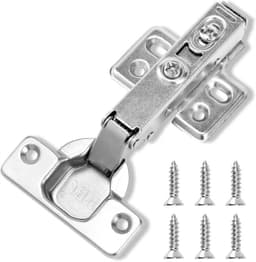
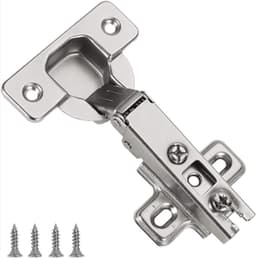
This set has no concealed hinge labelled as half overlay. Three listings mention full overlay, and they do not agree. The top pick, the HBL clip-on, states full overlay only and says other cabinet styles are not suitable. That matches a door covering its own side, and it is the wrong buy for a shared stile. The title says 10 and the unit count says 2, so check the pack before you pay. The overlay line is still not a crank in millimetres. The best value, the APACALI pack, puts full overlay in the title and inset in one bullet. Both lines are on the same amazon.co.uk page, so neither can stand as the specification on its own. Half overlay is in neither line. Furniware's 110° pair states full overlay on a frameless cabinet, slide-on, for doors about 14–22 mm thick. It is sprung, with no damper claimed, so that question belongs on the soft-close cabinet hinges page. The AOLISHENG 90° hinge is a blind corner, so it sits outside this choice. Two Furniware surface hinges claim full, half and inset and have no cup. Reviews on the 90° version say you cannot adjust the gap.

When full overlay, when half overlay

If the door covers the carcase edge by itself, or it is the end cabinet of a run, you are in full-overlay geometry. If two doors hinge on opposite sides of one centre panel and each covers part of it, you are in half overlay. Hettich's Sensys note uses a straight hinge for the first case and a cranked hinge for the second. Choose full overlay for a single door or an end cabinet, with the limit that the top pick, HBL, matches that geometry and still needs the pack checked. Choose half overlay for a shared stile, with the limit that this set states no concealed half-overlay crank. The best value, APACALI, does not state half overlay either. Fit the arm only after you have chosen it, on the how to fit cabinet hinges page. A 170° surface hinge clears a corner, and it does not correct an overlay.

Common questions

What is the difference between a full-overlay and a half-overlay hinge?
A full-overlay hinge holds a door that covers the carcase edge on its own, including a single cabinet or one at the end of a run. A half-overlay hinge holds two doors that share one centre panel, each covering part of that stile. Häfele pairs those jobs with a zero crank and an 8 mm crank on its own hinges.
Is half overlay the same as inset?
Half overlay puts the door in front of a shared centre panel. Inset puts the door inside the opening, flush with the face of the cabinet. Häfele's notes treat inset as a 15 mm crank on their hinge, against 8 mm for their half overlay. Hettich's Sensys note uses a highly cranked arm for inset and sets the plate back by door thickness plus 1 mm. A half-overlay hinge leaves an inset door proud of the face.
Can the adjustment screws turn a full-overlay hinge into a half-overlay hinge?
The side screw on a concealed hinge moves the gap by a few millimetres. Eurofit Direct says that screw sets the gap and does not replace the plate. When the screw runs out of travel, the plate or the crank was wrong. A different plate can trim overlay on a proper concealed system. It will not turn the HBL listing, which states full overlay only, into a hinge for a shared stile.
Which listings in this set state full overlay?
HBL states full overlay only and says other cabinet styles are not suitable, so it matches a door that covers its own side. Furniware's 110° pair states full overlay on a frameless cabinet for doors about 14–22 mm thick, and it is sprung with no damper claimed. APACALI states full overlay in the title and inset in one bullet. HBL's title says 10 while the unit count says 2, so check the pack.
What hinge do two doors on one centre stile need?
Two doors on opposite sides of one centre panel, each covering part of that panel, need half-overlay geometry. Hettich's Sensys note uses a cranked hinge there and a straight hinge for a full-overlay door. If both doors open together, Hettich asks for a reveal of at least twice the minimum clearance, on Hettich hinges only. This set has no concealed listing that states that half-overlay crank.
Why does a blind-corner hinge not belong in this choice?
A blind-corner hinge lets a door open beside a corner that another door would block. The AOLISHENG listing here is a 90° blind-corner hinge, outside full overlay, half overlay and inset. Buying it from a kitchen search will not set the crank for a shared stile or an end cabinet. A surface hinge that claims all three positions, and has no cup, is a different object again.

Related pages

Sources

Public sources from the research digest, last checked on 21 October 2026. Prices and review counts are amazon.co.uk listings, not a laboratory test.

  1. GAI guide to BS EN 1935:2002 (retrieved 21 October 2026)
  2. HOPPE: BS EN 1935 coding (retrieved 21 October 2026)
  3. London Fire Brigade GN92 (retrieved 21 October 2026)
  4. GOV.UK: fire safety England regulations 2022, fire door guidance (retrieved 21 October 2026)
  5. Häfele UK: cabinet hinge FAQs (retrieved 21 October 2026)
  6. ABC Home: kitchen cabinet door hinge types (retrieved 21 October 2026)
  7. e-Hardware: gate hinges guide (retrieved 21 October 2026)
  8. Consumer Rights Act 2015 (retrieved 21 October 2026)