Bathroom door knob: privacy without trapping someone
Someone has turned the snib, and the landing side has no slot you can open with a coin. A bathroom door knob should let you shut the door for privacy and still get in if a child cannot come out. The usual UK pattern is a thumb-turn inside and an emergency release outside. A key is the wrong tool for that room. Prices are on the [doorknob comparison](/hub/door-and-window-security/doorknob). How the set type sits in the wider order is on the [doorknob buying guide](/hub/door-and-window-security/doorknob/sub/doorknob-buying-guide). Peter F. used UK ironmongery pages and the amazon.co.uk listings, updated October 2026. A qualifying purchase can earn a commission at no extra cost to you.
Someone has turned the snib, and the landing side has no slot you can open with a coin. A bathroom door knob should let you shut the door for privacy and still get in if a child cannot come out.
Someone has turned the snib, and the landing side has no slot you can open with a coin. A bathroom door knob should let you shut the door for privacy and still get in if a child cannot come out. The usual UK pattern is a thumb-turn inside and an emergency release outside. A key is the wrong tool for that room. Prices are on the doorknob comparison. How the set type sits in the wider order is on the doorknob buying guide. Peter F. used UK ironmongery pages and the amazon.co.uk listings, updated October 2026. A qualifying purchase can earn a commission at no extra cost to you.
Our top picks
| Badge | Product | Set type | Key or privacy | Latch in the box | Note | Price | Offer |
|---|---|---|---|---|---|---|---|
| Best overall |  Infinity Decor Infinity Victorian brass knobs, 52 mm | Mortice pair | No lock in the box | No | 7.8 | about £16.95 | View offer |
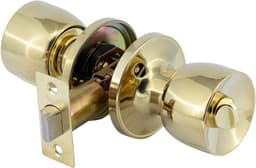
 CML Hardware CML keyed entry ball set | Keyed entry set | Key outside, thumb-turn inside | Yes, adjustable latch | 8.0 | about £7.90 | View offer | |
 Yale Yale brass bathroom knob set | Bathroom knob set | Deadlock latch on the listing; no emergency release described | A deadlock latch bolt is named | 7.2 | about £14.89 | View offer |


On this page
Privacy is not a key
Two spindles
What the bathroom listing actually says
When a lever is the kinder choice
Common questions
Is a keyed knob the same as a bathroom set?
Does the Yale bathroom knob set state an outside release?
Can I use the Victorian brass knobs on a bathroom if I add a turn?
Are bathroom locks high security?
What about a public toilet or a workplace?
What if the only release is a snib on the inside?
Related pages
Sources
Public UK and manufacturer sources from the research digest, used for this page in October 2026. Prices, stars and review counts are the amazon.co.uk figures in this comparison. None of these knobs is treated as BS 3621, BS 8621 or Secured by Design.
- BSI, BS EN 1906:2012 (retrieved October 2026)
- HOPPE UK: BS EN 1906 (retrieved October 2026)
- Approved Document M, Volume 2 (retrieved October 2026)
- Approved Document Q, 2015 (retrieved October 2026)
- Guild of Architectural Ironmongers, accessibility guide (2021) (retrieved October 2026)
- Secured by Design: doors, front and back (retrieved October 2026)
- More Handles, tubular latch guide (retrieved October 2026)
- Suffolk Latch Company: door knobs with locks (retrieved October 2026)