How to adjust a door closer
The door either bangs into the frame or stops short of the latch, and the two screws on the closer look the same. How to adjust a door closer depends on which machine you fitted. An overhead hydraulic closer has a sweep speed and a latch speed. A surface spring has tension, and that is a different screw. This page is the order to use on a closer you already own. The listings behind our [door closer comparison](/hub/door-and-window-security/door-closer) supply the examples. Peter F. used those amazon.co.uk notes and public UK fitting guidance, not a lab adjustment. A purchase through our links can earn a commission at no extra cost to you.
The door either bangs into the frame or stops short of the latch, and the two screws on the closer look the same. How to adjust a door closer depends on which machine you fitted.
The door either bangs into the frame or stops short of the latch, and the two screws on the closer look the same. How to adjust a door closer depends on which machine you fitted. An overhead hydraulic closer has a sweep speed and a latch speed. A surface spring has tension, and that is a different screw. This page is the order to use on a closer you already own. The listings behind our door closer comparison supply the examples. Peter F. used those amazon.co.uk notes and public UK fitting guidance, not a lab adjustment. A purchase through our links can earn a commission at no extra cost to you.
Our top picks
| Badge | Product | Closer type | Speed adjustment | Template or fixings | Note | Price | Offer |
|---|---|---|---|---|---|---|---|
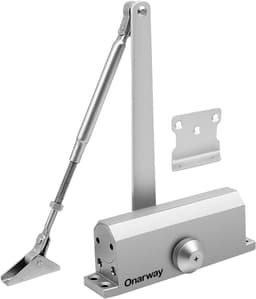
| Best overall |  Onarway Onarway hydraulic door closer | Overhead hydraulic | Adjustable hydraulic speed | Arm, screws, drill bit, template | 7.4 | about £23.19 | View offer |
| Best value |  Offfay Offfay roller-arm door closer | Surface spring with roller arm | Adjustable spring tension | Closer and adjusting rod | 6.4 | about £8.50 | View offer |
 Carlisle Brass Carlisle Brass CDG003 overhead door closer | Overhead hydraulic | Two adjustment screws | Template in the box | 8.5 | about £15.12 | View offer |


On this page
Sweep and latch are different
A spring closer is not those valves
Fit it the right way up before you adjust it
Stop when the door still will not shut
Common questions
Which screw changes the closing speed?
Which screw makes the door latch?
What if oil comes out?
How do I adjust a spring closer rather than a hydraulic one?
Why does the door still not latch?
Related pages
Sources
Public UK guidance and trade sources from the research digest, used for this page in October 2026. Prices, stars and review counts are the amazon.co.uk figures dated 19 October 2026. A listing claim of EN 1154 or Certifire is not treated as a certificate for your door.
- GOV.UK: Fire Safety (England) Regulations 2022, fire door guidance (retrieved 19 October 2026)
- Approved Document M, volume 2 (2024 amendments) (retrieved 19 October 2026)
- Code of Practice: hardware for fire and escape doors (retrieved 19 October 2026)
- Hoppe: BS EN 1154 (retrieved 19 October 2026)
- GAI door closer safety checklist (retrieved 19 October 2026)
- Fire Protection Association: do fire doors need to be self-closing? (retrieved 19 October 2026)
- Intertek: EN 1154 (retrieved 19 October 2026)
- MB Direct: how to adjust the speed of a door closer (retrieved 19 October 2026)