Fire door closer
A fire door only works if it is shut. A fire door closer pulls the leaf closed from any angle, not a wedge and not a star rating. If you rent a flat, manage a block, or you are the responsible person for a common stair, you need to know which doors must do that. This page follows the Fire Safety (England) Regulations 2022 guidance on GOV.UK. Scotland, Wales and Northern Ireland run their own arrangements. Listings in our [door closer comparison](/hub/door-and-window-security/door-closer) are claims, not certificates. Peter F. did not fire-test a closer. A purchase through our links can earn a commission at no extra cost to you.
A fire door only works if it is shut. A fire door closer pulls the leaf closed from any angle, not a wedge and not a star rating.
A fire door only works if it is shut. A fire door closer pulls the leaf closed from any angle, not a wedge and not a star rating. If you rent a flat, manage a block, or you are the responsible person for a common stair, you need to know which doors must do that. This page follows the Fire Safety (England) Regulations 2022 guidance on GOV.UK. Scotland, Wales and Northern Ireland run their own arrangements. Listings in our door closer comparison are claims, not certificates. Peter F. did not fire-test a closer. A purchase through our links can earn a commission at no extra cost to you.
Our top picks
| Badge | Product | Stated size or weight | Fire-door claim | Hold-open | Note | Price | Offer |
|---|---|---|---|---|---|---|---|
| Best overall |  MARIE MARIE 1403 hydraulic door closer | About 750–850 mm and 25–45 kg | n/a | Any angle from 90° to 180° | 4.4 | about £19.99 | View offer |
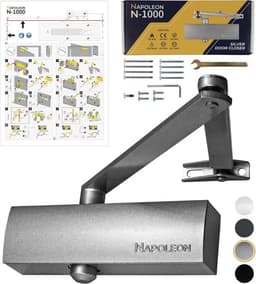
 Napoleon Napoleon N-1000 overhead door closer | About 20–60 kg, size 3 | EN 1154, EN 1634 and CE | n/a | 7.8 | about £49.90 | View offer | |
 Carlisle Brass Carlisle Brass CDG003 overhead door closer | Fixed size 3; door mass n/a | BS EN 1154, CE and Certifire | n/a | 8.5 | about £15.12 | View offer |


On this page
Which fire doors have to shut themselves
The two-position shut test
What the closer itself must be
Wedges and mechanical hold-open
When you stop being the fitter
Common questions
Do fire doors in England have to close themselves?
Does a flat entrance door need a closer if internal doors do not?
Can I prop a fire door open with a wedge?
Is a mechanical 90° hold-open allowed on a fire door?
When do I stop and call a fire-door inspector?
Related pages
Sources
Public UK guidance and trade sources from the research digest, used for this page in October 2026. Prices, stars and review counts are the amazon.co.uk figures dated 19 October 2026. A listing claim of EN 1154 or Certifire is not treated as a certificate for your door.
- GOV.UK: Fire Safety (England) Regulations 2022, fire door guidance (retrieved 19 October 2026)
- Approved Document M, volume 2 (2024 amendments) (retrieved 19 October 2026)
- Code of Practice: hardware for fire and escape doors (retrieved 19 October 2026)
- Hoppe: BS EN 1154 (retrieved 19 October 2026)
- GAI door closer safety checklist (retrieved 19 October 2026)
- Fire Protection Association: do fire doors need to be self-closing? (retrieved 19 October 2026)
- Intertek: EN 1154 (retrieved 19 October 2026)
- MB Direct: how to adjust the speed of a door closer (retrieved 19 October 2026)