Barrel bolt or mortice bolt
You are about to screw a surface bolt onto a back door, or onto one leaf of a pair, because it is the cheapest extra fastening on the page. Barrel bolt or mortice bolt is the fork that decides whether that is enough. A barrel or slide bolt is a face-fixed shoot. A mortice rack bolt is buried in the door edge. A flush bolt is recessed into the inactive leaf. None of the twelve listings on the [door bolt comparison](/hub/door-and-window-security/door-bolt) is a rack bolt or a flush bolt. Peter F. compared those amazon.co.uk surface bolts with public UK guidance, updated October 2026. A qualifying purchase can earn a commission at no extra cost to you.
You are about to screw a surface bolt onto a back door, or onto one leaf of a pair, because it is the cheapest extra fastening on the page. Barrel bolt or mortice bolt is the fork that decides whether that is enough.
You are about to screw a surface bolt onto a back door, or onto one leaf of a pair, because it is the cheapest extra fastening on the page. Barrel bolt or mortice bolt is the fork that decides whether that is enough. A barrel or slide bolt is a face-fixed shoot. A mortice rack bolt is buried in the door edge. A flush bolt is recessed into the inactive leaf. None of the twelve listings on the door bolt comparison is a rack bolt or a flush bolt. Peter F. compared those amazon.co.uk surface bolts with public UK guidance, updated October 2026. A qualifying purchase can earn a commission at no extra cost to you.
Our top picks
| Badge | Product | Type | Material | Stated use | Note | Price | Offer |
|---|---|---|---|---|---|---|---|
| Best overall |  SAYAYO SAYAYO padlock-hole slide bolt | Slide bolt with padlock hole | 304 stainless steel | Gates, sheds and doors | 9.2 | about £8.49 | View offer |
| Best value |  JelKen JelKen 75 mm slide bolt, silver | Slide bolt | 304 stainless steel | Indoor and shed, garden, fences | 9.0 | about £3.79 | View offer |
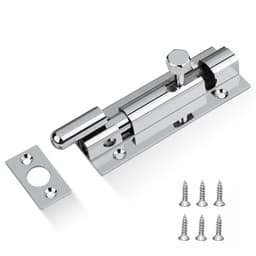
 n/a Necked barrel bolt 75 mm, chrome | Necked barrel bolt | Chrome-plated metal | Internal doors and cupboards | 8.8 | about £4.99 | View offer |


On this page
Two different bolts
When the mortice bolt is the better extra
Pairs and French doors
What you cannot buy in this comparison
The condition on the way out
Common questions
What thickness of door do I need?
French doors: surface bolt or flush bolt?
Can I use a surface bolt at night on the back door?
Does any listing here include a spline key?
Who fits a mortice if I am not sure of the thickness?
Related pages
Sources
Public UK sources from the research digest, used for this page in October 2026. Prices, stars and review counts are the amazon.co.uk figures on the twelve listings. No BS EN 12051 grade is claimed, because none of the listings prints the code.
- DHF: bolts to BS EN 12051:2000 (retrieved October 2026)
- Secured by Design: locks and associated hardware (retrieved October 2026)
- ProtectUK: security at home (retrieved October 2026)
- Secured by Design: secure sheds and outbuildings (retrieved October 2026)
- IronmongeryDirect: which type of door bolt (retrieved October 2026)
- The Crime Prevention Website: other door locks and bolts (retrieved October 2026)
- DHF: requirements for escape doors (retrieved October 2026)
- Master Locksmiths Association: minimum security requirements, January 2025 (retrieved October 2026)