Independent comparisons. We may earn from shop links. More info

Bending spring vs pipe bender: which one to use

Updated: 23 October 2026

A bending spring and a pipe bender both come up when copper needs a corner and the cupboard is tight. They do not do the same work. A spring, or a plastic strip, supports the wall while you supply the force with your hands or your knee. A lever bends the tube around a metal former. On 15 mm, a spring can be enough for the odd bend. On 22 mm, the lever is the tool. The [pipe bender comparison](/hub/diy-supplies/pipe-bender) includes no steel spring. The only insert in the eleven listings is a set of polyethylene strips. The Products Compared editorial team set this against DIY Doctor, DIY Data, BuildWiz and Plumbing Superstore, then checked the amazon.co.uk rows on 22 October 2026. We did not bend pipe in a lab. A qualifying purchase can earn us a commission at no extra cost to you.

A bending spring and a pipe bender both come up when copper needs a corner and the cupboard is tight. They do not do the same work.

Our top picks

On this page

What a spring does, and what a lever does

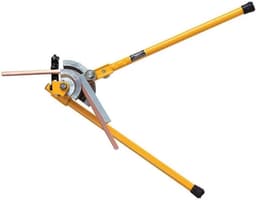
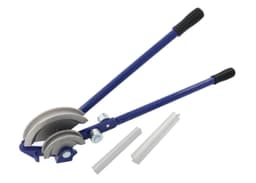
An internal bending spring is a steel coil you push up the bore. It keeps the wall from collapsing while you pull the tube into a curve. DIY Data describes a cord on the eye so you can retrieve it, and a slight over-bend so the spring loosens and comes out. You are still the bending machine. The spring does not set a radius and it does not show you 90°. An external spring fits over smaller tube. BuildWiz treats internal and external as not interchangeable: internal for 15 mm, external for about 8–10 mm. A 15 mm spring will not help 10 mm pipe. A lever is the other principle. The Hilmor GLM and the Toolzone each supply a 15 mm former and a 22 mm former, so the radius is the shoe's, not your knee's. The arms are about 76–79 cm and about 5 kg. If they cannot swing, the lever cannot work, and a spring wins only in that gap, on tube you can bend by hand.

15 mm sometimes, 22 mm almost never by hand

For an occasional 15 mm bend in a tight spot, the trade guides still describe an internal spring. Plumbing Superstore keeps it to intermittent 15 mm and moves you to a bender above that. DIY Doctor limits the knee to about 15 mm: cord on the eye, a slight over-bend, then ease the spring out. The copper has to be tube you can form by hand. 22 mm by hand is a different task. BuildWiz calls it impractical, and DIY Doctor would not attempt it. Do not buy a 22 mm spring as the cheap former. Use a lever or have the piece made. Plumbing Superstore's knee warning is their guide, not an HSE weight limit, because HSE publishes none. One awkward 15 mm bend is the case they allow. An afternoon of drops is a lever. The pull itself is on the how to use page.

The plastic strips in this set

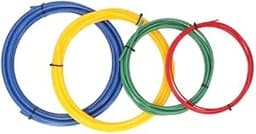
No steel spring is among the eleven listings. The object people confuse with one is Yosoo: four polyethylene strips at about £24.80, rated 4.2 from 12 reviews. You slide a strip inside soft tube and bend by hand. The listing does not name the four diameters. Other brands colour-code sizes and sometimes sell about 4 m of strip. Those details are not on this Yosoo row. Do not order it as if the sizes were known. Reviews mention a split install, one stretched strip, and use on PC water-cooling tube. That is soft small-bore pipe, not 22 mm half-hard copper. Retire a strip that has necked. It will not give you Toolzone's 45 mm and 75 mm radii. F-gas work needs the qualification GOV.UK describes. A review of a split install does not confer it. For a radiator branch, use a spring or a lever.

When the lever is the tool

Carry a lever when you have more than the odd 15 mm bend, when the tube is 22 mm, or when the angle has to repeat. In this set that is the Hilmor GLM at about £78.98, rated 4.7 from 243 reviews, or the Toolzone at about £34.95, rated 4.5 from 73. Both claim 15 mm and 22 mm formers. The Hilmor is the top pick on review volume. The Toolzone is the best value for the same stated sizes, with the published limits that reviewers found no angle marks and that one buyer creased every bend. Neither is a pocket tool. One Toolzone review says not to swing a long pipe in a confined space. Bend on the floor, then pass the pipe in. A 15 mm bend that can only happen in the hole is the spring's remaining case. A 22 mm bend that will not accept the arms needs another route or a fitting, not a spring. Gas work stays with a Gas Safe registered engineer, spring or lever. Choose the Yosoo strips only for soft tube of a diameter you have identified.

Common questions

When is a spring enough for 15 mm?
When the bend is occasional, you can form the copper by hand, and a lever's handles will not fit. DIY Doctor and Plumbing Superstore keep that method in the 15 mm band: an internal spring, a cord on the eye, and a slight over-bend so the spring comes out. It is a poor choice for a run of identical bends, because your knee will not repeat a radius the way a former does. If the work takes the afternoon, take the lever.
Should I spring-bend 22 mm?
Not as a planned method. BuildWiz calls a 22 mm spring bend impractical, and DIY Doctor says it is a task they would not attempt. The pipe is stiffer, the spring is harder to retrieve, and this is usually the pipe that can least afford a flat. Use a 22 mm former, the Hilmor or the Toolzone in this set, or bend where you can swing the arms. A 22 mm spring is not the budget version of those levers.
Internal or external for 10 mm?
External is the usual spring for about 8–10 mm, sometimes from 6 mm. Internal springs are matched to larger sizes, commonly 15 mm and 22 mm, and the two types do not swap. A 10 mm tube needs the external coil that fits over it, or a 6–10 mm crossbow, not a 15 mm internal spring forced into a bore it will not enter. Measure the outside diameter before you buy either.
What is the plastic bender in this set?
It is the Yosoo set of four polyethylene strips, about £24.80, rated 4.2 from 12 reviews. The diameters are not named. You slide one inside soft tube, often air-conditioning copper, and bend by hand. Reviews mention a split install, a stretched strip, and use on PC tubing. It is not a steel bending spring, and it is not a 15 mm or 22 mm heating former. If a strip has stretched, stop using it.
Will a lever fit in a cupboard?
Often it will not. The Hilmor is about 79 cm and the Toolzone about 76 cm, and both need a swing. A Toolzone reviewer says not to work a long pipe in a confined space. Bend on the floor, then offer the pipe into place. Where the bend can only be made in situ, a 15 mm internal spring is the fallback the guides allow. A 22 mm bend that will not accept the arms needs another route or a fitting.
Can the PE strips go on heating pipe?
They are the wrong support for half-hard 15 mm and 22 mm heating copper. Yosoo's strips are for soft tube, and the listing never states heating sizes. A plastic insert will not hold a former radius, and a stretched strip stops supporting the wall. Use an internal spring only for the occasional 15 mm case, and a lever when the diameter is 22 mm or the bends repeat.
Who may bend the refrigerant lines on a split system?
Only someone with the F-gas qualification that applies to the work. GOV.UK sets out that requirement for equipment containing F-gas. Polyethylene strips, and a review that found them useful, do not replace it. If you are not qualified, leave the lines alone, including the bends. The spring-and-lever choice here is for domestic water and heating copper, not for a refrigerant circuit.

Related pages

Sources

Public UK sources and the amazon.co.uk listings compared on this page. Listings captured 21 October 2026. Updated 23 October 2026.

  1. Water Supply (Water Fittings) Regulations 1999 (retrieved 23 October 2026)
  2. HSE: Gas safety for employers (retrieved 23 October 2026)
  3. Gas Safety (Installation and Use) Regulations 1998, Part D (retrieved 23 October 2026)
  4. GOV.UK: F-gas qualifications (retrieved 23 October 2026)
  5. BS EN 1057:2006+A1:2010 copper tubes (retrieved 23 October 2026)
  6. Lawton: How to bend plumbing copper tube (retrieved 23 October 2026)
  7. BPEC essential plumbing skills: copper (retrieved 23 October 2026)
  8. HSE: Manual handling (retrieved 23 October 2026)