Independent comparisons. We may earn from shop links. More info

How to use a pipe bender on copper tube

Updated: 23 October 2026

A bend goes wrong in three ordinary ways. The mark sits on the wrong side of the tube, you judge the angle while the handle is still loaded, or a kink is already there and you try to stroke it flat. This is how to use a pipe bender so those three show up before the tube is installed. The steps are for a hand lever on copper water or heating pipe. They are not a ranking of the tools on the [pipe bender comparison](/hub/diy-supplies/pipe-bender). Hilmor and Toolzone appear only as examples of formers you might be holding. The Products Compared editorial team drew the sequence from BPEC's copper skills notes, Lawton Tubes, Installer Online and DIY Data, and checked it against the listings on 22 October 2026. We did not bend a test piece in a lab. A qualifying purchase through our links can earn a commission at no extra cost to you.

A bend goes wrong in three ordinary ways. The mark sits on the wrong side of the tube, you judge the angle while the handle is still loaded, or a kink is already there and you try to stroke it flat.

Our top picks

On this page

Set the former to the tube you actually have

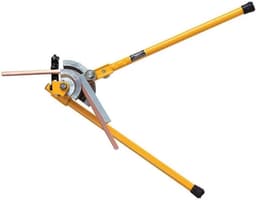
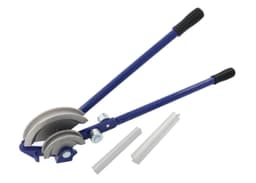
The former is the shoe the tube wraps around. The guide holds the tube in that groove so it cannot spring sideways and flatten. One former fits one outside diameter. A 15 mm shoe will not seat 22 mm tube. A 22 mm shoe on 15 mm tube leaves the wall unsupported, and the bore goes oval. Match the shoe to the stamp on the copper, then look again before you pull. BPEC treats that match as the start of the job. Lawton limits a crossbow, which has no support in the bore, to soft annealed R220. Half-hard R250 belongs on a lever. Hard R290 is not bent. A 6–10 mm crossbow is the wrong machine for 15 mm or 22 mm stick. The buying guide separates those families. A spring supports the wall while you bend by hand. It does not give you a lever radius. BPEC suggests a vice for learners so both hands stay on the pipe. Keep your fingers out of the closing gap. Lawton flags those pinch points on the last part of the pull.

Mark from a fixed point, on the outside

Decide where the bend must finish, measured from something that will not move: the face of a fitting, a pencil line on the wall, or the end you have just cut square. Mark the outside of the tube. You will not see a centre line once the pipe is in the shoe. BPEC's habit is to take that outside edge from the fixed point, then set the mark against the reference on the tool. If the bender has no reference, the mark still goes on the pipe. The Hilmor listing is described as having calibrated marks. Toolzone reviewers say that lever has none. Either way, mark the copper. A pipe without a mark is a guess, and the valve will miss it. Two figures are training methods, not a law for every shoe. BPEC uses a centre-line radius of about four times the diameter, about 60 mm on 15 mm tube. Installer Online's worked 90° uses about 0.53 times the outside diameter, about 8 mm on 15 mm. Toolzone states about 45 mm and 75 mm, which is not that four-times habit. Trust the former you own. Deburr the cut, and practise the mark on an offcut of the same temper. DIY Data's warning is that a bend pulled too far is hard to undo.

Pull, release, then square it

Seat the tube, confirm the former, and pull steadily. Lawton wants that steady pressure rather than a jerk, which is how the tube jumps the groove. Stop a few degrees past the angle you want, because copper springs open when you let go. Release the handles before you judge the angle. A square offered while the arm is still down measures a loaded bend, and the tube opens the moment you let go. Check a 90° free of the tool. A small extra pull is normal. Another full sweep is how legs end up short. An offset is two bends in opposite directions, with a straight section between them, so the pipe steps and then runs parallel. Installer Online's folding-rule layout is their worked example, not a universal drawing. Form the first bend, release it, check it free of the tool, then mark the second. If the tube ripples, stop. More force tightens a kink. It does not heal it.

A kink is a new piece of pipe

Look at the bend before it goes near a joint. The bore should stay round, without ripples or a folded throat. Lawton says inspect, and not to force a bad length into the job. A Screwfix thread on a kinked heating pipe says the same: cut that section out. Do not stroke it straight. You will work-harden the kink. The Water Fittings Regulations 1999, regulation 4, require a water fitting of appropriate quality for the circumstances. A crushed bore fails that practical test. If the former was one size out, scrap the bend even when the outside looks smooth. This sequence does not authorise gas work or refrigerant lines. The Health and Safety Executive expects a Gas Safe registered engineer on gas, and GOV.UK sets the F-gas qualification. If the tube is 28 mm, the temper is unclear, or the offcut kinked twice, ask a plumber to make that piece.

Common questions

Where do I mark a 90° bend?
Mark the outside of the tube from a fixed point, such as the face of a fitting or a line on the wall. BPEC's outside-edge habit still means something once the pipe is in the shoe. Put the mark on the pipe even when the bender has a scale, and especially when it does not. Toolzone reviewers say that lever has none. A Hilmor-style scale does not replace the mark on the copper.
Why is the angle wrong after I let go?
Copper springs back when the load comes off. If you squared the bend while the handle was still down, you measured a forced angle. Release first, then check with a square, and pull a few degrees past the target so the free pipe lands on it. The amount is not the same on every former. An offcut of the same tube shows how far your tool opens.
What happens if the former is one size out?
The tube either will not seat, or it sits loose and flattens. A 15 mm former will not bend 22 mm copper round, and a 22 mm former will not support 15 mm tube. The outside can look almost acceptable while the bore is oval. Match the shoe to the outside diameter before you pull. If you have already used the wrong shoe, cut the bend out.
Can I tweak a rippled bend with my hands?
No. A ripple or a fold means the wall has collapsed. Stroking it straight work-hardens the damage and leaves a restriction. Lawton's instruction is to inspect and not to force the piece into service. Cut the bad section out and bend a new length. A sound bend that went too far is already hard to undo. A kinked bend is not a candidate for a careful tweak.
Should I practise on an offcut?
Yes. Use a spare of the same diameter and temper, not soft microbore if the job is half-hard 22 mm. One or two trial bends show where your mark sits and how much that former springs open. DIY Data notes that a bend pulled too far is difficult to bring back. Learn that on the offcut, before you cut the legs that have to fit.
How is an offset different from one 90°?
An offset uses two bends in opposite directions, with a straight section between them, so the pipe steps aside and continues parallel. A single 90° changes direction and stops there. Set the first offset bend, release it, check it free of the tool, then mark the second. Installer Online's folding-rule layout is one taught method. The angles are often well short of 90°.
When do I stop and cut the pipe out?
Cut it out when you can see a kink, a ripple or a flat throat, or when the former was the wrong size. Do not install it and hope the pump will cope. Stop the method itself when the pipe is gas, when the line contains refrigerant, or when the tube is hard-drawn R290. Gas work belongs with a Gas Safe registered engineer. A fresh offcut is the right next step for a spoiled water or heating bend.

Related pages

Sources

Public UK sources and the amazon.co.uk listings compared on this page. Listings captured 21 October 2026. Updated 23 October 2026.

  1. Water Supply (Water Fittings) Regulations 1999 (retrieved 23 October 2026)
  2. HSE: Gas safety for employers (retrieved 23 October 2026)
  3. Gas Safety (Installation and Use) Regulations 1998, Part D (retrieved 23 October 2026)
  4. GOV.UK: F-gas qualifications (retrieved 23 October 2026)
  5. BS EN 1057:2006+A1:2010 copper tubes (retrieved 23 October 2026)
  6. Lawton: How to bend plumbing copper tube (retrieved 23 October 2026)
  7. BPEC essential plumbing skills: copper (retrieved 23 October 2026)
  8. HSE: Manual handling (retrieved 23 October 2026)