Independent comparisons. We may earn from shop links. More info

15mm 22mm pipe bender: where each size belongs

Updated: 23 October 2026

15 mm and 22 mm are outside diameters, not one pipe with two names. On a typical fully pumped UK heating circuit, 22 mm is the flow and return near the boiler, and 15 mm is the branch to a radiator. A 15mm 22mm pipe bender is a lever with a former for each. In the [pipe bender comparison](/hub/diy-supplies/pipe-bender) only the Hilmor GLM and the Toolzone lever claim both. A 6 mm or 10 mm crossbow will not do this job, however low the price. The Products Compared editorial team matched those listings to Worcester Bosch technical bulletin TB 0039 and to amazon.co.uk on 22 October 2026. We did not survey a house or bend pipe in a lab. The watt figures are the bulletin's indicative guide at an 11 °C difference. They are not your heat-loss calculation. A qualifying purchase can earn us a commission at no extra cost to you.

15 mm and 22 mm are outside diameters, not one pipe with two names. On a typical fully pumped UK heating circuit, 22 mm is the flow and return near the boiler, and 15 mm is the branch to a radiator.

Our top picks

On this page

What 15 mm and 22 mm are for

Both sizes are the outside of the tube under BS EN 1057:2006+A1:2010. The bore is smaller than the name, and you cannot sand a pipe down to fit a smaller former. Half-hard R250 stick is the usual domestic temper. You bend it on a matching shoe. You do not squeeze it in a microbore crossbow. Use 22 mm on the boiler flow and return, where the whole circuit's water is moving, and 15 mm on radiator branches. BuildWiz and a Screwfix thread describe that pattern. Three radiators on 15 mm is only a rule of thumb from those pages, not Worcester's table. Microbore is the aside: Toolwiz, LIBRATON and FUZVOL are 6–10 mm tools, not 15 mm formers.

A watt table is a guide, not your calculation

TB 0039 gives indicative outputs for a fully pumped system with an 11 °C difference between flow and return. In that table, 15 mm copper is about 6 kW and 22 mm copper is about 13 kW. The same bulletin puts 8 mm at about 1.5 kW and 10 mm at about 2.4 kW. Worcester says you still calculate the pipe. The numbers check an undersized guess. They do not promise that every 15 mm branch in your house will carry 6 kW. Emitters, connections and the real temperature drop all move the result. Running 15 mm all the way from the boiler, because the branches are 15 mm, is the mistake the table is there to catch. If the load sits near 13 kW, a tidy 15 mm bend does not add capacity. These watts are not a gas-inlet rule. Worcester's TB 0053 is a different note, for a registered engineer. Once the piece in your hand is 15 mm or 22 mm water pipe, the question is which lever has those shoes.

The two benders in this set that match those sizes

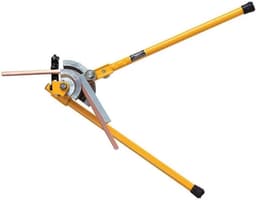
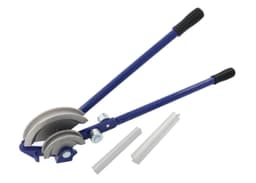
The Hilmor GLM, brand field IRWIN, was about £78.98 and rated 4.7 from 243 reviews. It weighs about 4.65 kg and is about 79.2 cm long. The bullets allow copper at 15 mm and 22 mm, and steel at 15 mm only. They state neither a bend angle nor a radius. Reviews include clean heating bends, and also force, ripples, a denting hook and a snapped weld on 22 mm. The review base is why it is the top pick here. It is not a promise of a round 22 mm bend. The Toolzone was about £34.95 and rated 4.5 from 73 reviews, about 5 kg and 76 cm. It states radii of about 45 mm on 15 mm and about 75 mm on 22 mm, the only pair in the set, and it does not state a bend angle. Reviewers report no 45° or 90° marks, one creased-every-time result, and some used-on-arrival tools. It is the best value if you bend occasionally, mark the pipe and scrap a crease. Expect 22 mm to feel harder than 15 mm, and give the arms room. The how to use page is the pull itself. BPEC's four-times-diameter habit, near 60 mm and 88 mm to the centre line, is tighter on the Toolzone shoes. Set out from the former you own.

Where this page stops

The gas connection belongs with a Gas Safe registered engineer. The Health and Safety Executive's guidance does not turn a 15 mm former into permission, and TB 0039's watts are not a gas chart. Nothing here claims 28 mm, so hire that size or have the piece made. Microbore, about 1.5 kW at 8 mm and 2.4 kW at 10 mm on the same indicative table, needs its own small tool. A crushed bend fails a practical reading of the Water Fittings Regulations 1999, regulation 4, which requires a fitting of appropriate quality for the circumstances. Cut a flat 22 mm flow out. If you are unsure of the diameter, calculate it before you buy the copper. The bender only follows the size you chose.

Common questions

Is 15 mm enough for radiator branches?
Often yes, on a fully pumped system, which is why 15 mm is the usual branch. TB 0039 puts 15 mm at about 6 kW as an indicative figure at an 11 °C difference, and tells you to calculate rather than treat the table as the design. A short feed to one radiator is a different load from a long branch with several emitters. Three radiators on 15 mm is only a rule of thumb from other pages. Match the pipe already there, or do the heat loss.
Where does 22 mm belong on a heating circuit?
On the shared flow and return, typically from the boiler until the circuit splits, because that pipe carries the system's water. TB 0039's indicative figure for 22 mm is about 13 kW at the same 11 °C difference. Running 15 mm for that whole length, because the branches are 15 mm, is the sizing error this page is here to stop. The bend still needs a 22 mm former. A tidy 15 mm bend in the wrong place does not add capacity.
Which two listings actually have both formers?
Only the Hilmor GLM, about £78.98 and 4.7 from 243 reviews, and the Toolzone, about £34.95 and 4.5 from 73 reviews. Everything else in the set is a small crossbow, an inch-size tool, an inch ratchet or a plastic insert. A lower price is not a second 15 mm and 22 mm option. Check the shoe list on the page you order, because titles drift.
How hard is 22 mm compared with 15 mm?
Noticeably harder. You are bending a larger, stiffer tube, and Hilmor buyers mention the force on 22 mm. Both levers are about 76 cm to 79 cm and around 5 kg, so you need room to swing. A 15 mm branch that felt easy is a poor rehearsal for the boiler flow. If the pull starts to ripple the tube, stop and cut that section out rather than forcing the handles.
What radius will I get?
Only the Toolzone states one here: about 45 mm on 15 mm tube and about 75 mm on 22 mm. The Hilmor listing states neither a radius nor a bend angle. BPEC's four-times-diameter example, about 60 mm and 88 mm to the centre line, will not match the Toolzone shoes. Set the mark from the former you are using. A guessed universal radius is how a measured leg finishes short.
Can I bend the gas pipe to the boiler with the same tool?
Do not treat the gas connection as part of this job. A former that suits heating copper does not authorise gas work. Gas sizing sits in Worcester TB 0053, for a registered engineer, and the Health and Safety Executive expects a competent person on the Gas Safe Register. Call one for the boiler gas pipe. Keep this bender on water and heating copper you are allowed to alter.
What if the job is 28 mm or 10 mm microbore?
Leave this page. No tool here has a 28 mm former, so a 22 mm shoe is not a near substitute. For 10 mm, Worcester's indicative output is about 2.4 kW, and the small crossbows are the relevant family if the tube is the soft temper they are sold for. The 8 mm figure on the same bulletin is about 1.5 kW. Buy the former that matches the stamp, or have a 28 mm section bent on a machine that states that size.

Related pages

Sources

Public UK sources and the amazon.co.uk listings compared on this page. Listings captured 21 October 2026. Updated 23 October 2026.

  1. Water Supply (Water Fittings) Regulations 1999 (retrieved 23 October 2026)
  2. HSE: Gas safety for employers (retrieved 23 October 2026)
  3. Gas Safety (Installation and Use) Regulations 1998, Part D (retrieved 23 October 2026)
  4. GOV.UK: F-gas qualifications (retrieved 23 October 2026)
  5. BS EN 1057:2006+A1:2010 copper tubes (retrieved 23 October 2026)
  6. Lawton: How to bend plumbing copper tube (retrieved 23 October 2026)
  7. BPEC essential plumbing skills: copper (retrieved 23 October 2026)
  8. HSE: Manual handling (retrieved 23 October 2026)