Independent comparisons. We may earn from shop links. More info

Decking pedestals vs concrete blocks

Updated: 23 October 2026

Concrete deck blocks, a stack of paving, and plastic screw pedestals all get called a base. Decking pedestals vs concrete blocks is a real choice, and the plastic foot is not the winner on every plot. These amazon.co.uk pedestals level a joist on sound concrete or paving when the gap is inside 18–140 mm. On soil, a post or a footing is the stronger tool. The [pedestal comparison](/hub/diy-supplies/pedestals) assumes you already want one of the eight packs. Products Compared checked those listings on 21 October 2026 and did not pour a pad. A qualifying purchase can earn a commission at no extra cost to you.

Concrete deck blocks, a stack of paving, and plastic screw pedestals all get called a base. Decking pedestals vs concrete blocks is a real choice, and the plastic foot is not the winner on every plot.

Our top picks

On this page

Three different supports

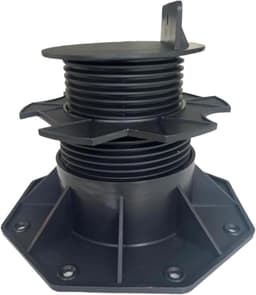
A screw pedestal here is a plastic collar and a joist head. You wind it on a hard surface, from 18–28 mm through 30–60 mm to 60–140 mm. None of them states a self-levelling head. A concrete deck block is a heavy casting with a slot for a bearer. The Decking Block Company describes its own blocks at about 10.5 kg and 18 kg and argues that light plastic blocks move. A screw foot on a slab is not a hollow plastic block on soil. A post goes into a footing when the deck is higher or the ground is soft. Ecodek puts pedestals on concrete and patio, and posts on soil and gravel. Those notes are not a certificate for these listings on turf.

When the plastic pedestal is the one to buy

Buy a pedestal when the base is sound concrete or stable paving, the void at the high spot and the low spot sits inside the title band, and the load is a low deck or a small shed. A collar gives you a range, so you can match a fall. About 40 mm starts on the 30–60 mm row. Read the shared-review warning on the best decking pedestals page. About 100 mm is a tall-pack gap. A slab counts as that base only when it does not rock. Set the height before you screw the joist, as on how to install decking pedestals.

When concrete or a post is the better tool

On turf or loose soil, leave the plastic packs in the basket. The reviews do not show a finished deck on grass. Jouplast’s note is that unprepared soil moves, so a collar in the lawn will follow it. CBG Decking puts deck blocks on a compacted sub-base and rules out grass and loose gravel. Compacted Type 1, a block, and a bearer in the slot is the low-deck method when there is no patio. A 140 mm foot, plus joist and board, can cross England’s 30 cm planning line. Scotland’s Class 3D floor limit is 0.5 m. Posts take over when that foot cannot reach the height.

Packers, airflow and treatment

Set the height before the screw goes in. Some reviews say these fixed heads will not wind afterwards. Packers creep once the gap varies along the joist. The support does not treat the timber. Ecodek, on its own frames, wants an airflow cavity of about 80 mm in one note and 101 mm in a worked example. That is not a legal minimum for every UK deck. An 18–28 mm foot leaves a very small void. The 30–60 mm band is the first gap you can see. Shed piece count is on decking pedestals for a shed base.

Which support to start with

If the base is sound concrete or paving and the gap fits a title in this set, start with a pedestal from the main table. If the base is turf or loose soil, use a compacted sub-base and blocks, or posts. If the deck is tall, tied to the house, or heavily loaded, design the footing before you compare unit prices.

Common questions

Are plastic pedestals better than concrete blocks?
They are better when you already have sound paving or a slab and you need to fine-tune a joist through a stated range, such as 30–60 mm. Concrete blocks are the better known method on a compacted sub-base where there is no slab yet. A light plastic block on soil is a third thing, and trade pages criticise it for movement.
Can they replace a concrete pad I already have?
They sit on the pad. They do not replace it. Reviewers used them because the pad was uneven, and the pedestal took up the difference under the joist. If the pad is cracked through or rocking, repair that surface first. A pedestal on a hollow slab will settle with the slab.
What if the garden is soil?
Use a prepared sub-base and deck blocks, or posts with a footing. The amazon reviews for these eight packs describe pads and paving. Grass is an unanswered prompt, not a finished install. A collar set in April can be out by autumn if the soil moves. A steel shed leveller for turf is a different listing.
Do deck blocks go straight on grass?
CBG Decking’s notes put deck blocks on a compacted sub-base, and they exclude grass and loose gravel. A block on the lawn will sink at the wet corner. The same limit applies to a plastic pedestal. If you want to avoid digging, the honest case is an existing sound patio.
When are timber packers enough?
Packers are enough for a few millimetres of rock on a base that is already flat. Once the gap is tens of millimetres and it changes along the joist, a stack of packers slips and gives you one fixed height. A 30–60 mm collar is where the adjustable foot earns its place.
Do I still need a fall and treated timber?
Yes, whichever support you choose. TDCA guidance is Use Class 4 for the joists, and a fall so water leaves the boards. A pedestal creates a void. It does not preserve untreated timber, and a concrete block does not either. Adding the fall afterwards with random offcuts twists the frame.
When is a poured pad or a post the grown-up choice?
Choose a poured pad when you have no hard surface and you want a permanent low deck on a slope. Choose posts when the height is beyond a 140 mm pedestal or the frame must meet a threshold. Choose a designer when the deck is tied to the house or the load is a tub or a cabin. Seller kilogram lines are not that design.

Related pages

Sources

Public UK sources and the amazon.co.uk listings compared on this page. Listings captured 21 October 2026. Updated 23 October 2026.

  1. Planning Portal: decking planning permission (retrieved 21 October 2026)
  2. GOV.UK: permitted development rights technical guidance (retrieved 21 October 2026)
  3. GPDO 2015, Schedule 2, Part 1 (retrieved 21 October 2026)
  4. mygov.scot: add decking to a house (retrieved 21 October 2026)
  5. Scottish Government: Circular 1/2024, Class 3D (retrieved 21 October 2026)
  6. GOV.WALES: planning permission for decking (retrieved 21 October 2026)
  7. TDCA: The Timber Decking Handbook 2022 (retrieved 21 October 2026)
  8. TDCA: what to know about deck joists (retrieved 21 October 2026)
  9. Wallbarn: decking pedestals (retrieved 21 October 2026)
  10. Consumer Rights Act 2015, section 9 (retrieved 21 October 2026)