Independent comparisons. We may earn from shop links. More info

How to install decking pedestals under a joist

Updated: 23 October 2026

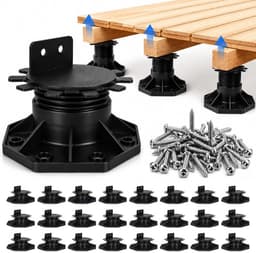
The pack is in the garden, the slab or the paving is the base you are keeping, and the joists are cut. How to install decking pedestals, on the fixed-head packs in this comparison, comes down to one order: get the collar close to height, then screw the joist, then fine-tune only if that model’s lower ring still turns. Wind the head hard against the timber first and the collar often locks. The [pedestal comparison](/hub/diy-supplies/pedestals) is where the eight amazon.co.uk packs are listed. This page is the method, not a ranking. We used the UK review text and public install notes, read on 21 October 2026. We did not build a deck. A qualifying purchase can earn a commission at no extra cost to you.

The pack is in the garden, the slab or the paving is the base you are keeping, and the joists are cut.

Our top picks

On this page

Set the height in the right order

Measure the void from the hard base to the underside of the joist at each support, and set each pedestal near that number before the screw goes in. A UK review of the Ceta type says to set the top collar, screw the head to the timber, then fine-tune the bottom ring. Another review says you cannot adjust the unit properly once it is fixed. Those two notes belong together. The first is the sequence that still leaves a little movement. The second is what happens if you skip it. Brand guides often assume their own head can still be wound with the joist in place. NeoTimber describes rotating the base to level, then screwing through the cradle into the side of the joist. Millboard’s DuoLift guide says that system can be adjusted with the joist already fitted. That is a different head from the fixed collars in this amazon set. Copy the Ceta review sequence for these packs. Stand the foot on the slab, turn the collar to the mark, and check with a spirit level along the joist. If the collar reaches the end of its thread before the joist is level, you have the wrong band. The bands are set out on the adjustable decking pedestals buying guide.

Lay the grid and the fall

Joists run at right angles to the deck boards. The pedestals sit under the joists, on a grid you have marked on the slab, so each board ends on timber rather than in mid-air. NeoTimber’s public steps put the grid down first, then the joists, then the boards. Laying boards first leaves you hunting for level with no room to turn a collar. Spacing is where the guides disagree, so keep each number with its speaker. One Ceta reviewer put feet at about 300 mm under a shed. A Silvadec aluminium-joist manual uses 600 mm centres for a private install and 400 mm for public. Wallbarn’s own note is a maximum of 600 mm between its pads. Ceta’s seller line says at least six to eight supports per square metre for its area load claim. Use the span you are actually building to. The Timber Decking and Cladding Association points deck joists at Use Class 4 under BS 8417, with C16 as a minimum. The plastic foot does not change that timber span. A slight fall away from the house lets water leave the boards. Ecoscape suggests about 2 per cent, which is 20 mm in a metre, more than the whole travel of an 18–28 mm pedestal. You may need the 30–60 mm band just to build the fall in, even if the slab itself is flat. Build the fall into the collars. Packing one end with random offcuts after the joists are fixed is how the frame twists.

Fix the joist, and keep the tab intact

Screw the joist to the cradle. These listings mostly tell you to fix the timber, and they do not tell you to bolt the foot through the slab. On a sound paving slab the foot can sit, with the frame held by the joist screws and by the weight of the deck. If you need the foot bolted down, you are outside what these amazon bullets describe. Jevervd’s included-components line names screws. Ceta reviews say none are supplied. NBYTLT says tool-free and also tells you to screw the head on through pre-drilled holes. UGEBROGH, BURMONG and Vpukveer do not list screws. Take exterior screws that suit the joist thickness, and drive them through the cradle into the side of the timber. A screw that bottoms out in the plastic thread, or that is so long it bursts the far side of a thin joist, is the usual miss. Offer the joist into the cradle so it sits central. A Ceta reviewer said about 45 mm timber suits the head. The fixing tab is easy to snap. A Ceta review says it breaks if you drop the unit. Set the pedestal down. Do not throw the spares onto the patio. If a tab has already gone, that foot will not hold the joist the way the intact ones do. One reviewer needed 12 feet for an 11×7 shed, so a ten-pack can run out before you have a spare.

Where you stop

Stop when the base is soil, grass, or a roof membrane. These reviews are slabs, paving and concrete pads. Bolting through a membrane is a detail these listings do not document, and Wallbarn’s own trade note is to avoid that. Stop when the load is a hot tub or a cabin, or the deck is ledgered to the house. A pedestal grid under a light timber frame is a different job from a structure that shares the house wall. Stop when the finished floor may cross the planning line where you live. Decking above 30 cm typically needs planning permission in England, which matches the Planning Portal test for a raised platform. Scotland’s Class 3D uses 0.5 m for the floor. Add pedestal, joist and board before you decide you are clear. A 140 mm foot under a deep joist is the usual surprise. If the collars are at the end of their thread and the frame still rocks, the tool has run out. A cracked, rocking slab is not a sound base for a plastic foot, however carefully you set the collar.

Common questions

Do I set the height before I screw the joist?
Yes on these fixed-head packs. A UK Ceta review says to set the top collar, screw to the timber, then fine-tune the bottom ring. Another says you cannot adjust properly once the head is fixed. Set every foot close to the measured void first. A trade system such as Millboard DuoLift, which says it can be adjusted with the joist in place, is a different head. Do not assume the bottom ring on every amazon ASIN still turns after the screws are in.
Which way do the joists run?
The joists run at right angles to the deck boards, so each board end lands on timber. Pedestals sit under those joists, on marks you have set out on the slab. NeoTimber’s public order is grid, joists, then boards. Laying boards first leaves you hunting for level with no room to turn a collar. Keep a straight edge on the joists before the first board goes down.
How far apart do the pedestals go?
There is no single centre for every brand. A Ceta reviewer used about 300 mm under a shed. A Silvadec aluminium manual uses 600 mm for a private deck and 400 mm for public. Ceta’s seller claim wants at least six to eight per square metre. Wallbarn caps its own pads at 600 mm apart. Follow the joist span for the timber you bought, and put a foot at each support that span needs. One number copied from a different system will either over-buy plastic or leave a joist spanning too far.
Can I stand them on old paving?
Yes when the slabs are sound, stable and fully supported. The reviews that describe a job are on paving and concrete pads. A slab that rocks, or a hollow one that drums when you step on it, will let the collar settle after you have levelled the joist. Bed or replace that slab before you treat it as a footing. These listings do not describe bolting the foot to the slab.
Do I need a fall?
A slight fall away from the house is what the public guides expect, so water leaves the boards. Ecoscape suggests about 2 per cent, which is 20 mm in a metre. That fall can use up the whole travel of a short pedestal, so choose the band after you have added it to the void. Build the fall in the collars. Random packers under one end, added after the joists are screwed, twist the frame.
When do I stop and call someone?
Call someone if the finished floor may exceed the height test where you live, if the deck is fixed to the house, if the load is a hot tub or a cabin, or if the base is soil, grass or a membrane. Also stop if the collars run out of thread and the frame still rocks. A plastic grid under a light joist on a sound slab is the job these packs describe. A structural deck is a different appointment.

Related pages

Sources

Public UK sources and the amazon.co.uk listings compared on this page. Listings captured 21 October 2026. Updated 23 October 2026.

  1. Planning Portal: decking planning permission (retrieved 21 October 2026)
  2. GOV.UK: permitted development rights technical guidance (retrieved 21 October 2026)
  3. GPDO 2015, Schedule 2, Part 1 (retrieved 21 October 2026)
  4. mygov.scot: add decking to a house (retrieved 21 October 2026)
  5. Scottish Government: Circular 1/2024, Class 3D (retrieved 21 October 2026)
  6. GOV.WALES: planning permission for decking (retrieved 21 October 2026)
  7. TDCA: The Timber Decking Handbook 2022 (retrieved 21 October 2026)
  8. TDCA: what to know about deck joists (retrieved 21 October 2026)
  9. Wallbarn: decking pedestals (retrieved 21 October 2026)
  10. Consumer Rights Act 2015, section 9 (retrieved 21 October 2026)