Corrugated vs box profile
You are covering a shed whose roof is closer to flat than to a steep pitch, and the names in front of you are corrugated iron and box profile. Corrugated vs box profile is a choice between a sine wave and a trapezoidal rib. Pitch, cover width and the screw position belong to the maker’s own sheet. Several amazon.co.uk listings here say corrugated and trapezoidal in one title, and those packs are 0.25 mm short sheets, separate from a stated 34/1000. Prices stay on the [corrugated iron sheets comparison](/hub/diy-supplies/corrugated-iron-sheets). Peter F. compared the listings with published UK maker sheets. We did not load a roof. A qualifying purchase can earn a commission at no extra cost to you.
You are covering a shed whose roof is closer to flat than to a steep pitch, and the names in front of you are corrugated iron and box profile.
You are covering a shed whose roof is closer to flat than to a steep pitch, and the names in front of you are corrugated iron and box profile. Corrugated vs box profile is a choice between a sine wave and a trapezoidal rib. Pitch, cover width and the screw position belong to the maker’s own sheet. Several amazon.co.uk listings here say corrugated and trapezoidal in one title, and those packs are 0.25 mm short sheets, separate from a stated 34/1000. Prices stay on the corrugated iron sheets comparison. Peter F. compared the listings with published UK maker sheets. We did not load a roof. A qualifying purchase can earn a commission at no extra cost to you.
Our top picks
| Badge | Product | Profile | Sheet size | Fixings | Note | Price | Offer |
|---|---|---|---|---|---|---|---|
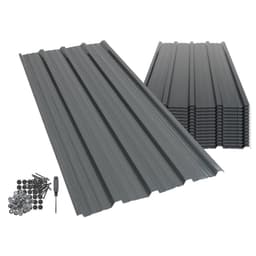
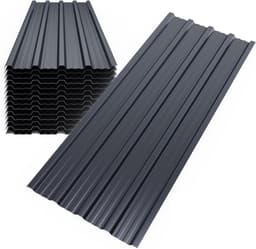
| Best overall |  Harbour Housewares Harbour Housewares anthracite 14-sheet pack | Classic corrugated | 110 x 46 cm | Not in the bullets; reviews mention bolts | 7.4 | about £57.99 | View offer |
| Best value |  Mondeer Mondeer dark grey 14-sheet pack | Corrugated and trapezoidal in the same listing | 110 x 46 cm | Not in included components | 7.3 | about £53.99 | View offer |
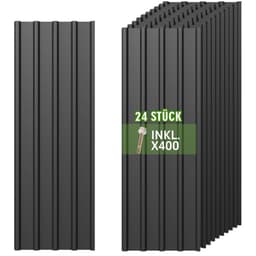
| Alternative |  Warmfay Warmfay black 24-sheet pack with screws | Trapezoidal; also called corrugated | 115 x 45 cm | 400 screws and washers stated | 5.7 | about £73.99 | View offer |
On this page
A wave and a trapezoidal rib
Minimum pitch is the maker’s figure
Where the screw goes
What these amazon packs actually are
Which profile to use when
Common questions
Which is better on a nearly flat shed?
Which looks like traditional corrugated iron?
Do they screw in the same place?
Is box profile stronger?
Can I mix them on one roof?
Does a conservation setting change the choice?
Related pages
Sources
Public UK sources and the amazon.co.uk listings compared on this page. Updated 22.10.2026.
- Planning Portal: Outbuildings (retrieved 22.10.2026)
- Planning Portal: Building regulations for an outbuilding (retrieved 22.10.2026)
- legislation.gov.uk: Class E outbuildings (retrieved 22.10.2026)
- Cladco: 13/3 corrugated datasheet (retrieved 22.10.2026)
- Cladco: Corrugated installation guide (retrieved 22.10.2026)
- HSE: Fragile surfaces (retrieved 22.10.2026)
- HSE: Using the right type of PPE (retrieved 22.10.2026)
- Briarwood: 13/3 declaration (retrieved 22.10.2026)
- Cladco: 13/3 galvanised corrugated roofing sheets (retrieved 22.10.2026)