Independent comparisons. We may earn from shop links. More info

How to use a cleaning gun: connect, set, then vacuum

Updated: 23 October 2026

The listing makes a cleaning gun sound ready as soon as the plug clicks, and the pressure bullet is often the part you should not trust. This is how to use a cleaning gun if you already own one and a compressor: connect, set a pressure you can defend, blow loose debris into a space you will vacuum, and stop before clothing, skin or a stuck trigger. The product table is the [cleaning gun comparison](/hub/diy-supplies/cleaning-gun). Peter F. wrote this on 21 October 2026 from amazon.co.uk listings and HSE and BCAS guidance. We did not run a lab. If you buy through our links, we may earn a commission at no extra cost to you.

The listing makes a cleaning gun sound ready as soon as the plug clicks, and the pressure bullet is often the part you should not trust.

Our top picks

Preciva Preciva dry blow gun

Best overall

Preciva Preciva dry blow gun
9.0/10about £18.69
On this page

Connect, then look at the plug

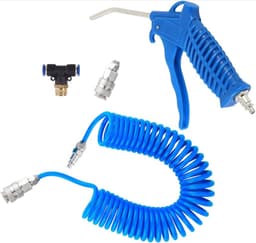
Seven of the eight guns in this set need a compressor. The YH-170 listing says it does not, because it is a hand textile spot gun with no airline. For the other seven, start with the compressor off, the regulator backed down, and the gun not yet aimed at anything. Offer the plug to the coupling. It either clicks home or it does not. A European fitting that will not take a UK PCL male plug is a mismatch, which is what UK reviews say about the Cretee. Preciva says EU and US connectors and does not name PCL. ACHANFLY’s kit includes a Euro quick connector. If it will not click, stop and identify the profile. Safety glasses go on before the air goes on. Choosing the type is the cleaning gun buying guide.

Do not set 160 psi because the bullet says so

Preciva and YUWEIC print 60–160 psi beside 0.6–0.92 MPa in the same sentence. Those ranges are not equal. Setting the regulator to 160 psi because it is the larger number overshoots a figure the other unit does not support. Cretee states a maximum of 8 bar, which is a ceiling. ABOHU states a working band of 6–9.2 bar and 240 litres per minute at 4.8 bar. ACHANFLY shows 10 kg/cm² in one field and 145 psi in another. Dazzlingyyh states no pressure at all. If the gun has no safety nozzle, the British Compressed Air Society’s advice is to reduce to 2 bar or 30 psi, and not to block the nozzle or dust clothing. Use the lower defensible figure and keep bursts short.
Preciva Preciva dry blow gun

Testsieger

Preciva Preciva dry blow gun
9.0/10about £18.69

Blow, then vacuum

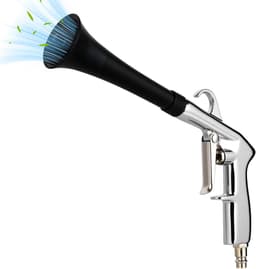
Point the nozzle at loose debris on a surface you can hoover, not at your chest and not along a seat you are sitting on. Short bursts move crumbs out of a vent or a mat gap. A spinning nozzle agitates fibres. It does not catch the dust. HSE’s dust guidance is to vacuum dust rather than blow it off surfaces or clothes, because blowing puts it back into the air. At home the vacuum follows the gun in the same session. On a car mat, blow the grit towards the footwell you are about to hoover, with the doors open. If the extension tube is loose, as Dazzlingyyh buyers reported when a tube left the gun, stop and seat it before the next burst. A straight gun such as the ACHANFLY is a narrow jet. Cabin surfaces are on cleaning gun for a car interior.

When to stop

Stop if you were about to dust your clothes, your hair, or a seat while you are sitting in it. HSE’s compressed-air guidance says blow guns cause eye injuries, can inject air through the skin, and must not be used to dust clothing. Stop if the dust is brake or clutch dust. HSE’s vehicle-repair guidance is never to blow that dust out with an airline. Stop if the trigger stays open. ACHANFLY’s UK notes include a trigger that stayed open. Kill the regulator and the compressor before you pull at the gun. Stop if the nozzle has come off. Dazzlingyyh’s file includes a buyer who was hit by the extension tube. A home compressor’s handheld gun is unlikely to need a written scheme under PSSR. HSE’s INDG178 says a receiver at or above 250 bar litres likely does.

Common questions

Which pressure number on the listing should you ignore?
Ignore 160 psi when the same Preciva or YUWEIC line also prints 0.6–0.92 MPa, because those ranges are not equal. HSE’s swarf guide is about 2.1 bar, and that is a guide for clearing swarf, not a setting for these guns. Dazzlingyyh gives you no number to misuse.
Can you dust your clothes or a seat you are sitting on?
No. HSE guidance is not to dust clothing with compressed air, because blow guns injure eyes and can inject air through skin. Stand clear, blow loose debris towards a mat you will vacuum, and keep the nozzle off skin. A 60 dBA claim on a listing is not a noise assessment.
What if the trigger stays open?
Treat it as a stop. ACHANFLY’s UK notes include a trigger that stayed open. Close the regulator and shut the compressor off before you wrestle with the handle. A trigger that will not release is a faulty tool. The Consumer Rights Act 2015 includes a 30-day short-term right to reject when the goods are not of satisfactory quality.
What if the nozzle comes off?
Stop and isolate the air. Dazzlingyyh reviews include an extension tube that left the gun and hit a buyer, and another nozzle that was taped after it broke. Seat a loose tube on the bench with the compressor off, or send the gun back. If Cretee’s small blue liquid tube blows off the line, refit it with the air off.
Does a home compressor need a written scheme?
A handheld tool is unlikely to need one. PSSR covers compressed air above 0.5 bar as a relevant fluid at work. HSE’s INDG178 says a receiver at or above 250 bar litres likely needs a written scheme of examination. If the receiver is a work compressor and you do not know the bar-litre figure, ask someone competent.

Related pages

Sources

Public UK sources and the amazon.co.uk listings compared on this page. Updated 22.10.2026.

  1. HSE HSG39 compressed air safety (retrieved 22.10.2026)
  2. HSE: vacuuming dust (retrieved 22.10.2026)
  3. HSE: PSSR overview (retrieved 22.10.2026)
  4. HSE INDG178 (retrieved 22.10.2026)
  5. Noise regulations, regulation 4 (retrieved 22.10.2026)
  6. HSE: COSHH and cleaning (retrieved 22.10.2026)
  7. Tornador Black maker page (retrieved 22.10.2026)
  8. Detailing World compressor thread (retrieved 22.10.2026)