Independent comparisons. We may earn from shop links. More info

How to use a garden auger drill bit

Updated: October 2026

The first time a garden auger drill bit bites a root, the drill kicks. How to use a garden auger drill bit is mostly how you stop that. Keep both hands on the drill, start at low speed with the tip already on the soil, and do not open a powered hole until you have a reason to think the ground is clear of cables and pipes. This page is the sequence, not a brand ranking. The listings are on the [Earth auger drill bit comparison](/hub/digging-tools/earth-auger-drill-bit). The warnings borrow the hazard from Makita’s DG002G earth-auger notes and from Electrical Safety First. They do not certify a chuck bit against either document. Peter F. set the sequence from those notes and the amazon.co.uk reviews in October 2026. A qualifying purchase can earn a commission at no extra cost to you.

The first time a garden auger drill bit bites a root, the drill kicks. How to use a garden auger drill bit is mostly how you stop that.

Our top picks

On this page

Fit the bit and set the drill

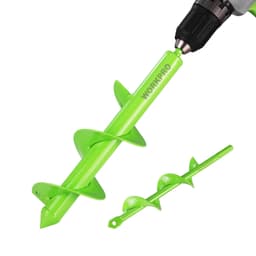
Change the bit only when the drill is safe to open. Electrical Safety First’s ordinary rule is the battery off or the pack removed, or the corded plug out, before your fingers are near the chuck. Seat the hex fully. Most bits in this set specify a 3/8 in hex for a 3/8 in or larger chuck. An SDS-only hammer drill is the wrong tool. Which diameter to buy is in the garden auger drill bit buying guide. Set the drill to forward, so the spiral feeds into the soil and lifts spoil. Reverse is for unwinding a jam, not for digging. A review on a short LYFETC listing said a centre joint came loose in reverse on hard ground. Do not use hammer mode. Percussion is how you shatter a flight. Fit the drill’s side handle if it has one. K-Brands does not supply a side handle, so the second grip is the drill’s own. Wear eye protection and keep loose clothing, laces, and cuffs away from the shaft. Brace the way Makita tells an operator to brace a dedicated earth auger: both hands, body out of the twist, tip already on the ground before the motor starts. Start on a low clutch setting and follow that drill’s manual. There is no universal clutch click. If the clutch rattles and the bit does not cut, step up one notch. If the drill twists you, stop. The bit will still bind if you bury it and keep the trigger down.

Drill the hole and clear it

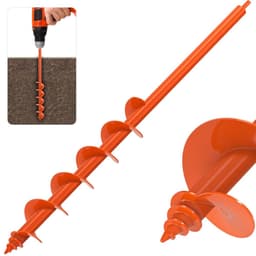
Mark the spot and set the tip on the soil before you pull the trigger. Use low speed and short bursts, straight down. After a few seconds, lift the flight so the soil can fall beside the hole rather than stay in it. Reviewers say the same thing across these listings: dirt falls back in, a steep flight buries the auger in a few turns, and the hole looks finished when it is only packed. Lifting is the cure. Keep the drill vertical. A leaned bit walks and then grabs. On a lawn, lift a turf cap so you can put it back. Reviewers say long flights wrap grass if you start in the sward at speed. Stop when the hole matches the job, not when the bit disappears.

Stones, roots, and clay

When the note of the motor changes, stop. A stone, a brick fragment, or a root will halt the tip and send the torque into your wrists. BeneLabel reviewers describe a rock that stops the bit and winds the wrist. LYFETC reviewers describe a bit that bent and still twisted a wrist, and a head that stripped on first use. Suewidfay reviewers describe a smaller bit bent in solid summer ground, and a large bit that compacted a hole instead of lifting soil. Holding the trigger does not sharpen the tip. It heats the drill, which is the burnt-out drill one BeneLabel reviewer reported. Back the bit out and move the stone by hand once you can see it. If you cannot see it, widen the top with a trowel. Some sellers mention pulse mode for small stones. Pulse means brief trigger pulls, not hammer mode, and it will not cut a flint. Wet clay can clog the flight so the auger spins a polished hole and removes nothing. Lift, scrape the flight, and let the clutch slip. K-Brands reviewers who met stony ground said the small bit first, then the wider bit, worked better than starting wide. That is a sequence for soil you have already decided to open. A stone is a nuisance. A cable is not.

Check for buried services first

Assume the ground has services until you have a reason to think otherwise. The Health and Safety Executive’s excavation guidance, and HSG47, say you plan and locate before you dig, and you do not use a power tool to expose a cable. CIS65 carries a caution about powered tools within about 0.5 m of buried services. Those documents are written for excavation. A flower bed is still a hole, and a chuck bit is still a power tool. LSBUD, at lsbud.co.uk, is the free asset search. Look for a meter box, a cover, or a scar from the house to a shed. If the bed sits on that line, use a spade, not the auger. If you strike a cable, keep clear and call 105 or 999.

Common questions

Which way should the drill turn?
Forward, so the spiral pulls into the soil and brings spoil up the flight. Put the tip on the ground first, then start slowly. Use reverse only to unwind a bind. A jointed bit can loosen if you reverse it under load. Do not dig backwards.
Where do I put my hands?
Both hands on the drill, one of them on the side handle if the drill has one. These auger sets do not include a side handle. Keep sleeves and laces off the shaft. Makita’s earth-auger warnings, written for a dedicated machine, say the same about bracing, and that hazard is the one that applies when a chuck bit snatches.
What clutch setting should I start on?
A low setting, then one step at a time, using the numbers in your drill’s manual. No single click suits every brand and every clay. If the clutch slips and nothing happens, the soil may be harder than the setting, or the bit may be blunt. If the drill twists, the setting is already too high.
How do I get the soil out of the hole?
Lift the bit after short bursts and let the soil fall off the flight beside the hole, then go back in. Reviewers say spoil falls back if you keep the auger buried. Finish with a trowel so the base is clear, and measure the depth rather than trusting the length printed on the bit.
What do I do when it hits a stone?
Stop, ease the drill straight up, and take the stone out by hand once you can see it. Do not hold the trigger and hope the tip will climb over flint. If the ground is full of stones, the auger is the wrong tool for that spot.
How do I know if a cable might be there?
Use LSBUD, look for meters, covers, and old trenches, and remember that private supplies may not be on the plan. HSE guidance is to locate services and to prove them with hand tools, not with a powered auger. Within about half a metre of a known run, CIS65 is the reason to put the drill down. If you strike a cable, keep clear, call 105, and call 999 if there is immediate danger.

Related pages

Sources

Public UK sources from the research digest. Last checked in October 2026.

  1. HSE HSG47: Avoiding danger from underground services (retrieved 19 October 2026)
  2. HSE: Excavations and underground services (retrieved 19 October 2026)
  3. GOV.UK: General Product Safety Regulations 2005 (retrieved 19 October 2026)
  4. Consumer Rights Act 2015, goods contracts (retrieved 19 October 2026)
  5. LSBUD: Line search before you dig (retrieved 19 October 2026)
  6. RHS: Planting bulbs (retrieved 19 October 2026)
  7. Jacksons Fencing: How deep to dig fence posts (retrieved 19 October 2026)
  8. Electrical Safety First: Drills (retrieved 19 October 2026)