Independent comparisons. We may earn from shop links. More info

Bulb planting with an auger drill bit

Updated: October 2026

A bare bed and a bag of tulips is how most people meet a bulb planting auger drill bit. Your back is already complaining, and the hole still has to be deep enough for the bulb and narrow enough that the lawn survives. Use the narrow bit for a single bulb, plant at two to three times the bulb’s height, and lift the flight before it packs the hole. The ranked listings are on the [Earth auger drill bit comparison](/hub/digging-tools/earth-auger-drill-bit). The depth rule below is the Royal Horticultural Society’s, not a measurement from a trial bed. Peter F. checked it against the RHS page and the amazon.co.uk listings in October 2026. A qualifying purchase can earn a commission at no extra cost to you.

A bare bed and a bag of tulips is how most people meet a bulb planting auger drill bit. Your back is already complaining, and the hole still has to be deep enough for the bulb and narrow enough that the lawn survives.

Our top picks

On this page

How deep the bulb sits

The RHS tulip guidance is to plant at two to three times the bulb’s own height, pointed end up, and to space bulbs at least twice their width. The RHS bulbs page works an example: a 5 cm bulb goes into a hole about 10 to 15 cm deep, and bulbs are better in groups of at least six than as lonely singles. That is the rule to plant by. It is not one centimetre for every tulip, daffodil, and crocus. Ideal Home is the secondary voice gardeners quote, often as about 5 to 6 inches and twice the bulb, with a warning that a very deep bulb may not reach the surface. Five to six inches is about 13 to 15 cm, the deeper end of the RHS example for a 5 cm bulb. Use it as a check, not as a second law. If your tulip is smaller, do not drill to 15 cm because a magazine said six inches. A 22 cm bit is already longer than a 15 cm planting hole. Stop when a mark on the bit, or a cane, shows 10 to 15 cm, plus a little loose soil under the bulb. Pointed end up, firm the soil so the bulb does not sit on an air pocket. Depth is useless if the bit is the width of a post.

Which auger width fits

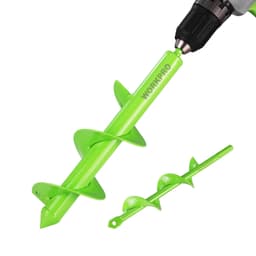
For one bulb, the useful shape in this set is the narrow flight, about 4 cm across. That is the WORKPRO 4 × 22 cm bit, the WORKPRO 4 × 42 cm bit, the K-Brands 4 × 41 cm bit, and the Suewidfay 4 × 22 cm size where the listing actually includes it. These are examples of the diameter, not a lab placing. Nobody here measured the cutting width with a gauge, and Suewidfay’s pages disagree on which sizes are in the box. A 4 cm hole is a little wider than many tulip bulbs. Step the next hole along rather than overlapping the bores. Shank and size clashes are in the garden auger drill bit buying guide. An 8, 9, or 10 cm bit is for a clump or a small pot of soil, not for one tulip in a lawn. The green WORKPRO’s second bit is 8 × 30 cm. K-Brands’ second bit is 9 × 41 cm. Several LYFETC and BeneLabel titles are 10 cm. A 10 cm auger lifts a plug the size of a small plant pot, which is a poor trade for one flower. Use it when the hole is meant to hold a group, or a bedding plant, and you will backfill. Crocuses use the same narrow bit and a shallower hole, because the corm is smaller. One LYFETC reviewer put in about 100 bulbs with the clutch slipping. A WORKPRO review used the smaller bit for single bulbs and the larger for small pots. The lawn will tell you if the flight is wrapping.

Lawn, clay, and spoil

On a lawn, lift a turf cap so you can put it back. Start the tip in the soil, not in a mat of grass at speed. Reviewers of the long green LYFETC bit say grass wraps the flight. A wrapped auger stops cutting. Short bursts, then a lift, keep the spiral clear. The soil on the spiral is your backfill. Knock it off beside the hole, set the bulb, and return it. Do not leave a packed plug in the bottom, which is what reviewers describe when the auger spins and the hole does not get deeper. A trowel finishes the base faster than another ten seconds of trigger. Sellers often write 18 V or higher. Who should open the K-Brands pair or the green WORKPRO set first is on best garden auger drill bit.

When a trowel is the better tool

Use a trowel when the ground is rubble, when you have not checked for buried services, or when the drill stalls and starts to twist. Clutch, kickback, and cables stay on how to use a garden auger drill bit: LSBUD, hand tools near a known run, and no powered bit to find a service. A tulip bed over the run to a shed is not the place to discover an auger. Ten bulbs in open lawn, away from that line, is where these bits earn their keep. Stop if the smaller bit bends. Suewidfay reviews describe that in solid summer ground, and a bent flight will not cut a round hole. Stop if the only bit you own is a 60 or 80 cm post flight.

Common questions

How deep should a tulip go in the UK?
Follow the RHS: two to three times the bulb’s height, pointed end up. Their example puts a 5 cm bulb in a hole about 10 to 15 cm deep, spaced at least twice the bulb’s width, in groups rather than single dots. Do not turn that example into 15 cm for every bulb in the bag. A smaller bulb gets a shallower hole.
Is a 4 cm bit wide enough?
For one tulip, daffodil, or crocus, about 4 cm is the width these listings sell for the job. The WORKPRO and K-Brands narrow bits are that shape. The hole only needs to admit the bulb and a little soil around it. If a second size line contradicts the title, check the listing before you assume the narrow bit is in the box.
Is a 10 cm bit too wide for a lawn?
For a single bulb, yes. A 10 cm flight lifts a large plug and leaves a scar that is slow to disappear. Keep 8 to 10 cm bits for a clump or a small plant. If you only own the wide bit, a trowel will scar the lawn less than a post-sized auger drilled to 12 cm.
Can I plant crocuses with the same bit?
Yes. Use the same narrow bit and a shallower hole, because the corm is smaller than a tulip. The RHS multiple still applies to that corm’s height, not to the 15 cm you marked for a fat tulip. Lift often. A 22 cm flight overshoots a shallow hole easily.
Will it work in clay?
Sometimes. Reviewers on K-Brands and Suewidfay describe clay that went well, and others describe bits that stalled, bent, or packed the soil. WORKPRO says its bits are not for roots or rock. If the flight clogs, lift and clear it. If it will not penetrate, the trowel is the honest tool for that patch.
When should I stop and use a trowel?
When you hit stone or rubble, when the bit bends, when the drill stalls, or when you have not shown the ground is clear of services. Also when you are planting a handful of bulbs rather than a drift, and when the only auger to hand is a long post bit. The auger is for repetition in soil you can read.

Related pages

Sources

Public UK sources from the research digest. Last checked in October 2026.

  1. HSE HSG47: Avoiding danger from underground services (retrieved 19 October 2026)
  2. HSE: Excavations and underground services (retrieved 19 October 2026)
  3. GOV.UK: General Product Safety Regulations 2005 (retrieved 19 October 2026)
  4. Consumer Rights Act 2015, goods contracts (retrieved 19 October 2026)
  5. LSBUD: Line search before you dig (retrieved 19 October 2026)
  6. RHS: Planting bulbs (retrieved 19 October 2026)
  7. Jacksons Fencing: How deep to dig fence posts (retrieved 19 October 2026)
  8. Electrical Safety First: Drills (retrieved 19 October 2026)