Independent comparisons. We may earn from shop links. More info

Wet tile cutter vs manual tile cutter

Updated: October 2026

You are tiling a kitchen splashback, and every listing wants you to buy a tray of water and a 230 V lead before you have counted the cuts. Wet tile cutter vs manual tile cutter is the other order: most straight ceramic cuts are a score and a snap, and a wet saw is for the cuts that rail cannot finish. The [wet tile cutter comparison](/hub/cutting-tools/wet-tile-cutter) is the product table if you already need a powered saw. This page is allowed to end on do not buy one. The buying tree starts only after that decision, on the [wet tile cutter buying guide](/hub/cutting-tools/wet-tile-cutter/sub/wet-tile-cutter-buying-guide). A qualifying purchase can earn a commission at no extra cost to you. Peter F., DIY & tools editor, 20 October 2026. This is not a lab test.

You are tiling a kitchen splashback, and every listing wants you to buy a tray of water and a 230 V lead before you have counted the cuts.

Our top picks

Sealey Sealey TC115

Alternative

Sealey Sealey TC115
6.4/10about £90.99
On this page

Use a manual cutter for straight ceramic cuts

A manual tile cutter is a rail, a scoring wheel, and a breaker. You score the glaze once, then snap. TileFlow’s UK note says a manual cutter does most straight cuts. tilers.trade says the same and adds that the job is quick and nearly dust-free on ceramic and on most porcelain that will still snap. There is no tray, no slurry, and no plug. For a splashback of 10 × 20 cm or 30 × 60 cm ceramic, that is usually enough. Score once. BuildWiz and The Sandwich Handyman both describe a single firm score on ceramic, then the break. A second score on the same line widens the scratch and makes a ragged snap. Keep the tile tight to the fence so the score is straight. Narrow strips are the budget-rail failure: the breaker cannot lever a 15 mm offcut without crushing the glaze. That is a reason to change the layout or to hire a saw for those few cuts, not a reason to buy a wet saw for every tile in the room. Porcelain can still snap on a decent rail if the body is not too thick and the format is not too large. Do not claim a manual cutter never cuts porcelain. Do claim that 20 mm outdoor porcelain and large-format slabs often will not snap cleanly, which is why those jobs move to a wet saw. A cheap rail that already struggles on ceramic will not suddenly love a dense floor tile. This category does not rank manual cutters. The manual article codes were taken out of the set. If you already own a rail that scores straight and breaks cleanly, use it. Those are the only jobs that do not justify the water.

Use a wet saw for notches, mitres, and hard porcelain

A manual cutter cannot finish an L. An L-cut around a pipe or a socket is two meeting cuts. The rail scores a straight line; it does not nibble the waste out of the corner. A wet saw, or a careful pair of cuts on a tray, can run into the waste and leave the inside corner. The Sandwich Handyman’s description is the same: two cuts that meet, which a score-and-snap tool does not complete. Mitres are the other gap. A 45° outside corner on a window reveal needs the edge taken off at an angle. The table saws in this comparison all state an angle: Vitrex 22.5° and 45°, Sealey 0–45°, Einhell 45°, T-Mech 0–45°. The MXBAOHENG handheld does not state an angle. A manual rail does not tilt the tile through a diamond disc. If the room is full of mitred end panels, you are in wet-saw territory. Thick or large porcelain is the third gap. TileFlow puts large or thick porcelain, diagonals, and L-cuts on the wet saw. BuildWiz says porcelain, especially larger format, often needs one. A 600 mm floor tile that will not snap is not a technique problem on a £20 rail. It is the wrong tool. Chipping and compact-saw limits sit on cutting porcelain with a wet saw. An angle grinder covers many awkward cuts for less money. TileFlow says that, and tilers.trade calls the grinder the dusty option for notches. It is not a dust-free substitute. A dry diamond disc on porcelain is the silica cloud a wet saw is meant to avoid. Use a grinder only if you already understand that trade-off, not as a clean shortcut around a wet tray.

What you take on if you buy one

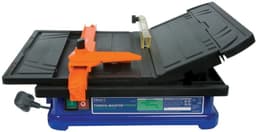
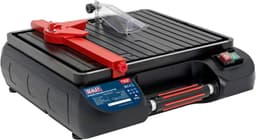
A wet saw adds water, noise, and a 230 V risk that a manual cutter does not have. You need a level bench, a plan for slurry, and an RCD on a mains machine. HSE advises a 30 mA device as extra protection and tells you to test the button. None of the listings in this comparison publish a decibel figure, so this page does not invent one. The Control of Noise at Work action values still exist for employers. The five saws are examples of that cost, not a second ranking. The Vitrex at £59.95 is the reviewed compact tray: 4.4 from 3,106 reviews, plastic guides that snap, too light for 600 mm porcelain. The Einhell at £84.00 is the cordless body without a battery. The Sealey at £90.99 states a 3-pin plug and has nine mixed reviews. The MXBAOHENG at £99.00 is a handheld with no UK reviews and no stated plug. The T-Mech at £289.99 is a 720 mm bench on four reviews. If you do buy, the simple domestic saw is named on the best wet tile cutter page rather than re-picked here. Water on the blade is the dust control when a powered cut is actually needed. A manual cutter avoids that cloud by not spinning a disc. Buying a wet saw just in case for a room of straight ceramic gives you the electrical risk without the cuts that justified it. How you fill the tray sits on how to use a wet tile cutter. If the job is one weekend of large porcelain, hiring is the comparison, not a second purchase.

Hire, grinder, or leave it

TileFlow’s hire point is the one that belongs on a versus page. One large job — a porcelain patio, a long run of 20 mm planks, a kitchen of mitred window returns — is often cheaper to hire than to buy a £290 bench with four reviews, or to gamble a £60 tray on a slab it cannot hold. Hire shops also tend to hand you a leaflet about the RCD and the water level. That is useful the first time. An angle grinder is the other one-job tool. It is already in many UK vans. It will cut a notch. It will also put a dry dust cloud into a bathroom if you have not wet the disc or taken the work outside. Do not send yourself to a grinder as if it were the clean option. It is the option you use when you accept dust and noise for three awkward tiles. Leave both machines when the tile is expensive, the layout is all L-cuts, and you have not used a wet saw. Call a tiler. Leave the wet saw on the shelf when every cut is a straight ceramic snap you can already do on a rail you own. Do not buy a wet saw to feel prepared. Buy one when the rail has already failed, or when you can see the mitres and notches on the drawing before you open the first box.

Common questions

Do I need a wet saw for a ceramic splashback?
Usually not, if the cuts are straight and you have a rail that scores cleanly. A splashback of ordinary ceramic is the manual cutter’s job. Buy a wet saw only for notches, mitres, or tiles that will not snap.
Can I score and snap porcelain?
Sometimes, on thinner, smaller porcelain and a decent rail. Thick outdoor porcelain and large-format slabs often will not snap cleanly. That is when a wet saw earns the water.
How do I cut an L around a pipe?
A manual cutter cannot finish it. You need two meeting cuts and a way to remove the waste, which is a wet saw or a carefully used grinder. Plan the two lines so they meet inside the waste, not into the finished edge.
What about a 45° outside corner?
That is a mitre. The table saws in this comparison tilt to 45° or have a 45° guide. A manual rail does not do that cut. If the room is full of mitres, you are no longer in score-and-snap territory.
Is an angle grinder a substitute?
For a few notches, yes, with dust. TileFlow and tilers.trade both treat it as the awkward-cut tool. It is not dust-free. Do not use a dry disc on porcelain as a clean stand-in for a wet tray.
Should I hire instead of buy?
Yes, if the job is one weekend of large or thick porcelain. Hiring a longer saw is the comparison against a £289.99 bench with four reviews, not against a rail you already own.
If I do buy, which saw in this set is the simple one?
The Vitrex tray at £59.95 for ordinary domestic ceramic, with the skip cases on the best page. Do not buy the Einhell as a working cordless kit at £84.00: the battery is extra.
What extra hazards does the wet saw add?
Water next to a 230 V lead, slurry, noise, and a spinning disc. Use an RCD on mains, keep the rim wet, and unplug before you top up. A manual cutter has none of those.

Related pages

Sources

Public UK sources used for this comparison. Listing prices, stars and review counts are the amazon.co.uk figures saved for this set on 20 October 2026.

  1. HSE: Wet cutting (retrieved 20 October 2026)
  2. HSE: Silicosis and respirable crystalline silica (retrieved 20 October 2026)
  3. HSE CN6: Cut-off saws on silica-bearing masonry (retrieved 20 October 2026)
  4. HSE: Electrically powered equipment (retrieved 20 October 2026)
  5. Control of Noise at Work Regulations 2005, regulation 4 (retrieved 20 October 2026)
  6. BS EN 13236:2019 diamond wheel safety requirements (retrieved 20 October 2026)
  7. Topps Tiles: A basic guide to cutting tiles (retrieved 20 October 2026)
  8. amazon.co.uk: Vitrex Torque Master B000C74Y6M (retrieved 20 October 2026)