Independent comparisons. We may earn from shop links. More info

Wet tile cutter buying guide

Updated: October 2026

You are about to tile a bathroom, and amazon.co.uk has already mixed a £60 tray saw with a 720 mm bench and a cordless body that arrives without a battery. A wet tile cutter buying guide should settle the order before you compare wattage: which machine type matches the tile, whether the blade will actually fit that saw, and whether the listing will switch on in a UK house. The [wet tile cutter comparison](/hub/cutting-tools/wet-tile-cutter) ranks the five saws. This page is the decision order only. Named picks sit on the [best wet tile cutter](/hub/cutting-tools/wet-tile-cutter/sub/wet-tile-cutter-best) page. If a score-and-snap cutter would still finish the job, start on the [wet tile cutter vs manual tile cutter](/hub/cutting-tools/wet-tile-cutter/sub/wet-tile-cutter-vs-manual) page instead of buying water and a 230 V lead. A qualifying purchase can earn a commission at no extra cost to you. Peter F., DIY & tools editor, 20 October 2026. This is not a lab test.

You are about to tile a bathroom, and amazon.co.uk has already mixed a £60 tray saw with a 720 mm bench and a cordless body that arrives without a battery.

Our top picks

Sealey Sealey TC115

Alternative

Sealey Sealey TC115
6.4/10about £90.99
On this page

Start with the cut, not the wattage

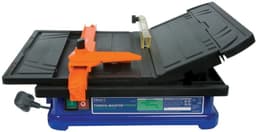
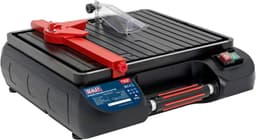
Wattage is an easy number to sort on and a poor first filter. A 1,300 W handheld and a 450 W tray saw are not two sizes of the same tool. They hold the tile differently, they put water in different places, and they fail in different ways. Decide the cut first, then look at the motor. A compact tray saw with a water bath is the usual UK DIY machine for wall and floor tiles you can lift onto a bench. In this set that is the Vitrex Torque Master 103402NDE at 450 W and the Sealey TC115 at 500 W. Both take a 110–115 mm blade and keep the slurry in a tray or reservoir. They suit a splashback or a small bathroom if the tile is ceramic or light porcelain and you can support it on the table. They are the wrong mass for a 600 mm outdoor slab that wants a longer, stiffer bed. A cordless tray saw is the same idea without a mains lead. The Einhell TE-TC 18/115 Li-Solo is the example here: 18 V, a water tank, a 115 mm disc, and a table that tilts to 45°. It only becomes a saw after you add a Power X-Change battery and charger. If you do not already own that pack, you are not buying a working cutter at the body price. A handheld with a hose cuts the tile where it sits. The MXBAOHENG NBT-MC-110B is that type: 1,300 W, a 5 m hose, two 115 mm blades, and no fence in the specification. It is useful for a notch you cannot take to a bench. It is harder to keep straight than a table with a rip guide, and the water has to go somewhere on the floor. A long bench or bridge saw is the tool for large-format and 20 mm porcelain. The T-Mech in this set states a 720 mm bench, 800 W, a laser, and a 0–45° range. That length is why people look at it. Voltage and blade diameter are not in the listing specification, and the review sample is four lines. Above this shelf, Tradetiler lists a Rubi ND-200 from £323.99. Those are shop prices, not a market average, and they are the honest next step when a 110 mm plastic tray cannot hold the slab. Porcelain limits sit on cutting porcelain with a wet saw. The type only works if the blade fits the spindle.

Match the blade to the saw and the tile

A wet saw is only as clean as the rim that meets the glaze. Match diameter, bore, and maximum rpm to the machine, then match the rim to the tile. The Vitrex listing states a 110 × 22 mm continuous-rim blade. The Sealey and Einhell take 115 mm. The MXBAOHENG includes two 115 mm blades. The T-Mech includes a diamond blade and a spare; the diameter is not stated, so you cannot assume a 180 mm trade disc. A continuous rim is the usual choice for glaze because the rim is a closed ring and chips less on the way out of the cut. A turbo or segmented rim clears slurry faster and is harsher on a polished edge. The Einhell ships a turbo disc; UK reviewers still report neat porcelain when they feed slowly. That is a review theme, not a reason to buy a segmented masonry blade for a splashback. Bore and rpm are the parts shops skip. Screwfix and Tileasy sell 110 mm and 180 mm continuous-rim tile blades with bores around 20–22.23 mm. The Vitrex bore is 22 mm. Do not force a 22.23 mm blade onto a smaller spindle, and do not run a blade above the speed stamped on it. The Vitrex states 4,600 rpm; the Einhell 3,800 rpm; the MXBAOHENG 12,000 rpm. BS EN 13236:2019 is the identifier for diamond cutting-off wheels. Buy the marking: size, bore, max rpm, rotation arrow, and a wet-only pictogram if it is there. Do not paste the standard text into a shopping decision. Topps Tiles says supplied blades are often ceramic-only. That matters more than wattage when the box already holds porcelain. If the listing does not name porcelain on the blade, treat a replacement continuous rim as part of the purchase, not as an optional extra. Do not invent a cut depth the specification does not give. The Einhell states 24 mm at 90° and 16 mm at 45°. The MXBAOHENG states 30 mm. The Vitrex, Sealey, and T-Mech depths are not stated in the listing specifications. Retailer pages that add a 25 mm Vitrex figure are not a source we can use here. A correct blade still needs a supply you can switch on.

Check the plug, the voltage, and the battery

UK mains are 230 V with a BS 1363 three-pin plug. Listings that say 240 V are in the same domestic band. Listings that say 220 V without naming the plug are not confirmed for a UK socket. HSE treats a 30 mA RCD as extra protection on 230 V equipment and tells you to test the button before use. On a construction site HSE prefers cordless or 110 V centre-tapped tools. None of that makes a wet saw safe; it is the minimum electrical check before water and a spinning disc share a bench. Read the five rows in that order. Sealey states 230 V and a 3-pin plug. Vitrex states 240 V and does not name the plug. MXBAOHENG states 220 V and does not name the plug. T-Mech does not state voltage at all. Einhell is 18 V and sold without the battery. If you need a stated UK plug on a compact mains saw, Sealey is the only machine in this set that writes it down. That is a supply fact, not a reason to ignore its 3.2 score from nine reviews. The Einhell price is the other trap. The title says without battery. You add a Power X-Change pack and charger before the first cut. If you already own that battery, the body at £84.00 is a cordless tray with a stated cut height and no lead to keep out of the slurry. If you do not own it, compare the kit cost with the Vitrex at £59.95, not the solo sticker with a mains saw. A 220 V handheld is not a bargain because it looks like 230 V. Confirm the plug on arrival, or do not keep the listing. A Schuko-only lead is a UK buying problem, not a footnote. The same rule applies to the T-Mech bench: 800 W and a 720 mm table do not tell you what you will plug in.

What the price bands in this set actually buy

Entry in this set is the Vitrex at £59.95, 4.4 from 3,106 reviews. You get a 450 W tray, recirculating water, a 110 mm continuous rim, and fences that reviewers say snap. It is the reviewed domestic saw, not a bridge saw. Skip it if the tile is 600 mm-class heavy porcelain or you will only buy a stated 3-pin plug. Mid compact is £84–£99. The Einhell at £84.00 is 4.4 from 145 reviews and still needs a battery. The Sealey at £90.99 is 3.2 from nine reviews, with a stated plug and reports of a missing fence or a snapped guard screw. The MXBAOHENG at £99.00 has no review line in the saved listing, a 220 V listing, and no fence. None of those three is a cheaper Vitrex. Each buys a different constraint: no lead, a named plug, or a hose in your hand. The higher bench in this set is the T-Mech at £289.99, 2.0 from four reviews. You are paying for 720 mm of table and a spare blade. You are not paying for a confirmed voltage or a review sample you can trust. One UK reviewer cut 20 mm porcelain at 900 × 600 mm and needed replacement screws. Another said not to buy it. That is not a durability test. Skip the wattage sort if it puts the handheld above the tray. Skip any listing that hides the battery, the plug, or the blade bore. When the tile is already 20 mm outdoor porcelain and the table is a 110 mm plastic tray, leave this amazon.co.uk band and look at a trade bridge saw. The comparison table stays on the wet tile cutter page. This guide only tells you which row you should be looking at.

Common questions

What size blade does a bathroom wet saw usually take?
Compact tray saws in this set take 110 mm or 115 mm. The Vitrex is 110 × 22 mm. The Sealey and Einhell are 115 mm. That is enough for ordinary wall and floor tiles you can lift onto the table. A 180 mm blade belongs on a larger saw, not as an upgrade forced onto these spindles.
Is 110 mm enough, or do I need 180 mm?
110–115 mm is enough for a splashback and most domestic ceramic if the table can support the tile. 180 mm is a different machine: more depth and usually a longer bed. Do not treat a 180 mm trade blade as a drop-in for the Vitrex. If the slab is 600 mm and heavy, the limit is the frame, not only the diameter.
Will a 220 V listing plug into a UK socket?
Not on the evidence in this set. The MXBAOHENG states 220 V and does not state the plug. UK sockets want a BS 1363 three-pin plug on a 230 V appliance. Confirm the lead before you fill the tray. A 240 V Vitrex listing is in the domestic band; it still does not name the plug.
Why is the Einhell cheaper than a working cordless kit?
Because the £84.00 price is the saw and one disc. The title says without battery. A Power X-Change pack and charger are a second purchase. Compare the kit total with the Vitrex at £59.95 if you do not already own that battery.
What should I check before I trust a 720 mm bench listing?
Voltage, blade diameter, and the review sample. The T-Mech states 800 W, a 720 mm bench, a laser, and 0–45°. It does not state voltage or blade size. The score is 2.0 from four reviews. Length is not a substitute for those facts.
When is a trade bridge saw the honest next step?
When the tile is large-format or 20 mm porcelain and a compact tray cannot hold it. UK reviews already say the Vitrex is too light for 600 mm square porcelain. Tradetiler’s Rubi ND-200 from £323.99 is context for that step, not stock on this page.
Does the saw include a porcelain blade?
Only if the listing says so. Topps Tiles warns that supplied blades are often ceramic-only. Sealey names porcelain in the bullets. The Einhell listing names ceramic, granite, clinker, marble and stone. Treat an unnamed rim as a ceramic blade until you replace it.

Related pages

Sources

Public UK sources used for this comparison. Listing prices, stars and review counts are the amazon.co.uk figures saved for this set on 20 October 2026.

  1. HSE: Wet cutting (retrieved 20 October 2026)
  2. HSE: Silicosis and respirable crystalline silica (retrieved 20 October 2026)
  3. HSE CN6: Cut-off saws on silica-bearing masonry (retrieved 20 October 2026)
  4. HSE: Electrically powered equipment (retrieved 20 October 2026)
  5. Control of Noise at Work Regulations 2005, regulation 4 (retrieved 20 October 2026)
  6. BS EN 13236:2019 diamond wheel safety requirements (retrieved 20 October 2026)
  7. Topps Tiles: A basic guide to cutting tiles (retrieved 20 October 2026)
  8. amazon.co.uk: Vitrex Torque Master B000C74Y6M (retrieved 20 October 2026)