Independent comparisons. We may earn from shop links. More info

Cutting porcelain with a wet saw

Updated: October 2026

The first 600 mm porcelain tile has a clean line on the glaze and a bitten exit on the underside, and the compact saw you already bought is still wet on the bench. Cutting porcelain with a wet saw is a material problem: the body is denser than ceramic, the glaze chips if the rim is wrong or the feed is rushed, and a 110 mm plastic tray often cannot hold the slab. The [wet tile cutter comparison](/hub/cutting-tools/wet-tile-cutter) ranks the five saws. This page stays on porcelain thickness, blades, and the point where those saws run out. It is not the general buying tree. A score-and-snap cutter often fails on thick porcelain; that versus argument sits on [wet tile cutter vs manual tile cutter](/hub/cutting-tools/wet-tile-cutter/sub/wet-tile-cutter-vs-manual). A qualifying purchase can earn a commission at no extra cost to you. Peter F., DIY & tools editor, 20 October 2026. This is not a lab test.

The first 600 mm porcelain tile has a clean line on the glaze and a bitten exit on the underside, and the compact saw you already bought is still wet on the bench.

Our top picks

On this page

Why porcelain chips on a wet saw

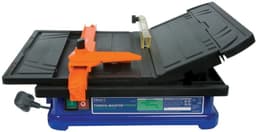
Porcelain is pressed harder than a cheap wall ceramic. Topps Tiles says it needs more breaking pressure on a manual cutter, which is why people move to a wet saw. The wet saw still chips if you treat it like a soft tile. The usual three causes are a ceramic-only blade, a feed that speeds up as you leave the cut, and a table that lets the slab drop as the offcut separates. Exit breakout is the one you see. The rim is still cutting as the last few millimetres of glaze lose support. BuildWiz’s electric-tile-cutter note says a slow feed, water at the cut, a fresh continuous rim, and, on thick tile, a reverse cut from the far edge. Treat those reverse-cut distances as that author’s method, not as a lab result. The practical point is the same: do not sprint the last 10 mm on a 20 mm patio tile. A compact saw makes this worse when the tile overhangs the table. The Vitrex reviewers split here. Some report clean porcelain with little edge chip. Several say 600 mm square is too much for the weight of the frame. That is not a contradiction. A 300 mm wall tile that sits inside the extensions is a different job from a 600 mm floor tile that teeters on a 36 cm body. If the chip is already on a tile you cannot replace, stop. A tiler with a longer bridge saw is cheaper than a second pack of 20 mm porcelain. The how-to for water and feed sits on how to use a wet tile cutter. The blade in the box may be the wrong one.

Continuous rim, bore, and a blade that has glazed

A continuous rim is a closed diamond ring. Tilers Tools sells that shape for a clean cut on 20 mm porcelain and warns that it is slower than a segmented rim. A segmented or coarse turbo rim clears slurry and bites faster; it also leaves a rougher glaze. Pro Tiler Tools and Tilers Tools both warn that some fine rims are a poor match for 20 mm material. Buy the rim for the tile you have, not for the speed you want. Bore and rpm still have to match the saw. The Vitrex is 110 × 22 mm. The Sealey and Einhell take 115 mm. The MXBAOHENG includes two 115 mm blades stated for tiles or stone. The T-Mech includes a diamond blade and a spare; the diameter is not stated in the listing specification. Do not assume a 250 mm trade disc will drop onto these machines. Trade blade shops write for 180–250 mm saws. This set is mostly 110–115 mm. Glazing is what happens when the diamond skin polishes smooth and stops cutting. Tilers Tools describes dressing the blade: a short cut in a dressing stone or a coarse block to reopen the grit. If the saw suddenly needs more push on the same porcelain, the rim may have glazed. Forcing it then chips the exit and heats the motor. Topps Tiles also says a wet cutter is often supplied with a ceramic-only blade. If the box does not name porcelain on the disc, budget a replacement continuous rim before you open the first pack. Do not switch to a segmented masonry blade because a forum said it was faster. Faster on porcelain is how the glaze feathers. Even a correct blade needs a table that holds the slab.

What these saws can and cannot claim

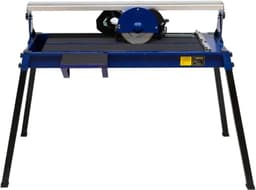
Only one saw in this set publishes a millimetre cut height. The Einhell TE-TC 18/115 Li-Solo states 24 mm at 90° and 16 mm at 45°. UK reviews say it cut porcelain, including thick porcelain, and holds speed in the cut. One trade review reported a smoking motor and batteries wearing out after a few weeks. That is a domestic porcelain option if you already own a Power X-Change pack, not a trade bench for a patio run. The Vitrex does not state a depth in the specification we used. Some UK reviews report clean porcelain. Several say 600 mm square is too much for the weight. Do not copy a retailer depth onto this row. The top pick for a small ceramic job can still be the wrong porcelain tool. Sealey names glazed ceramic, porcelain, quarry, slate and natural stone in the bullets. Depth is not stated. Four UK reviews in the saved listing are not a porcelain sample. One missing fence already made the saw unusable for a buyer. Treat the porcelain bullet as a claim, not as a 20 mm proof. The MXBAOHENG states 30 mm and a blade for tiles or stone. It is handheld, so there is no fence to keep a 600 mm slab square. There are no UK reviews in the saved listing. A 30 mm sticker does not make it a patio saw. The T-Mech is the only listing in this set with a 720 mm bench. One UK reviewer cut 20 mm porcelain at 900 × 600 mm and needed replacement screws. Another UK review says not to buy it. A French review reports a wandering blade. The score is 2.0 from four reviews. Voltage is not stated. That is not a pass on one patio note, and it is not a reason to call the bench the porcelain pick. When the slab is 20 mm and 600 mm-class, a trade bridge saw or a tiler is the honest next step. Named compact picks for ordinary jobs sit on the best wet tile cutter page.

Water, slurry, and the dust you still should not ignore

Porcelain and stone can contain crystalline silica. HSE’s wet-cutting page says water on the blade is the control that removes the visible dust cloud. It does not publish a personal exposure figure for a bathroom tray saw, and this page does not invent one. The COSHH workplace limit of 0.1 mg/m³ (8-hour TWA) binds employers. For high-silica cut-off work, HSE’s CN6 still specifies RPE at assigned protection factor 20. That is why you do not run porcelain dry to keep the kitchen floor clean. The MXBAOHENG nozzle can be removed for dry cutting; that is a listing option, not a method for a silica-bearing tile. Keep the rim wet, feed slowly, and empty the slurry wet. Dried porcelain dust on a tray is the cloud you already paid the water to avoid. A compact saw that stalls, smokes, or will not support the tile is the stop point. So is a blade that has glazed and a tile you cannot replace. Hire a longer saw for one patio, or hand the pack to a tiler. Do not keep pushing a 110 mm plastic tray through 20 mm outdoor porcelain because the listing mentioned stone in a bullet.

Common questions

Why does the glaze chip as the blade exits?
The last few millimetres lose support while the rim is still cutting. A ceramic blade, a rushed feed, or a slab that drops off a short table makes it worse. Slow down before the exit, keep the water on the rim, and support the offcut.
Is the blade in the box a porcelain blade?
Only if the listing says so. Topps Tiles warns that supplied blades are often ceramic-only. Sealey names porcelain in the bullets. The Einhell names stone-family materials. Treat an unnamed rim as ceramic until you fit a continuous-rim porcelain disc.
Can the Vitrex cut 600 mm porcelain?
UK reviews split. Some report clean porcelain. Several say 600 mm square is too much for the weight. Do not plan a heavy 600 mm floor on that tray. A 300 mm wall tile is a different job.
What cut height does the Einhell actually state?
24 mm at 90° and 16 mm at 45°. It is the only saw in this set with a millimetre figure. UK reviewers cut porcelain on it; one trade user reported a smoking motor.
Will the 720 mm T-Mech cut 20 mm patio porcelain?
One UK reviewer did, at 900 × 600 mm, after missing screws were replaced. The listing score is 2.0 from four reviews, and voltage is not stated. That is not a recommendation.
Should I use a segmented blade because it is faster?
Not for a clean glazed edge. A continuous rim is the usual porcelain choice. Segmented rims clear slurry and leave a harsher cut. Faster is how the exit feathers.
Does wet cutting remove the silica issue?
No. Water knocks down the visible cloud. HSE still specifies RPE for high-silica work by employers. This page does not claim a measured exposure for a domestic tray.
When is the tile a tiler’s job?
When the slab is 20 mm or 600 mm-class and your compact saw cannot support it, when a wrong cut cannot be replaced, or when the motor is already smelling of heat. Hire or hand it on.

Related pages

Sources

Public UK sources used for this comparison. Listing prices, stars and review counts are the amazon.co.uk figures saved for this set on 20 October 2026.

  1. HSE: Wet cutting (retrieved 20 October 2026)
  2. HSE: Silicosis and respirable crystalline silica (retrieved 20 October 2026)
  3. HSE CN6: Cut-off saws on silica-bearing masonry (retrieved 20 October 2026)
  4. HSE: Electrically powered equipment (retrieved 20 October 2026)
  5. Control of Noise at Work Regulations 2005, regulation 4 (retrieved 20 October 2026)
  6. BS EN 13236:2019 diamond wheel safety requirements (retrieved 20 October 2026)
  7. Topps Tiles: A basic guide to cutting tiles (retrieved 20 October 2026)
  8. amazon.co.uk: Vitrex Torque Master B000C74Y6M (retrieved 20 October 2026)