Independent comparisons. We may earn from shop links. More info

Tower fan vs pedestal fan

Updated: 21 October 2026

You are measuring the gap beside the sofa, and the listing calls every slim body a quiet tower. Tower fan vs pedestal fan is a shape question first: how much floor the base takes, how high the air leaves the machine, and whether the noise table matches the title. A tower is not automatically quieter. This page uses the twelve amazon.co.uk listings in our [quiet fan comparison](/hub/cooling/quiet-fan). It does not pick a single winner. Peter F. used those listings on 19 October 2026. We did not run a lab. If you buy through our links, we may earn a commission at no extra cost to you.

You are measuring the gap beside the sofa, and the listing calls every slim body a quiet tower.

Our top picks

On this page

A tower when the floor space is a corner

A floor tower suits a corner that cannot spare a wide base. In this set the DREO floor towers sit around 30 cm square and about 92 cm tall. The DR-HTF017 is 28.3 × 28.3 × 92.6 cm and 3.79 kg, at £74.99, with 90° oscillation, four speeds, a remote and a 1–8 hour timer. The title and the table both say 28 dB. Across 4.4 from 2,365 reviews, low speed is quiet enough for a bedroom for many buyers, and higher speeds are audible. The connector field still says NEMA 5-15. A slim body does not turn that into a BS 1363 plug. The black DR-HTF007 at £79.99 titles 220–240 V, then names an EEC 7/7 connector, with 20 dB in the title and 25 dB in the table. The white DR-HTF007 is the same £79.99 and the same shared 4.6 from 47,486 reviews, and its table says 120 V and 28 dB. Buy either colour only after the live page shows a British plug. That pool is one file across two finishes, not two noise tests. A mini tower is a different footprint. The Levoit is about 33.5 cm and 7.5 W. The Dr. Prepare states a UK plug and prints 60 dB. Neither replaces a floor tower in a living room. Night placement is on the quiet bedroom fan page.

A pedestal when you want a high head

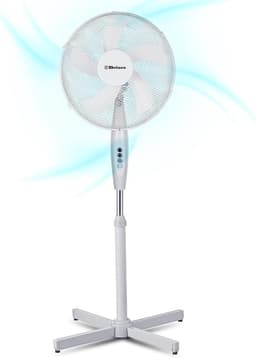
A pedestal puts the head higher and usually takes more floor. The Belaco BLSF-40 is the one here that states a BS 1363 plug. It is a 16 inch pedestal at £29.99 and 45 W, with height up to 125 cm, 85° oscillation, and airflow listed as 2,750 m³/h. The bullet and the table both say 45 dB maximum. Across 4.0 from 3,039 reviews, the weakest average in this set, owners praise the air and treat that ceiling as audible on high. The bullets name a pull chain. There is no remote and no timer. The base is given as 60 cm, and 1.36 kg is the catalogue weight as printed, so give it a clear circle. The dearer DREO standing fans look quieter on the title and then fail the plug column. The DR-HPF013 at £79.99 is about 105 cm tall. Its bullet says 20 dB and eight speeds; the table says 28.2 dB, three speeds, 120 V and a 2-pin connector. The PolyFan at £99.99 agrees on eight speeds, then prints 23 dB against a 20 dB title, 120 V, and a height bullet of 35–40 inches beside dimensions of 66 cm. Skip both until a live listing shows 230 V and a BS 1363 plug. If you want air across a living room and you will not sleep beside the top speed, the Belaco is the pedestal whose plug and 45 dB line you can read without a second connector. If you need a remote from the sofa, this set does not give you that remote on a stated British plug.

Bladeless means the impeller is enclosed

Several DREO towers are sold as bladeless. The white DR-HTF007 still describes a rear grille and an impeller you can take off. Bladeless, on these listings, means the spinning part sits inside the column, not that the fan has no rotor. The practical gains are a guard you are less likely to put a finger through, and a case you can wipe, compared with an open 16 inch blade. They are not a measured quieter result, and they are not a stronger breeze. Do not treat a bladeless headline as 20 dB at every speed. The black DR-HTF007 title says 20 dB and the table says 25 dB. The white row’s table says 28 dB. The DR-HTF017 says 28 dB in both places, and high speed is still audible in the reviews. An enclosed impeller also holds dust, which is why a quiet June tower rattles in August. Oscillation spreads the breeze. It does not lower the room temperature, and a fan does not reject heat the way an air conditioner does.

A circulator or a USB fan is a third answer

If you force every job into a tower or a pedestal, you buy the wrong mass of plastic. The Honeywell HT900E at £35.32 is a 30 W circulator. Across 4.5 from 28,764 reviews, people praise the airflow and say it is not as quiet as the quiet-operation line. The bullet says 39–56 dB, the table has no decibel cell, and the plug is unstated at 240 V. The MBSM at £49.99 agrees on 25 dB in the title and the table. Across 4.4 from 236 reviews, speed 1 was acceptable for some office use and speeds 2 and 3 were too noisy for work. The plug is unstated at 220 V. A 2.5 W USB fan is a face at a desk, not a room. The SWEETFULL at £12.99 and the OCOOPA at £18.99 have no mains plug and no battery. Reviewers call them too small for a room. The Dr. Prepare at £35.99 is the desk tower that does state a UK plug, with timers of 2, 4 or 8 hours and a 60 dB table. That is a personal tower where 60 dB is acceptable, not a whisper claim. Choose the shape for the throw and the floor, then read the noise table and the plug. A corner points you at a floor tower, and you still send it back if the pins are NEMA, Schuko or 120 V. A living room and a stated BS 1363 plug point you at the Belaco, if 45 dB on high is noise you will live with. One person at a laptop points you at USB or a desk tower. Who each type is for, once the shape is settled, is on the best quiet fan UK page.

Common questions

Is a tower fan always quieter than a pedestal?
No. The Belaco states 45 dB maximum, and the floor towers state 25 dB or 28 dB depending on the cell. Reviews still call the high speeds audible. A tower shape is not a noise test. Read the table for the speed you will actually run, and do not treat a slim body as a quieter result than an open 16 inch head.
When is the Belaco the better shape?
When you want a 16 inch head up to about 125 cm, 85° oscillation, and a listing that states a BS 1363 plug, at £29.99. Airflow is listed as 2,750 m³/h, and 45 dB maximum is in the bullet and the table. It is the better shape for a living room if you accept that noise and a pull chain. It is the worse shape for a light sleeper, and for a corner that cannot take a 60 cm base.
What does bladeless mean on the DREO towers?
It means the impeller is inside the column. The white DR-HTF007 still says the rear grille and the impeller come off, so there is a spinning part to clean. The gain is a covered rotor, not a proof that the fan is quieter than the Belaco’s open blades. The decibel conflict on those DREO pages is unchanged by the word bladeless.
When is a USB fan the right shape?
When you need air at a desk and a floor fan would be in the way. The SWEETFULL and the OCOOPA are both 2.5 W, with no battery and no British mains plug. They are a face breeze, not the Belaco’s listed airflow. The Honeywell sits between them: more throw than USB, and a 39–56 dB bullet. The Dr. Prepare is the desk tower that states a UK plug, at a 60 dB table.
Which shapes in this set state a UK plug?
The Belaco pedestal states BS 1363. The Dr. Prepare desk tower states a standard UK plug. The SWEETFULL and the OCOOPA use a 5 V USB lead, which sits outside the mains-plug rule. The black DREO tower titles 220–240 V and names EEC 7/7. The DR-HTF017 names NEMA 5-15. Three other DREO tables print 120 V. A pounds price does not confirm the pins.

Related pages

Sources

Public UK sources named below. amazon.co.uk prices, stars and review counts on these twelve listings were read on 19 October 2026. Page updated 20 October 2026.

  1. Electrical Equipment (Safety) Regulations 2016, regulation 35 (retrieved 19 October 2026)
  2. GOV.UK electrical equipment safety guidance (retrieved 19 October 2026)
  3. OPSS product safety report, T-SUN floor fan, 17 August 2026 (retrieved 19 October 2026)
  4. Household Appliances (Noise Emission) Regulations 1990 (retrieved 19 October 2026)
  5. Quiet Mark certification explainer (retrieved 19 October 2026)
  6. BS 8233 explained (retrieved 19 October 2026)
  7. GOV.UK energy-related products (retrieved 19 October 2026)
  8. Approved Document F (retrieved 19 October 2026)